


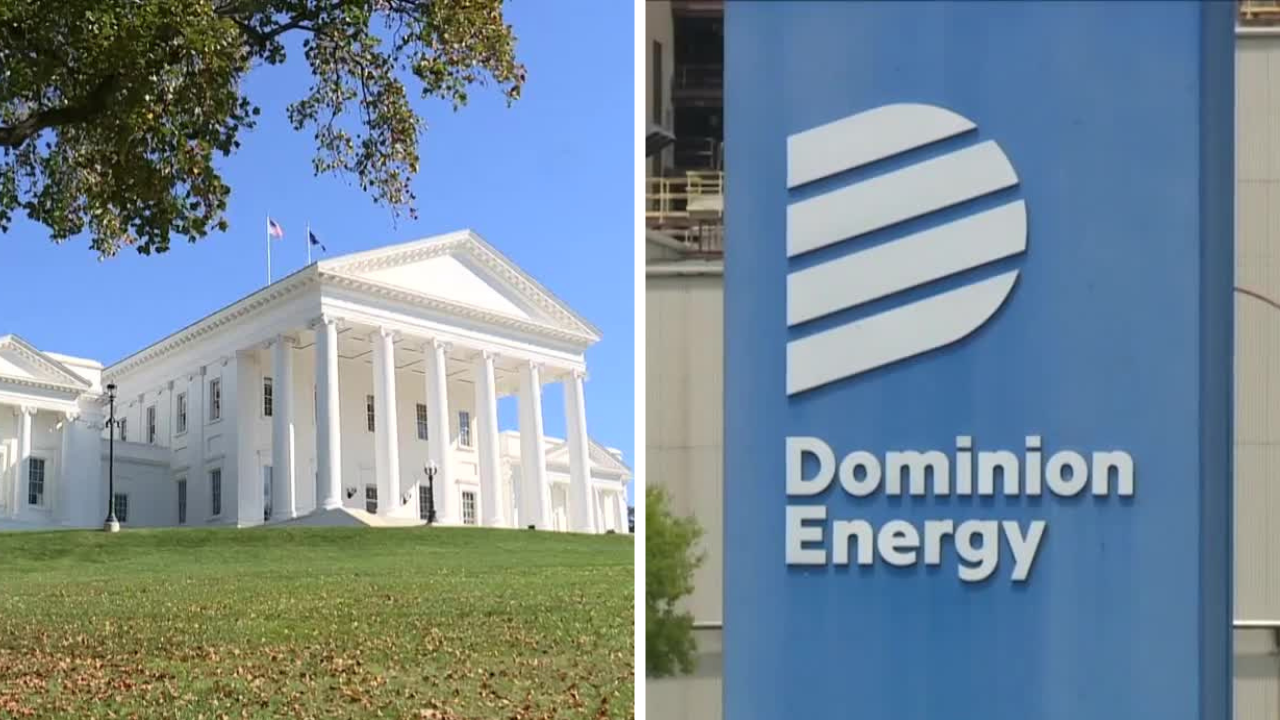


RICHMOND, Va. — Virginia is moving closer to rejoining the Regional Greenhouse Gas Initiative, and questions are growing about what it will cost ratepayers and how the revenue it generates could be used.
Earlier this year, Gov. Abigail Spanberger signed legislation that would allow Virginia to rejoin the Regional Greenhouse Gas Initiative, also known as RGGI, on July 1.
RGGI aims to limit the amount of CO2 power plants can emit and requires them to purchase allowances for those emissions. In Virginia, those costs are passed on to ratepayers.
The last time Virginia participated in RGGI, customers paid an average of $4 a month. But in a recent filing to the State Corporation Commission, Dominion Energy reported that cost is now $13 per month over the course of one year.
Virginia State Senator Mark Obenshain responded to that figure.
"I was disturbed and deeply concerned yesterday when I saw the news of the $13 per month cost to the average household consumer for reentry of Virginia into RGGI, and the impact on affordability," Obenshain said.
In its filing, Dominion proposed spreading the impact over two years, which would lower that monthly cost to $10.
"It's about three to four times higher than where it was last time the RGGI was, when the RGGI rider was in effect, Senator Scott Surovell, Chair of the Commission of Electric Utility Regulation, said. "I think it's prudent to talk about ways to potentially mitigate that."
Every quarter, power plants bid on CO2 allowances, which determine how much CO2 they are permitted to emit. Each state participating in RGGI decides how to use the money raised through those auctions. When Virginia was previously in RGGI, that money was used for energy efficiency and flood preparedness programs.
The Commission of Electric Utility Regulation is now exploring other possible uses for those funds. Dallas Burtraw of Resources for the Future addressed the commission.
"The program still yields over $750 million in auction proceeds at current prices that could be used to a variety of purposes, one of which is including rebated at the households in the form of lower residential electricity prices, and it could reduce bills by more than Dominion's recently requested increase in bills to cover the cost of joining the RGGI program," Burtraw said.
One idea under discussion is providing rebates to residential customers. Obenshain questioned whether those rebates could hurt Virginia's reputation with businesses. Bill Shobe with the University of Virginia said that question does not have a clear answer.
"I think it just depends on the business. It depends on the sector. I think again, if there is an advantage to being in Virginia, for a variety of reasons, not just the cost of electricity, and Virginia, as a state, has chosen to put itself on a path of reduced emissions, which is also a valuable attribute of its electricity," Shobe said.
Any changes to how RGGI revenue is used would have to be approved by the General Assembly. The commission emphasized that the rebate discussion is still in its early stages. The commission must submit its recommendations by November 30.
CBS 6 is committed to sharing community voices on this important topic. Email your thoughts to the CBS 6 Newsroom.
📲: CONNECT WITH US
Blue Sky | Facebook | Instagram | X | Threads | TikTok | YouTube

This story was initially reported by a journalist and has been converted to this platform with the assistance of AI. Our editorial team verifies all reporting on all platforms for fairness and accuracy. To learn more about how we use AI in our newsroom, click here.

