


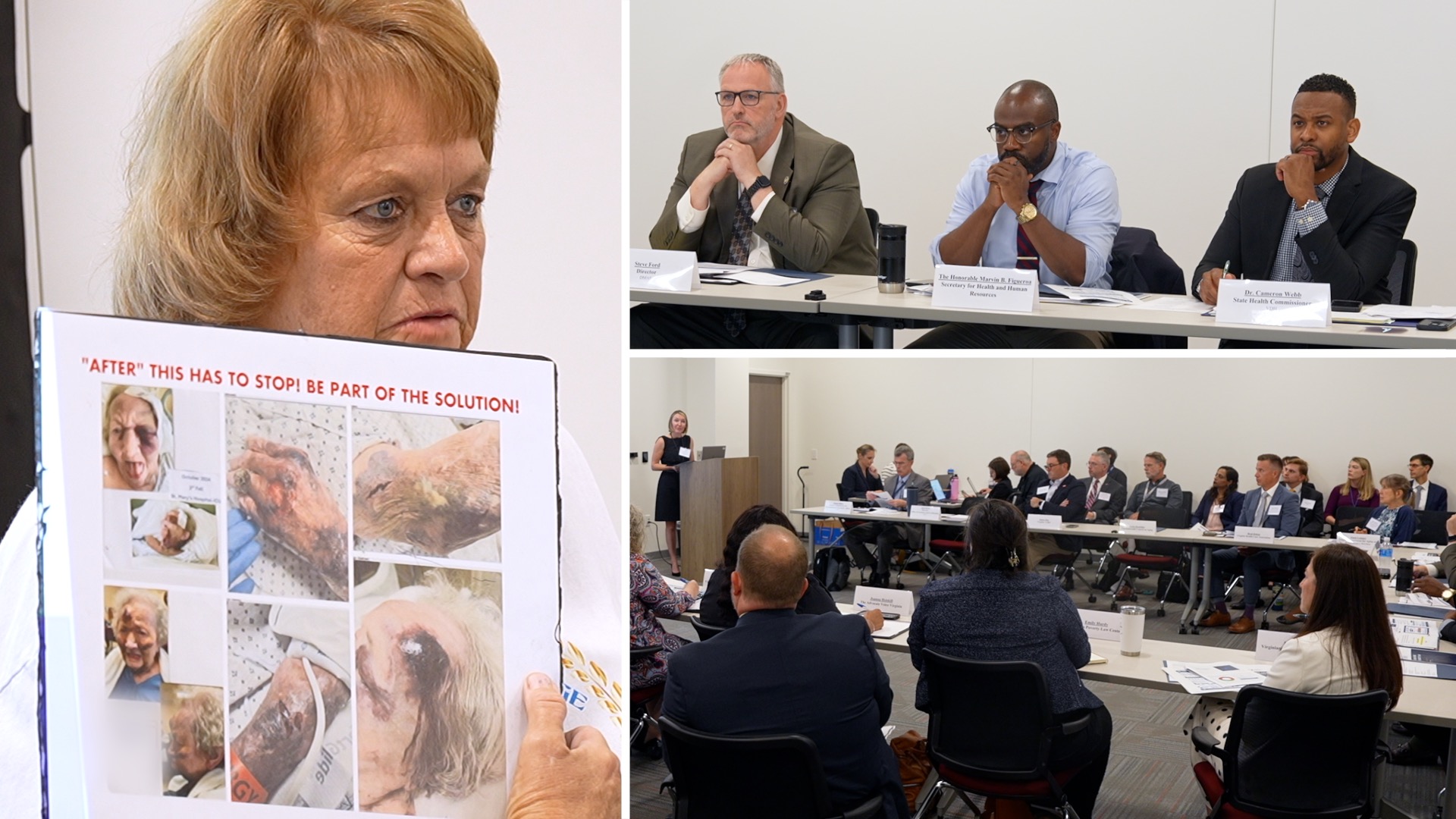


RICHMOND, Va. — Virginia's nursing home oversight advisory panel, a body formed with a goal of improving care and accountability across the long-term care industry, is back to work.
Tuesday marked the panel's first meeting under Governor Abigail Spanberger's administration and was chaired by State Health Commissioner Dr. Cameron Webb and the state's Medicaid agency director Steve Ford.
The body was created last year through an executive order issued by former Governor Glenn Youngkin, partly in response to CBS 6's reporting on mounting concerns from families about the quality of care in nursing homes.
Watch: Governor, top health officials take action following CBS 6 investigations into nursing home oversight
The board had previously met three times and issued a report, which Gov. Spanberger's Secretary of Health and Human Resources Marvin Figueroa said "identified important issues" but did "not solve the problem."
“This work will require us to have difficult conversations, to be honest about where the system is falling short, and to hold ourselves accountable for moving in a better direction," Figueroa said.
Janet Payne, whose mother died from a fall in a nursing home, attended the meeting as a concerned member of the public. While she's optimistic about the panel, she said there were many top priority issues that weren't addressed.
Late inspections remain a problem
During the meeting, the Virginia Department of Health's (VDH) licensing director April Dovel presented her office's plan to catch up on late inspections, which are supposed to occur at least once every 16 months to ensure resident protection. For years, VDH has struggled to complete timely inspections as the agency faced a shortage of inspectors. The oversight failures were the subject of previous CBS 6 investigations.

Local News
Nursing home care worsens, Virginia struggles to hold facilities accountable
Dovel said while Virginia was not unique in taking a staffing hit after the COVID-19 pandemic, other states were able to mitigate the impacts of inspector shortages through internal process changes.
To date, federal data shows Virginia remains the second worst state in the country for the amount of overdue nursing home inspections, even a year after an executive order directed VDH to hire more inspectors and be more efficient.
Federal data shows the national average for overdue nursing home inspections is 13%. By comparison, Dovel said 58% of Virginia nursing homes are currently overdue — down from 68% this time last year.
Dovel said her office has been making progress since she became director in November, when the backlog was even greater.
"We have a 20% reduction in the backlog that our new leadership team inherited at the beginning of November. So that's really exciting that we've made some headway. It's still an uphill climb. I don't want to discount that there's a lot of work still left to be done," Dovel said.
She said one barrier to getting the work done is that VDH continues to get flooded with nursing home complaints from the public, which extends the amount of time required to complete inspections.
Data showed the complaints frequently allege issues with patient neglect, medication management, staffing, and people being left soiled. VDH has received 1,046 nursing home complaints so far this year. That figure surpasses last year's July numbers, which were already skyrocketing back then.
“It's very high volume, and that is work that directly impacts our staffing, our survey scheduling, our investigative capacity, and our ability to quickly respond when a resident may be at risk," Dovel said.
“Do you think there's a correlation between an increase in complaints and declining quality of care?” reporter Tyler Layne asked.
“It's certainly possible. I mean, we have not been on site for some of these facilities in years," Dovel said. "I think if the public recognizes that we're putting our best foot forward, we have a good plan in place to move forward with these recertifications and getting that backlog under control, my hypothesis is that the complaint volume will decrease."
VDH's prior deadline for getting through the inspection backlog was January 1, 2027. The agency is now giving itself another year, to December 31, 2027, to get through the backlog.
To achieve that goal, Dovel said her office will continue with hiring and retention efforts, revamp its scheduling practices, and dedicate new personnel solely to investigating complaints.
VDH is also looking to take more ownership in its enforcement role. While VDH has long had the authority to take some licensing actions against poor performing nursing homes, Dovel said the agency historically deferred to federal regulators to "do our dirty work" when it came to imposing penalties.
The agency has now developed a new proposal that will lay out clear guidance for when VDH should restrict or prohibit admissions at a nursing home and suspend or revoke a nursing home's license.
"We need to be doing more from an accountability measure and making sure that we are taking appropriate action at the state level and not waiting for the federal partner to take any type of accountability against a provider that is not providing good quality care," Dovel said.
For Dovel, meeting these goals is personal.
She explained the reason she took the job in the first place was because of a concerning experience her grandmother had in a nursing home.
“I just remember thinking when I left that facility that if I ever found myself to be in a position where I could be in some type of licensing capacity for those communities, that I would want to do it to change the system and to hopefully impact the system in some better way," she said.
Medicaid officials highlight ownership data
Officials from the state's Medicaid agency, the Department of Medical Assistance Services (DMAS), presented an array of data to the panel concerning ownership.
Tammy Whitlock, DMAS' Deputy Director for Complex Care Services, said 81% of Virginia nursing homes are for-profit organizations. The share of for-profit ownership has grown slightly from last year, when data presented to the board by the Long-Term Care Ombudsman showed 75% of the state's facilities were for-profit.
According to DMAS' data, 61% of Virginia nursing homes are owned by ten chains. For five of those chains, more than half of their facilities are rated either below average or much below average.
For one chain, 100% of its facilities have low ratings. For another chain, 94% of its facilities have low ratings.
DMAS' data showed nearly half of residents insured through the Medicaid program are concentrated in low-performing nursing homes.
“That's a data point that we can't ignore, and that's something we have to look into and ask the question why," DMAS Director Steve Ford said.
Ford said "substantial taxpayer dollars" are used to subsidize care for the 19,000+ Medicaid members who live in nursing homes.
Officials said they have taken steps to ensure that money is spent on good quality care, such as implementing a program that gives extra money to facilities who meet certain performance measures. One new change to that program is excluding Virginia's six worst-performing nursing homes from eligibility. The change followed a CBS 6 investigation that found DMAS had been awarding quality-based bonus money to facilities flagged for a history of serious quality issues.
Watch: Virginia Medicaid will stop giving quality-based bonus payments to the state's worst-performing nursing homes
But they said more work needs to be done.
"We do need to, at some point, tie reimbursement to quality, and I don't know how we do that. We're doing some investigation on that and some research but just wanted to put that out there that that is a goal," Whitlock said.
'Talk to the families'
Janet Payne brought her mother's story to the board's attention during public comment, showing pictures of her mother badly bruised due to falls.
She said her mother fell 30 times in three years at the local long-term care facility where she was a resident. According to her mom's death certificate, she died in 2024 of "blunt force trauma to the head" due to a "ground level fall" at the nursing home.
“When I saw her like that, it breaks my heart. And I still live in guilt today. But it was me, myself and I taking care of her, and it wasn't that I didn't fight for her. I tried, but nothing did any good," Payne said.
The tragedy launched her into advocacy, where she now pushes for stronger resident protections as part of the group "Justice and Change for Victims of Nursing Facilities."
“I feel Virginia has a lot of things to correct, a lot of things that have been ignored for many years, and that's why we're losing a lot of people in nursing homes," she said.
Her message to the board: "Talk to the families. Papers, complaints — they don't tell you the real story. Families do."
She said there were some topics important to patient advocates that the board did not address during Tuesday's meeting. In future meetings, she'd like to see proposals to mandate minimum staffing standards and address the industry's political influence on lawmakers.
"How can they change the laws or try to make laws that work if they're taking money from the nursing homes?" she said.
Another public commenter, Kay Carithers, who said she was a registered nurse in Virginia, called on the board to "get corporate money out of political campaigns."
Her other recommendations included improving staffing levels, paying nurses more, and increasing Medicaid reimbursement rates.
Board members spent some time discussing general ideas among themselves. Areas of concern some members identified included funding for the Long-term Care Ombudsman's Office and the changing acuity landscape across the industry.
Industry executive Brad Dalton, the chief operating officer of American Healthcare LLC, called on the panel to focus its work on the system at large as opposed to singular incidents.
“Unfortunately, in our business, negative occurrences and isolated events are going to happen, and we want to make sure they don't happen again," Dalton said.
State Health Commissioner Dr. Cameron Webb said the next meetings are set for September and November. He mentioned the board will also help provide input for a report on nursing home quality due at the end of the year.
CBS 6 is committed to sharing community voices on this important topic. Email your thoughts to the CBS 6 Newsroom.
📲: CONNECT WITH US
Blue Sky | Facebook | Instagram | X | Threads | TikTok | YouTube

This story was initially reported by a journalist and has been converted to this platform with the assistance of AI. Our editorial team verifies all reporting on all platforms for fairness and accuracy. To learn more about how we use AI in our newsroom, click here.

