


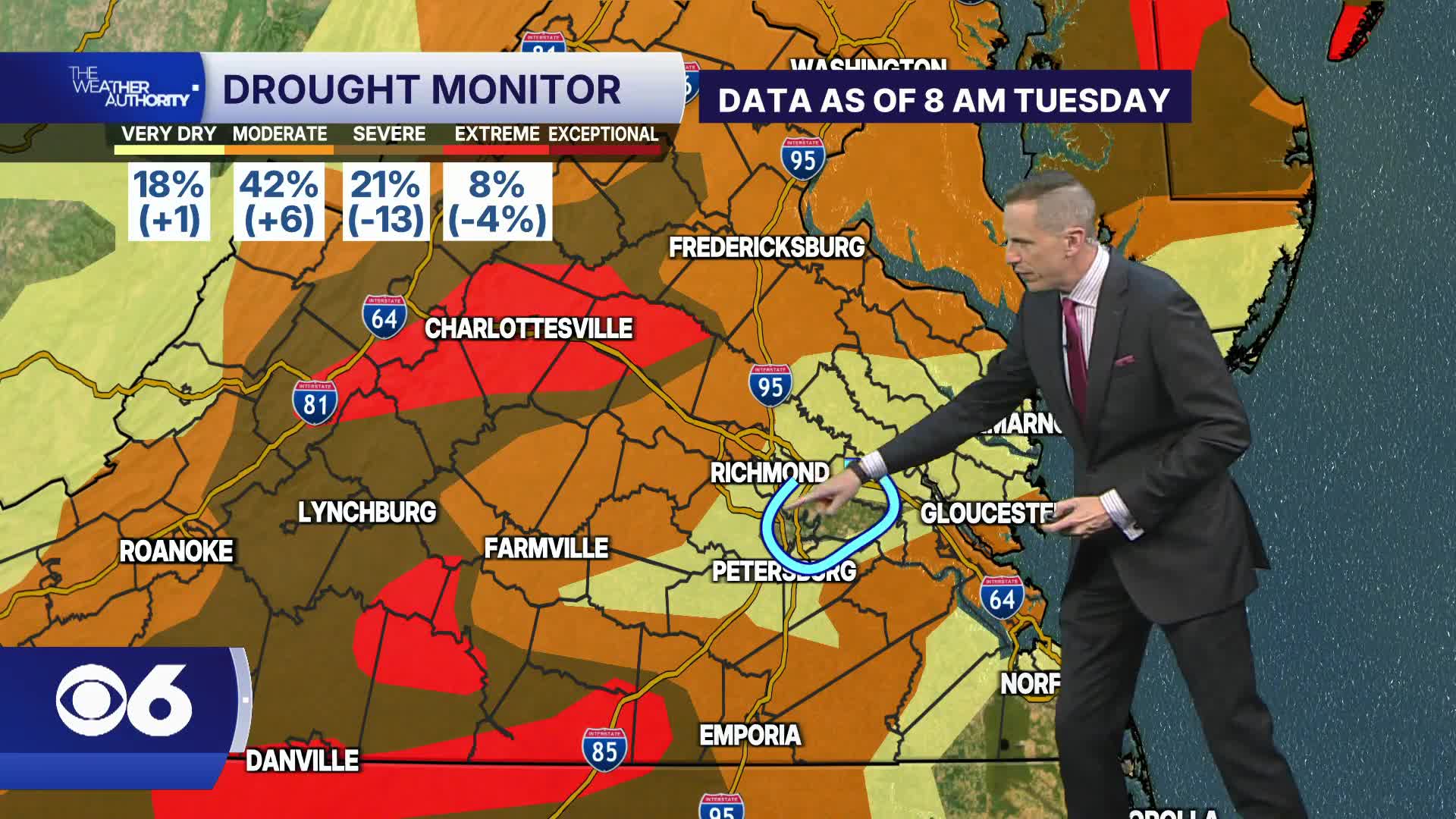


RICHMOND, Va. — Virginia's historic drought is showing its most significant signs of improvement in months, with the extreme and severe drought categories dropping sharply and 10% of the state now out of drought status entirely. As a result, officials said voluntary conservation measures in Metro Richmond could be lifted as soon as next week.
The latest U.S. Drought Monitor, released Thursday and based on conditions through 8 a.m. Tuesday, shows 18% of the state is in the very dry category, 42% is in moderate drought, 21% is in severe drought, and 8% is in extreme drought.
In last week's figures, 17% of Virginia was in the very dry category, 36% in moderate, 34% in severe, and 12% in extreme.
Severe drought dropped by 13 percentage points, and extreme drought fell by 4 points. Much of that improvement was absorbed into the moderate and very dry categories.

One area of particular note for local viewers: a pocket southeast of Richmond has moved out of drought status entirely, joining the 10% of the state that is now drought-free.
The City of Richmond, along with Chesterfield, Goochland, Hanover, Henrico, and Powhatan counties, remains in a voluntary water conservation advisory. Officials with the City of Richmond said Friday that a decision about lifting the voluntary conservation measures will be made next week, dependent on more rain, "continued stable river flow conditions" and Drought Monitoring Task Force guidance.
Richmond issued its first voluntary water conservation advisory since 2002 on July 1, as the James River continued to run below normal levels. Richmond's water treatment plant supplies water to Richmond, Chesterfield, Hanover, Henrico, Goochland, and Powhatan, making regional participation critical.

Despite the encouraging trend, drought conditions persist across much of the Commonwealth. Extreme drought remains in isolated pockets near Charlottesville, south of Farmville, and near Danville. The Roanoke region, which reached emergency drought status earlier this month, remains in severe drought.
The Virginia Drought Monitoring Task Force met this week and recommended de-escalating the drought warning in the Big Sandy region — which covers far Southwest Virginia including Buchanan, Dickenson, Lee, Russell, Scott, Smyth, Tazewell, Washington, and Wise counties and the cities of Bristol and Norton — to a drought watch. That is one step below a warning and reflects meaningful improvement in that part of the state.
However, the task force maintained all other existing drought advisories across the Commonwealth.

What it means for Central Virginia
For folks in Central Virginia, the Middle James drought evaluation region remains under a drought warning. That region includes Chesterfield, Goochland, Hanover, Henrico, and Powhatan counties and the cities of Colonial Heights, Hopewell, Petersburg, and Richmond, among others.
The Virginia Department of Environmental Quality noted that streamflow remained much below normal in Central Virginia, including the upper portions of the James, Shenandoah, and Rappahannock river basins. The Richmond area is a notable exception — normal year-to-date precipitation amounts are present in the Richmond area, a significant bright spot compared to the rest of the state.
Precipitation over the past week was substantial, ranging from less than 1 inch to more than 6 inches across the state, with amounts generally increasing from west to east, officials said. The seven-day forecast calls for slightly above-average temperatures with predicted rainfall totals of over one inch for much of the state, though the Roanoke and Shenandoah basins are expected to see only 0.25 to 0.75 inches.
Longer-term precipitation deficits remain severe and expansive. Except for the Richmond area, the rest of the Commonwealth is experiencing deficits ranging from 5.3 inches in Norfolk to 9.4 inches in Danville.
The Northern Piedmont region — which includes Louisa, Orange, Culpeper, Greene, Madison, Rappahannock, Spotsylvania, and Stafford counties and the City of Fredericksburg — also remains under a drought warning, as does the Northern Coastal Plain region covering Caroline County and surrounding areas.
WATCH: Virginia governor pushes back on claims that data centers are worsening Virginia's drought
Roanoke region still in emergency status
The Roanoke region — which includes Bedford, Campbell, Charlotte, Franklin, Halifax, Henry, Mecklenburg, Patrick, Pittsylvania, and Roanoke counties, and the cities of Danville, Martinsville, Roanoke, and Salem — reached drought emergency status after the Drought Monitoring Task Force recommended the designation on July 7.
Gov. Abigail Spanberger held a news conference at Smith Mountain Lake last week, warning that a drought emergency executive order remains possible if conditions do not improve.
"As governor, I do not want to put an executive order in place. I do not want us to need mandatory practices to conserve water," Spanberger said. "But we are constantly in that reevaluation phase of when do we hit true, true emergency where we do need to take that extra step."
Smith Mountain Lake remains 5.5 feet below normal levels. Groundwater wells in the region continue to set provisional record daily low water levels, and the Virginia Department of Health has reported an uptick in well applications to replace wells that are going dry.

Weather News
MAPS: A week-by-week look at tracking Virginia's drought
Mandatory restrictions still in place
Twenty-nine community water systems continue to have mandatory conservation measures in place across Caroline, Fauquier, Louisa, Orange, Powhatan, and Shenandoah counties.
The Drought Monitoring Task Force, which has been meeting weekly given the severity of conditions, will meet again on Aug. 4.
NEWS CONFERENCE: Roanoke region reaches drought emergency as Virginia drought deepens
What residents can do
Officials say water conservation should remain an everyday practice at home and at work, even as conditions improve. Suggested steps include:
- Shorten showers
- Turn off faucets while brushing teeth or shaving
- Run full loads of dishes and laundry
- Disable automatic lawn sprinklers
- Water lawns less frequently, only between dusk and dawn
- Wash cars less often
- If on a private well with low or no flow pressure, contact your local health department
-
Giving You A Voice
-
Your Voice, Your Story
🎙️ WTVR Podcasts
-
Eat It, Virginia! with Scott and Robey
Untold with Catie Beck
This story was initially reported by a journalist and has been converted to this platform with the assistance of AI. Our editorial team verifies all reporting on all platforms for fairness and accuracy. To learn more about how we use AI in our newsroom, click here.
-
 Facebook
  TikTok
  YouTube
 Blue Sky
 Instagram
 Threads
 X
X


