


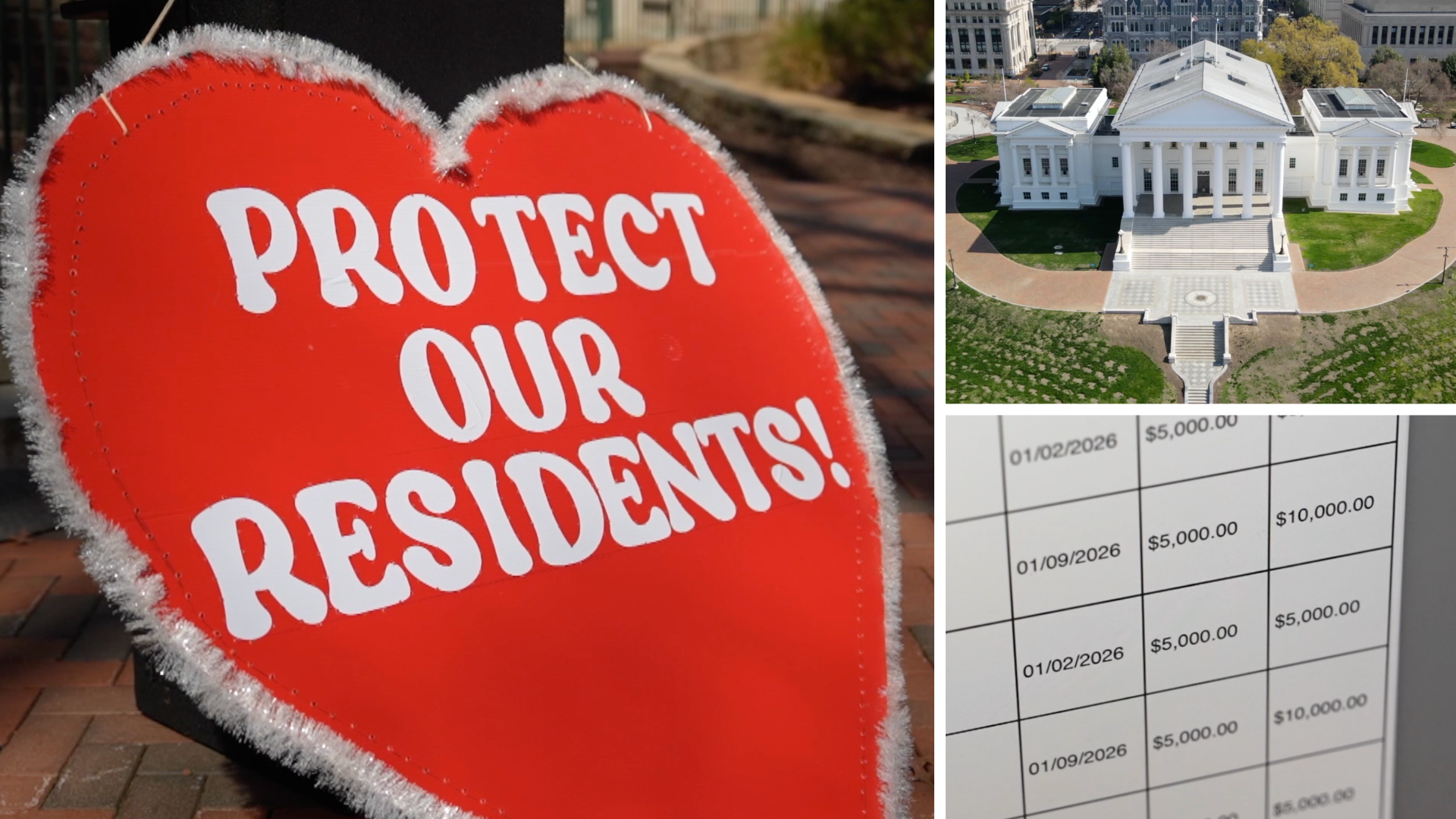


RICHMOND, Va. — The nursing home industry saw a recent boost in political activity as a new special interest group funded by out-of-state companies was a top donor to Virginia politicians ahead of the 2026 legislative session, according to data compiled by the Virginia Public Access Project.
While the group has not answered questions about who it represents and what its objective is, federal data shows its funders are associated with nursing home chains that perform below average on overall quality indicators.
'A major letdown'
The increased political activity came as patient advocates said they were disappointed that Virginia lawmakers, in their view, did not pass meaningful reforms during the General Assembly session.
"I feel that it was a major letdown," said Joanna Heiskill, whose mother's experience in a nursing home prompted her to advocate for residents and family members. "I call it the hamster wheel, and we've been on this hamster wheel for a lot of years."
Their concerns follow a year in which consumers filed more than 1,500 complaints against facilities, according to state health department data, far exceeding the number of complaints in previous years. Former Governor Glenn Youngkin (R-Virginia) also placed a spotlight on nursing home accountability last year by issuing an executive order near the end of his tenure aimed at strengthening oversight.
Multiple family members who told CBS 6 their loved ones received inadequate care in Central Virginia nursing homes often blamed weak laws and oversight for the problems they observed.
"I feel like just the government itself has failed us, because if you have Medicaid, they don't care," Dominica Williams said in a previous interview.
"We need to get out of the dark and get new laws in place... so this state can catch up, because it is very, very far behind," Debra Kabel said in a previous interview.
One measure that has been championed by reform advocates is a nursing home staffing standard, which would require facilities to provide a minimum level of care staff.
This past legislative session, Delegate Rodney Willett (D-Henrico) introduced a bill to implement a staffing standard, something he said was long overdue. Virginia remains in the minority of states without one.
But the bill was ultimately amended to direct the Joint Commission on Health Care to study the issue. The commission already studied nursing home staffing in 2021, which suggested a staffing standard similar to the one Willett proposed to target the lowest staffed and poorest performing facilities.
Watch: Virginia bill to set nursing home staffing standard reduced to another study
The final version of the legislation left supporters frustrated.
"It's extremely disappointing. This issue has been studied ad nauseam," said Peter Anderson, a nursing home abuse attorney. "And all of these studies show the more staff that a nursing home has, the safer the patient population."
"Pass a bill. Pass a bill now. What do we need to study?" said Sam Kukich, a nursing home resident advocate. “I just feel like it's a constant. That's the procedure. They're never going to establish ratios. I have no idea why."
Willett attributed the changes to the bill to Medicaid funding constraints during a tight budget year.
"We will take action. I'm still confident we'll get that through. The study will certainly support that. And it's really— that piece of it is really a funding hurdle. Everyone is on board now with having staffing standards," Willett said.
On the other side of the aisle, Senator Glen Sturtevant (R-Colonial Heights) also introduced reform bills.
One would have withheld bonus performance-based Medicaid funding from facilities that pay themselves excessive rent, in an effort he said would incentivize nursing homes to prioritize financial resources for care over profits. However, it failed at an early stage as industry representatives argued there was no link between quality and rent payments.
Another bill would have increased doctor visits in nursing homes, but he said that legislation was significantly weakened before passage. Industry representatives said they didn't have the workforce capacity or money to meet the proposed requirement.
Sturtevant attributed the outcomes of both bills to industry lobbying.
"When you're trying to put in place regulatory oversight… there's going to be a lot of pushback from the nursing home industry and the nursing home lobby, and they put a lot of money behind making it very difficult to get those reforms through," Sturtevant said.
One lobbying group that appeared this past session was called Virginians Advocating for Seniors, which according to its website is part of a trade association. During bill hearings, the group's lobbyist said it represents "over a third of the nursing homes in the state."
But when CBS 6 asked the lobbyist exactly which nursing homes the group represents, he referred us to a different contact, who then referred us to another.
That contact has not responded to our inquiries.
"If you're going to advocate for seniors, you can't do that and at the same time be lobbying for the industry," Heiskill said.
Another prominent industry group is the Virginia Health Care Association (VHCA), which CBS 6 political analyst Dr. Bob Holsworth said is "very well known" and "highly respected" on Capitol Square.
The association represents nearly all nursing homes in the state.
The VHCA declined an interview for this story, but spokesperson Amy Hewett said in a statement it "is important that the long term care sector has a voice in the legislative process because our members bring real-world experience and insights. They understand what it takes to care for residents with complex medical and personal needs in a system facing a funding gap between the cost of caring for a nursing home resident and what Medicaid reimburses."
"In recent legislative sessions, VHCA-VCAL has supported a nursing home staffing standard, stronger oversight and accountability measures, and increased licensure fees to cover the cost of operating the licensure and inspection program to ensure timely completion of inspections. We did that because we believe these measures support resident care, quality, and transparency," Hewett said. "Our goal is the same as policymakers and families: making sure every nursing home resident in Virginia receives safe, compassionate care."
This past session, both industry groups supported a softened version of the staffing bill, which lowered the minimum standard from what was initially proposed.
They also fully endorsed another bill from Del. Willett that he said will improve ownership transparency.
That bill was successful and will require new operators in Virginia to disclose information to the health department about who they are and their history running other facilities.
"I think we made a lot of progress this session, and progress that needed to be made," Willett said.
Two other successful bills will 1) direct a different study of industry quality, operations, and financial practices that will be due by December 2027 and 2) direct the state health commissioner to submit an annual report detailing ways to improve nursing home quality.
Holsworth said the passages show "the reform movement isn't just losing at every place" and has "been more effective the last couple of years in raising the profile of this issue."
Watch: Virginia leaders say they delivered on promise to fix nursing home oversight. Did they?
But patient advocates argue none of the measures approved by lawmakers will make an immediate difference for those relying on bedside care right now.
"There was nothing done to improve the lives of nursing facility residents and their families or those who care for them," Heiskill said.
They believe their lobbying resources pale in comparison to the industry's resources.
"There's a disturbing amount of political influence being bought by industry associations," said nurse aide and advocate Victoria Jackson.
Following the money
Donations from nursing home industry groups to state politicians got a recent boost from a seemingly new political action committee called Organizing for Virginia Seniors.
According to the Virginia Public Access Project (VPAP), the group was among the top political donors in the commonwealth for the first part of 2026 — donating over $300,000 before the start of the legislative session.
Holsworth said that's an unusually high amount for the nursing home industry.
"I think this really represents something that's quite different, and it tells us that there's an enormous amount of political attention that has been paid to the nursing home industry in the past couple of years," Holsworth said. "I think what we've seen over time now is the nursing home industry becomes more consolidated and you have these national or out-of-state operators owning homes in multiple states, they become more interested in using government affairs and lobbying as a way of getting their positions solidified."
A listed contact for Organizing for Virginia Seniors did not respond to questions about who they are and who they represent.
But state election department filings do show who's funding the PAC. The top contributors are out-of-state companies.
First, there's "SNF Services LLC" out of Brick, New Jersey. CBS 6 found little publicly available information about this entity.
Then, there's "MLMD Holdings LLC" based in Lakewood, New Jersey.
Centers for Medicare and Medicaid Services (CMS) data links this entity to the Lifeworks Rehab chain.
According to CMS, the chain has an overall quality rating of 2.1-out-of-5 stars and a staffing rating of 1.5 stars. Both are below the national averages.
Another top contributor is "Alexandria SNF Operations LLC" out of Woodmere, New York.
That company is the legal business name for a nursing home that CMS reports as part of the Hill Valley Healthcare chain.
Hill Valley has an overall quality rating of 2.2 stars and a staffing rating of 2 stars. Both are below the national averages.
Filings also show multiple facilities within the New Jersey-based Eastern Healthcare Group gave money to the PAC.
Eastern has an overall quality rating of 1.3 stars and a staffing rating of 1.4 stars. Both are below the national averages.
CBS 6 reached out to each of the companies for comment, but we have not received any responses.
CMS data shows the chains have dozens of for-profit nursing homes across Virginia.
"It's not totally clear who's behind this, not totally clear what they're up to and what they're doing, but they certainly have a whole lot of money," Sturtevant said.
According to state filings, the PAC's donations included:
- $100,000 to Governor Abigail Spanberger's Inaugural Committee
- $20,000 to Virginia Senator Democratic Caucus
- $20,000 to House Democratic Caucus
- $20,000 to Virginia Senate Republican Caucus
The PAC also gave more than two dozen contributions ranging from $2,000 to $10,000 to many members of the General Assembly on both sides, including to Del. Willett, who chairs a powerful healthcare committee.
"Organizing for Virginia Seniors did give a $10,000 donation to you, to your campaign. Did that donation influence votes in any way for you or decision making?" reporter Tyler Layne asked him.
"No, again, I am chair of the Health and Human Services Committee. And yes, I do accept donations from a broad range of groups. That's one of the ways we're able to do this very part time job to afford to do that in terms of covering our costs. But again, I meet with all advocates, and I really feel like I have the ear of the people here, of my constituents who are concerned, and that's who I'm representing here in Henrico," Willett said.
In addition to Organizing for Virginia Seniors' money, the VHCA donated $187,000 to Virginia politicians in 2025 and 2026, according to VPAP data.
A spokesperson for the association did not directly answer a question about its donations in a statement provided for this story.
When asked about the impact of political donations, Holsworth said they don't "necessarily carry influence," but they "almost always" guarantee access to legislators.
Holsworth believes the industry's political efforts likely had some impact on the outcomes of bills this past session, but he pointed out that lawmakers also weighed expected Medicaid cuts and workforce challenges when making decisions.
"The General Assembly has certainly not met the moment on this issue, but like a lot of things down there, you just keep after it," Sturtevant said.
For Heiskill, she views the General Assembly's actions as another missed opportunity to better protect vulnerable people like her mother.
"While they show to want to try and do this and do that, nothing is actually getting done," Heiskill said.
CBS 6 is committed to sharing community voices on this important topic. Email your thoughts to the CBS 6 Newsroom.
📲: CONNECT WITH US
Blue Sky | Facebook | Instagram | X | Threads | TikTok | YouTube

This story was initially reported by a journalist and has been converted to this platform with the assistance of AI. Our editorial team verifies all reporting on all platforms for fairness and accuracy. To learn more about how we use AI in our newsroom, click here.

