


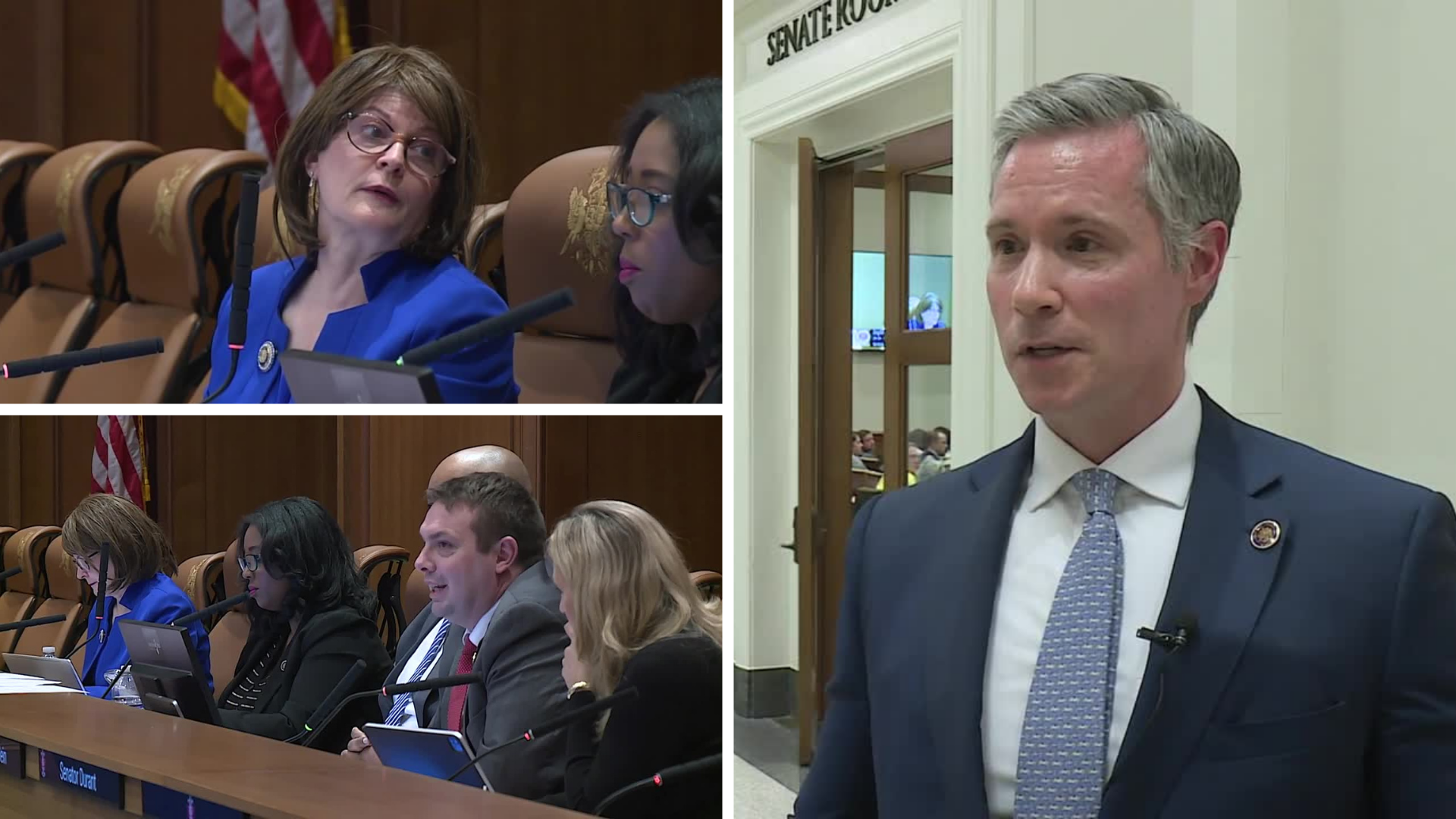


RICHMOND, Va. — Mixed perspectives were expressed during a General Assembly hearing on Thursday, as Sen. Glen Sturtevant presented a bill that he said aimed to prevent nursing home companies from essentially paying themselves excessive rent with taxpayer dollars. Amid industry opposition to the bill, a group of lawmakers ultimately decided to table it.
“What this bill seeks to do is say we're not going to contribute to those profits being sucked out of a company under the form of rent," Sturtevant (R-Colonial Heights) told the subcommittee.
He proposed the legislation in response to CBS 6's investigative reporting that revealed two facilities significantly increased the amount of rent it paid to a related party landlord, meaning a sister company under common ownership, over a two-year period, according to financial filings.
WATCH: Virginia lawmaker seeks to penalize nursing homes that pay themselves excessive rent
The nursing homes said the rents reflected capital investments and fair market value. The state's maximum fair rental value calculations for the facilities, if all residents were Medicaid members, were much lower than what was reportedly paid.
“These companies are receiving tax dollars that's supposed to go to bedside care for more doctors, more nurses, better care, when that is instead going to excessive rent payments that ultimately go as bigger profits to the parent company," Sturtevant said.
His bill would have directed the state Medicaid agency to withhold quality-based bonus payments for facilities that pay above 125% of an established fair market value threshold, with some exceptions. The bill would not have impacted base Medicaid funding, only the extra money the state distributes to reward quality.
It received support from AARP Virginia, which in part advocates for nursing home reform. In speaking in favor of the bill, the organization's lobbyist Jared Calfee cited research suggesting it's common for nursing homes to pay related parties higher than the actual costs for goods or services.
“This is a big problem. We think that this bill will improve transparency and make sure that public money is actually going to quality of care for residents and not to fill the pockets of ownership and increase their profits," Calfee said.

But the bill faced pushback from nursing home operators.
“The bill is built on the incorrect assumption that the quality of care a resident receives is tied to how much a facility pays in rent. There's no evidence that higher rent results in poorer care," said Wendy Walter, the regional director of operations for Commonwealth Care of Roanoke and board chair for the Virginia Health Care Association (VHCA), the prominent trade association for nursing homes.
Industry representatives argued financial arrangements should not be connected to the state's quality incentive program, which is designed to promote specific care outcomes. Further, they said the measure would discourage providers from investing in their buildings.
“We want the highest quality, but if I've got an old facility and I put money in new a roof, new washing machine, hiring staff, my rent may be higher than a facility that's 10 years old, still in pretty good shape," said Scott Johnson, a lobbyist for the VHCA, which represents nearly all nursing homes in the Commonwealth.
"The level of complexity that is involved in these relationships are a lot more complicated than you might think," said Matt Benka, with Virginians Advocating for Seniors. Benka told the subcommittee the group represented over a third of the state's nursing home beds, but the organization did not answer CBS 6's questions about which facilities or chains it includes.

Local News
In-Depth Investigations: Voices from Virginia Nursing Homes
Sturtevant argued the opposition presented during the hearing did not address the point of his bill, which was to provide accountability over taxpayer dollars.
“I think most of the concerns that I heard was not that [excessive spending on related-party rent] was not happening, but that they really wanted to be able to keep doing it," Sturtevant said.
Industry lobbyists asked the subcommittee to effectively kill the bill, but Sen. David Suetterlein (R-Roanoke) took issue with those requests.
“I thought that was completely out of line, and I find it very concerning that they do not want any continued discussion of the subject," Suetterlein said. "And I think everyone ought to be really concerned by that testimony that we just heard from folks that represent people that receive so much taxpayer money to care for our older Virginians that are in vulnerable states.”

While Suetterlein motioned to advance the bill, Democratic Sen. Barbara Favola (D-Arlington) said it wasn't "fully cooked." She counter-motioned to continue it to next year, which a majority of the subcommittee voted in favor of.
“I’m not sure the rent is really related to the quality of care, and if I'm reducing the incentive payments, will I actually be inhibiting the ability of the nursing home to provide better bedside care?” Favola told CBS 6 regarding her decision.
“When you see that facilities are paying themselves high amounts of rent, do you see that as a problem? Does that concern you in any way?” reporter Tyler Layne asked.
“It’s a factor. I would have to look at a number of other things. Is their staffing ratio at least at the average? Do they have trained CNAs? Do they have a good bedside quality control? It would be one factor. I'm not minimizing it. I'm just saying we need to look at more," Favola said.
Favola said her effort to shelve the legislation was not persuaded by industry testimony and said "they may not be satisfied with the deep dive we do next year" in terms of imposing transparency requirements. Favola currently has her own bill moving through the General Assembly that would require several ownership disclosures when nursing homes change operators. The VHCA said it supported that bill.
With her motion to table Sturtevant's bill, she included a caveat that she would send a letter to the Joint Commission on Healthcare requesting a study on this topic.
“I do want an independent review, and I would like it done by experts who have some experience in evaluating healthcare systems," Favola said.
Share your nursing home stories with the CBS 6 Investigative Team: Email Melissa Hipolit and Tyler Layne

📲: CONNECT WITH US
Blue Sky | Facebook | Instagram | X | Threads | TikTok | YouTube

