


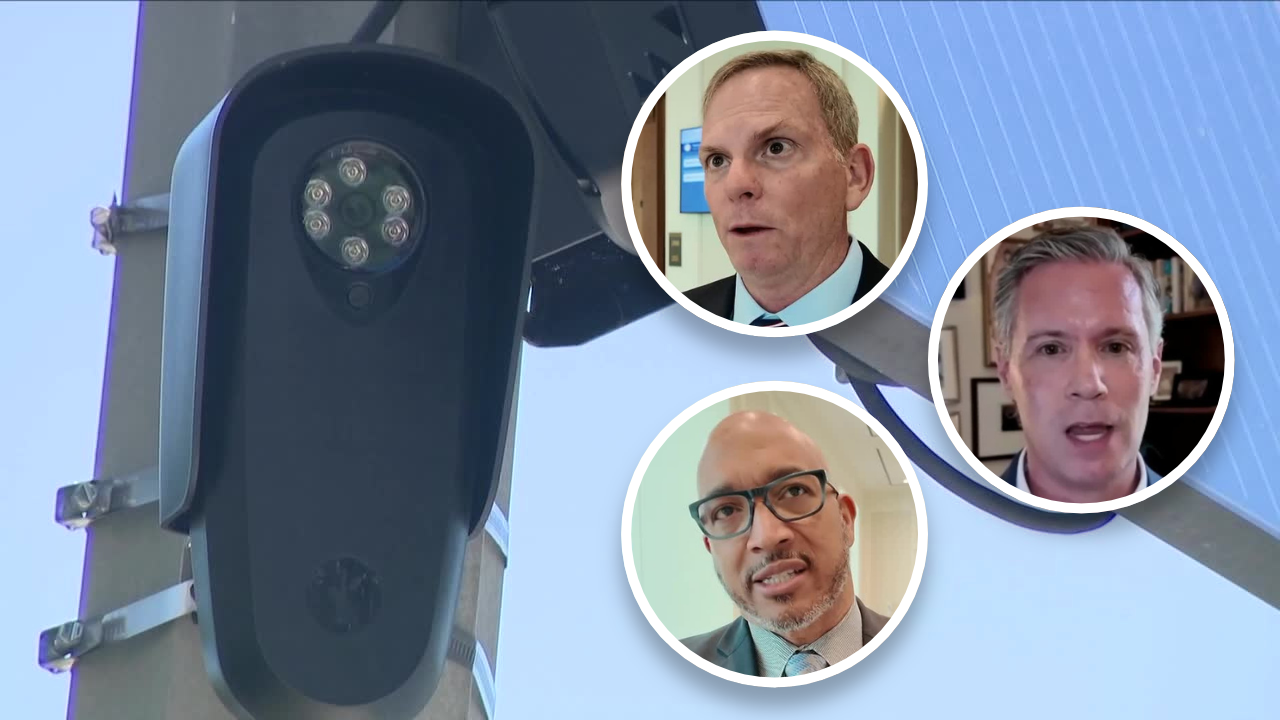


RICHMOND, Va. — The Virginia State Crime Commission (VSCC) has approved a legislative packet for the 2027 General Assembly session with proposed changes to the state's law governing how law enforcement agencies use Automated License Plate Readers (ALPR).
The recommendations come after a meeting earlier this month where a survey conducted by VSCC staff found several examples of police misuse, but did not lead to prosecution in most cases.
"Just because we say the law is the law doesn't mean people are going to follow it based on the results we just got back from our survey," said State Sen. Scott Surovell (D-Fairfax) at the November 10 meeting. "And so, it's important that there's sufficient consequences."
Among the potential changes are penalties when law enforcement misuse ALPRs. Currently, law enforcement officials who willfully and intentionally access an ALPR system or share its data for unapproved reasons can be charged with a Class 1 Misdemeanor. The VSCC's 2026 survey on ALPR use said 20 of the 191 responding law enforcement agencies report misuse of the system, but reported only two cases where charges were brought (staff did note that the results of the survey were not reflective of the current environment as many departments had announced plans to end ALPR use since the survey was conducted).
So, lawmakers approved a proposal to create a $5,000 fine for the corresponding law enforcement agencies for each infraction.
it carries a Class 1 Misdemeanor charge -- but a survey by the Virginia State Crime Commission found 20 cases of misuse by police departments -- but it only led to two prosecutions.
So, lawmakers approved proposing a $5,000 dollar fine for a department for each infraction.
"We want to try to address those concerns," said commission member Bruce Cruser. "The fee needs to reflect the importance of this violation."
Among the other proposals approved the commission: allowing the Department of Criminal Justice Services to conduct random, independent audits of law enforcement agencies' ALPR programs (currently, each agency is supposed to conduct a self-audit every 30 days), require that requests for ALPR data be made in writing, allow the Office of the Attorney General and Commonwealth's Attorneys to enforce violations of the state law, explicitly ban sharing data for immigration and healthcare enforcement (unless required to do so by a court order), and to set-up a process to decertify law enforcement officials who violate the ALPR law.
Sen. Mike Jones (D-Richmond) said he already plans to file legislation on the latter issue.
"If there is a bad actor, that they can and should be decertified," said Jones. "That they should lose their employment for breaking the public trust because that's all this is about. How do I know that I'm not being surveilled as I go to and from my daily activities? Everyone deserves privacy."
There was also a discussion about adding language to explicitly banning the sharing of ALPR data with out-of-state and federal agencies, but some members raised concerns that this could harm the ability to solve actively occurring crimes.
Hampton Commonwealth's Attorney Anton Bell pointed to the March 2026 shooting at Old Dominion University as an example.
"Where it's involving time is of the essence. If we recall, with the ODU shooting, at the time everything was just fluid, and they were trying to figure out what was going on, whether other individuals were involved," said Bell. "And if we recall, the Isle of Wight Sheriff's deputy shared that information with the federal authorities. That was considered a violation. And so, my concern is whether our restrictions are too restrictive that is covering things that are unintended consequences or having unintended consequences."
The commission agreed to put in an exemption when there is an imminent threat of bodily harm.
But as the commission voted to put more guard rails into place, a bipartisan group of lawmakers are calling for a total ban of ALPRs.
"My view is this is a surveillance network that should never have been installed in the first place. The state and the General Assembly has tried to put guardrails on this technology that was done last year and we've seen the abuses and misuses of this technology since then," said Sen. Glen Sturtevant (R-Chesterfield), who plans to introduce legislation for a statewide ban. "There really are no guardrails that are going to make this surveillance network appropriate for Virginia, and we need to get these flock camera networks off of our roads. Period."
Jones said he will be backing similar legislation that another Democratic state senator plans to introduce and that his decertification legislation was intended to be an additional guard rail if a ban is not approved
"Hopefully, it's banned, but we don't know if that's going to take place."
While there is bipartisan support for banning ALPRs, there is also bipartisan support for keeping them.
"As we've debated all this over the last three years, one of the situations that often comes to my mind is the D.C. sniper and how much faster the D.C. sniper might have been found if these things had existed at the time this happened," Surovell said at the meeting. "All the people that got murdered and terrorized for an extra two weeks or whatever because nobody could figure out which white van to look for, and it turned out it wasn't even a white van. But in any event, there's situations like that that arise and which is one of the reasons I still support this technology, notwithstanding a lot of the concerns people have raised and why I want more guardrails."
"I'm a supporter of them, where they're used for truly crime prevention and cracking crimes," said State Sen. Bill DeSteph (R-Virginia Beach). "We truly have laws in place to keep those guardrails operating properly around the LPRs. I believe that every once in a while we have to tighten up the guardrails -- that may be the case at this point in time. But I wouldn't take it away because it truly helps law enforcement crack cases that we otherwise would not be able to crack."
The first day of the 2027 session is January 13.
CBS 6 is committed to sharing community voices on this important topic. Email your thoughts to the CBS 6 Newsroom.
-
-
Eat It, Virginia! with Scott and RobeyUntold with Catie Beck
-
-
-
This story was initially reported by a journalist and has been converted to this platform with the assistance of AI. Our editorial team verifies all reporting on all platforms for fairness and accuracy. To learn more about how we use AI in our newsroom, click here.
 Facebook
 TikTok
 YouTube
 Blue Sky
 Instagram
 Threads
 X

