


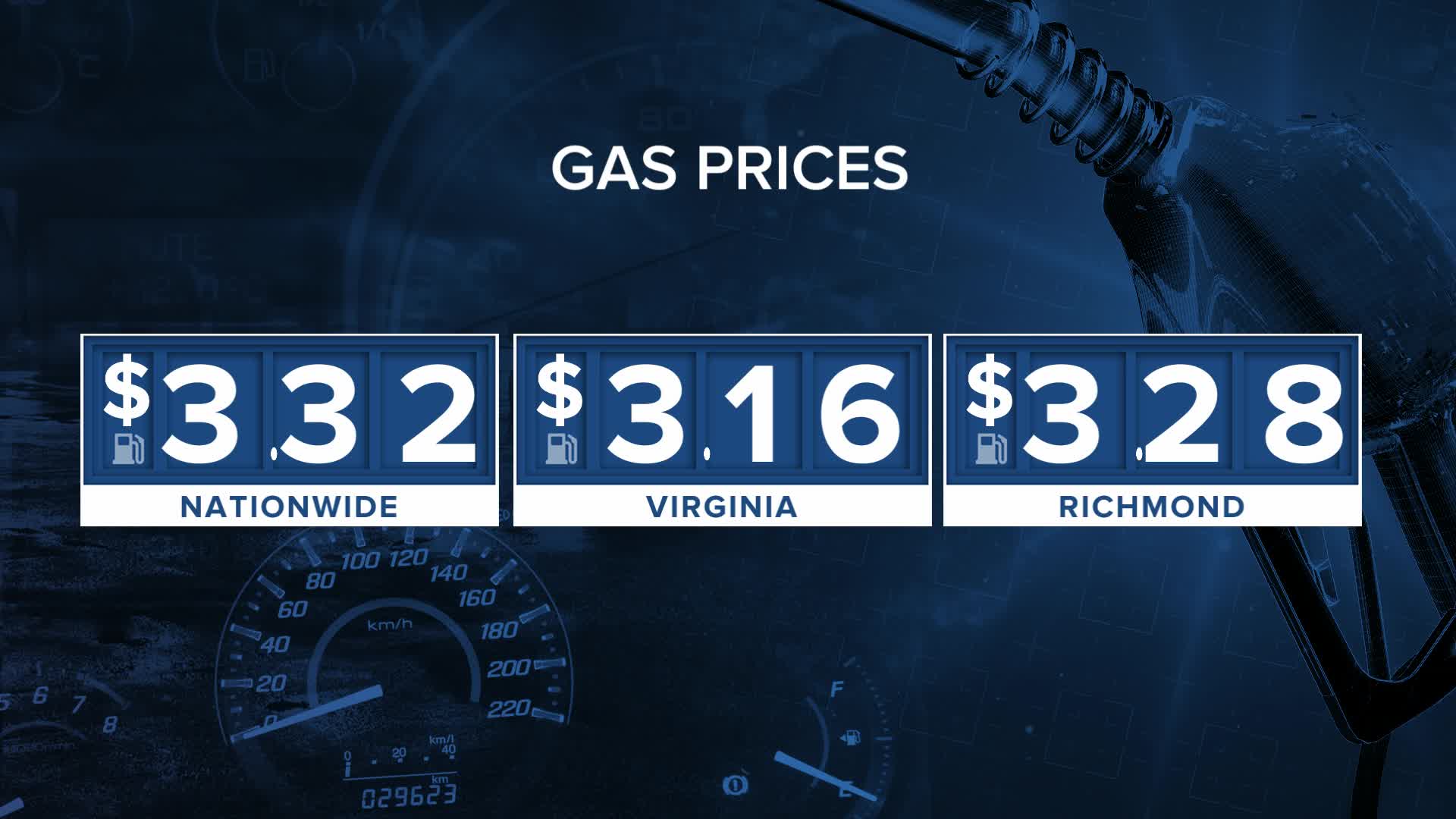


RICHMOND, Va. — Gas prices across the United States have risen by more than 40 cents per gallon in the week since the war against Iran began, to their highest level since September.
According to GasBuddy.com, the nationwide average is now $3.37, up more than 11 percent.
On Feb. 28, before the U.S. and Israel's attack on Iran, gas cost about $2.94 on average nationally and about $2.81 per gallon in Virginia.
The attacks on Iran and the Iranian counterattacks have effectively closed of the Strait of Hormuz through which 20 percent of the world's oil passes.
Oil is the biggest factor in the price of gas for American drivers.
Gas currently costs $3.23 in Virginia; in Richmond, it's about $3.30.
Analysts says the price is expected to rise even further, perhaps as much as 30 cents higher.
Oil Prices
The price for a barrel of Brent crude, the international standard, leaped another 8.5% to settle at $92.69.
It briefly rose above $94 to touch its highest level since September 2023.
A barrel of benchmark U.S. crude breached the $90 level for the first time since 2023 and jumped 12.2% to $90.90.
Oil prices have surged, with Brent up from near $70 late last week, as the war has expanded and included areas critical to the production and movement of oil and gas in the Middle East. Much will depend on what happens with the Strait of Hormuz off Iran’s coast.
The U.S. government gave details Friday about a plan President Donald Trump announced earlier to offer insurance to ships crossing the strait, but it had little effect on the market.
If oil prices spike further, like to $100 per barrel, and stay there, some analysts and investors say it could be too much for the global economy to withstand.
To be sure, the U.S. stock market has a history of bouncing back relatively quickly following conflicts in the Middle East and elsewhere, as long as oil prices don’t jump too high for too long.
Uncertainty about just how high oil prices will go this time around and for how long caused frenetic swings across financial markets this past week, sometimes hour by hour.
On Monday, the S&P 500 tumbled to an immediate 1.2% loss at the start of trading but made it all back and ended the day with a tiny gain.
Trump’s most recent signal on the war was that he wants an “unconditional surrender” of Iran, apparently ruling out negotiations.
In the bond market, Treasury yields wavered, with higher oil prices pushing upward on them and the discouraging updates on the U.S. economy pulling downward.
The yield on the 10-year Treasury initially rose toward 4.19% before pulling back to 4.14%. That’s up from 4.13% late Thursday and just 3.97% a week earlier.
Smaller companies often feel the bite of high borrowing costs more because many need to borrow to grow. Smaller companies can also be more dependent on the strength of the U.S. economy for their profits than big multinational rivals, and the smallest stocks on Wall Street took Friday’s sharpest dives.
The Russell 2000 index of small stocks fell a market-leading 2.3%.
Among the big companies in the S&P 500, companies with high fuel bills helped lead the way lower. Old Dominion Freight Line sank 7.9%, cruise line Carnival fell 5% and Southwest Airlines lost 5.3%.
All told, the S&P 500 fell 90.69 points to 6,740.02. The Dow Jones Industrial Average dropped 453.19 to 47,501.55, and the Nasdaq composite sank 361.31 to 22,387.68.
In stock markets abroad, indexes slumped in Europe following a better finish in Asia. London's FTSE 100 fell 1.2%, while Hong Kong’s Hang Seng jumped 1.7%.
South Korea’s Kospi was nearly unchanged after plunging 12.1% Wednesday for its worst loss in history and then rebounding 9.6% Thursday.
The Associated Press contributed to this report.
📲: CONNECT WITH US
Blue Sky | Facebook | Instagram | X | Threads | TikTok | YouTube

This story was initially reported by a journalist and has been converted to this platform with the assistance of AI. Our editorial team verifies all reporting on all platforms for fairness and accuracy. To learn more about how we use AI in our newsroom, click here.

