


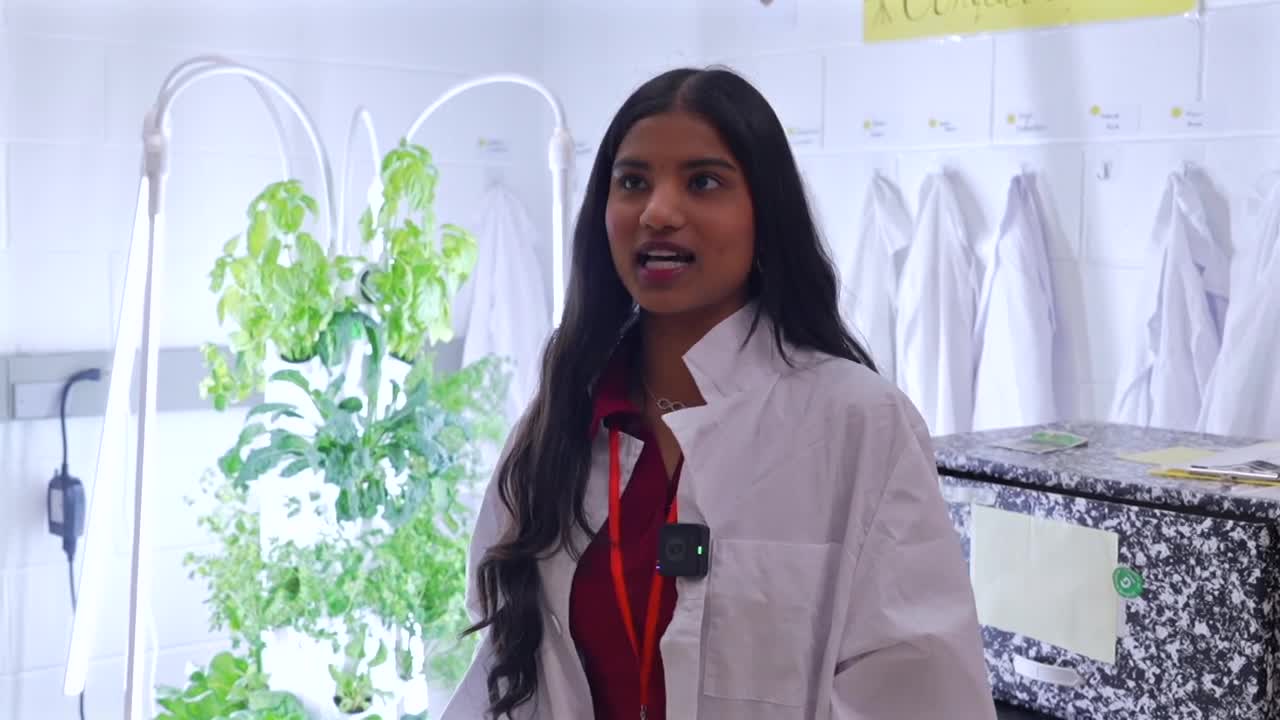


HANOVER COUNTY, Va. — Eighth graders at Oak Knoll Middle School in Hanover are tackling one of space exploration's most pressing questions: How do you feed people on the moon?
The students are participating in NASA's "Plant the Moon Challenge," researching, planning, and conducting experiments to grow plants in simulated lunar soil. They are currently about four weeks into the eight-week grow period.
Science teacher Kara Zedakar said the project is about preparing students for a future that is closer than many people think.
"How can we feed ourselves if we're going to space. And it's not a matter of how, but when we're doing that. So this is the generation that's going to go back to the moon, and I'm just excited for them to ask big questions and explore science," Zedakar said.
The simulated lunar soil used in the experiments is not ordinary dirt — and it does not come cheap.
"We are trying to grow plants in lunar soil. Soil is a generous word though. It's really just moon rocks, and we're trying to make things grow," Zedakar said.
The soil comes from the Exolith Lab in Florida, which simulates lunar conditions based on samples collected from prior missions.
"This bag of rocks is actually close to $600 to $700, but they have simulated what it's like from samples that they've taken from prior missions," Zedakar said.
The Virginia Space Grant supported the program and sent the team to the Kennedy Space Center in Florida. Student Rishitha Lakkakula served as a team leader on the project last year.
"I think my first thought was, wow, this is absurd. Like, can you believe it? Like who would have thought growing plants on the moon?" Lakkakula said.
For Lakkakula, the project is more than a classroom assignment.
"I was always very interested in NASA and once I heard this I was like this is my first step, you know, for my career," Lakkakula said.
The project is also inspiring classmates to pursue careers in STEM fields. Fellow 8th grader Evie Felts said the experience has reinforced her own ambitions.
"I'd actually love to go into biology. I love nature. I love animals," Felts said.
Zedakar said she hopes every student walks away from the experience with a deeper passion for science.
"Hopefully when they leave they are interested deeply in one of those agriculture, aerospace, or STEM, and it's going to broaden their horizons on all of those," Zedakar said.
This is a developing story. Email the CBS 6 Newsroom if you have additional information to share.
CBS 6 is committed to sharing community voices on this important topic. Email your thoughts to the CBS 6 Newsroom.
📲: CONNECT WITH US
Blue Sky | Facebook | Instagram | X | Threads | TikTok | YouTube

This story was initially reported by a journalist and has been converted to this platform with the assistance of AI. Our editorial team verifies all reporting on all platforms for fairness and accuracy. To learn more about how we use AI in our newsroom, click here.

