
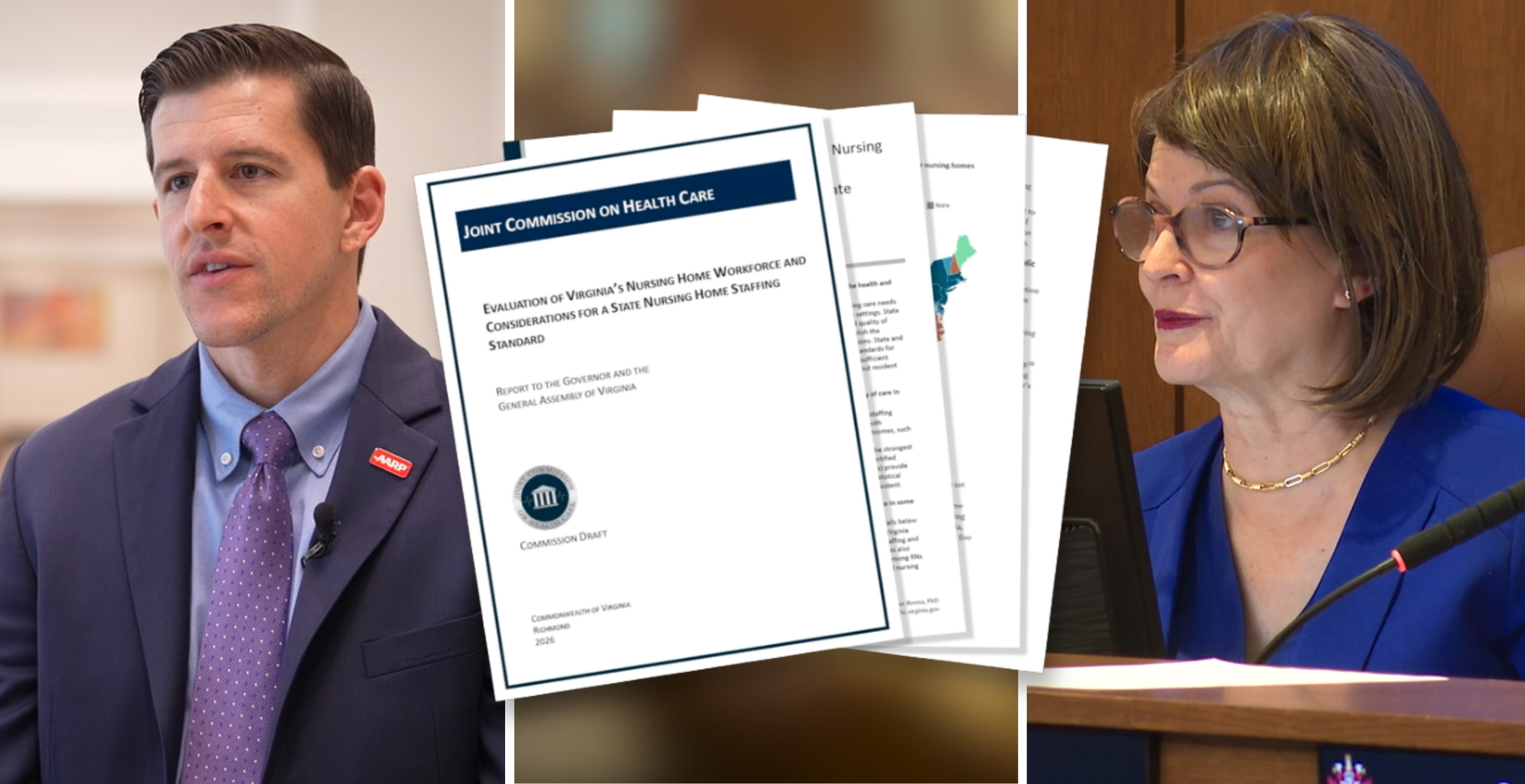


RICHMOND, Va — Virginia has spent more than $52 million incentivizing its worst-staffed nursing homes to hire more nurses. But data presented in a new report shows that investment has not proven to be fully effective, and those same low-staffed nursing homes are more profitable than more highly staffed nursing homes.
Now, state researchers are recommending a mandate.
Those were some of the findings detailed in a report by the Joint Commission on Health Care, which was presented to a group of lawmakers on Wednesday. The purpose of the study was to examine Virginia's nursing home workforce and considerations for a state staffing standard.
The report's findings painted a grim picture of the staffing levels inside Virginia's nursing homes.
Virginia performs below average on staffing measures
It found Virginia ranked among the worst-rated states in the country for registered nurse (RN) and certified nurse aide (CNA) coverage and had higher rates of staff turnover than the national average.
Virginia ranked 38 out of 53 states and territories for RN staffing and ranked 50 out of 53 for CNA staffing.
The report also identified significant differences in staffing levels based on ownership type. For-profit nursing homes, which make up the majority of all facilities, provide an average of 1.5 fewer hours of total nurse staff per resident per day compared to non-profit facilities.
“The rankings you presented, I think, are problematic," Senator Barbara Favola (D-Arlington), who chairs the commission, said after receiving the report.
“The numbers are just unacceptable," Del. Rodney Willett (D-Henrico) echoed.
The report comes on the heels of a CBS 6 investigation that found the state's own inspections have repeatedly tied patient harms and nurse burnout to insufficient staffing. Just last month, the Virginia Department of Health (VDH) cited another facility with immediate jeopardy violations, the most severe kind, for insufficient staffing and neglect after inspectors entered a facility during a night shift to find just one CNA covering 89 residents.
Healthcare workers have expressed staffing concerns to CBS 6 in previous interviews.
“If you have 13 to 40 patients, how do you take care of them?" CNA Tomeka Coley said.
“I think the typical practice for Virginia nursing homes, especially the for-profit nursing homes, is to staff as low as possible," medical director and long-term care physician Dr. Jim Wright said.
And residents and their families have often cited low staffing as a root cause of quality problems.
“You can ring that call bell, and it might be an hour and a half, two hours before they come," nursing home resident Maurice White said.
“The ratio of nurses to residents, it needs to be done better," nursing home resident Ronald Rawlings said.
PAST COVERAGE: Virginia nurse aide pushes for nursing home staffing standards
Report: More staffing leads to better care
The commission's study confirmed strong evidence exists linking higher staffing to better care.
Despite this, Virginia has not successfully established an enforceable, defined staffing standard, even though legislation attempting to do so has been proposed for decades. The report said Delegate Vivian Watts (D-Fairfax) has been proposing staffing standards since 2002.
The report said investigators with VDH trace many complaints they receive — such as pressure ulcers, lack of food or water, and missed medications — to inadequate staffing.
But the report said the absence of a specific standard may limit their ability to get ahead of those issues. Instead, the study suggested VDH can only take action once insufficient staffing causes harm to a resident or presents a regulatory violation.
Most of the staffing violations VDH has documented in inspection reports since 2025 have been cited under federal regulations, which broadly require nursing homes to provide sufficient staffing but do not set a minimum threshold.
Jared Calfee with AARP Virginia, which advocates on behalf of Virginia seniors, said he wasn't surprised by many of the report's findings.
“We heard a lot of what we already knew- that Virginia is largely failing to adequately staff our nursing facilities," Calfee said.
Enforceable staffing mandate recommended
Commission staff found states with enforceable staffing standards see increased staffing and improved quality of care.
"Stakeholders disagree on whether Virginia should enforce or incentivize staffing standards. Some stakeholders indicate that without an enforcement mechanism, nursing homes lack adequate consequences to drive change in staffing measures. Other stakeholders support only incentivizing staffing standards ... with financial incentives provided to nursing homes that exceed or show progress towards meeting a staffing threshold," the report said.
However, it continued that "significant financial incentives provided" through a program run by the state's Medicaid agency "have demonstrated mixed results in staff improvements. In contrast, states with staffing standards tied to licensing requirements have seen increased staffing levels in nursing homes."
The report added that while some stakeholders cited concerns that staffing standards could lead to nursing home closures, there has been no evidence of that actually happening. The report further said such mandates have a "minimal impact" on finances.
MORE COVERAGE: Lawmakers challenge Virginia's handling of questionable nursing home costs
Senator Favola, however, wasn't totally sold on that point.
“That I'm not sure was investigated as thoroughly as one might think. I did find that interesting, for sure, but it's something that the nursing homes will probably dispute," Favola said.
The study recommended that Virginia establish a minimum staffing mandate of 3.09 adjusted total nurse hours per resident per day (HPRD) starting fiscal year 2029. It recommended then raising the threshold over time to 3.43 HPRD by fiscal year 2034.
For comparison, the 3.09 number is on par with legislation that passed the General Assembly in 2023, but was later repealed. However, it's lower than Del. Willett's initial 2026 proposal of 3.25 adjusted total nurse HPRD and lower than the 3.48 total nurse HPRD the Centers for Medicare and Medicaid Services proposed in 2024.
Some lawmakers, though, didn't seem bought in on the proposed timeline for implementation.
"I sense the feeling in the room that we want to move faster here, and I think that's certainly something to look at," Willett said.
The study also suggested lawmakers could consider allowing waivers for nursing homes who try to meet the mandate but can not, appropriating additional Medicaid funding to cover staffing costs, requiring nursing homes to report how they spent that money, giving more funding to VDH so that it can enforce the mandate, and commissioning an independent evaluation of whether the mandate is driving positive change.
91% of worst-staffed facilities are for-profit
The commission's report found 79 Virginia nursing homes currently do not meet the minimum threshold of 3.09 total nurse HPRD. Of them, 72 are for-profit and are affiliated with ten corporate chains, "indicating a high degree of operational consolidation."
The study added that the nursing homes that do not meet the minimum threshold are "more profitable" than those that do.
Additionally, it said the state has already given these lowest-staffed nursing homes $52.7 million in extra Medicaid money to reward their staffing performance. Yet, the study described the results of that investment as "mixed."
While the report said the incentivization funding reduced the numbers of days nursing homes go without RN coverage, it did not lead to any change in the percentage of nursing homes meeting higher benchmarks that measure total nurse hours per resident per day.
“You can staff at adequate levels when you're prioritizing resident care, but when you're prioritizing profits over residents, when you're prioritizing profits over providing quality care to the people in your facilities, that's when you see these really low staffing levels," Calfee said.
Given the state's historic investment in these low-staffed nursing homes and evidence of profitability, the report suggested lawmakers could require them to exhaust all available resources to meet staffing standards before giving them more money.
CBS 6 requested an interview with the state's prominent nursing home industry group, the Virginia Health Care Association, for this story.
Spokesperson Amy Hewett instead sent a written statement that said,
"VHCA-VCAL has been consistent in its support for and work with legislators to develop a commonsense and achievable staffing standard for nursing homes since 2023. As members of the Joint Commission on Health Care weigh the policy options presented today, we want to reiterate that it is essential to acknowledge the challenges these providers face in finding qualified caregivers as well as the need for funding to support the care of nursing home residents."
The report highlighted that the nursing home workforce experienced a sharp decline after the pandemic but has now returned to pre-pandemic levels.
That said, the study said a "longstanding gap between nursing supply and demand remains."
Jen Piver-Renna, Deputy Director with the Joint Commission on Health Care, told lawmakers the top reasons nurses leave their jobs surround the climate of the nursing home, morale, the ability to do the job with the resources they're given, low staffing, and inability to provide care with high ratios of staff to patients.
For CNAs specifically, Piver-Renna said they often quit due to low wages.
After receiving the report, Favola told CBS 6 that "it's time" for Virginia to implement a standard.
“I don’t want to be in a position of not having quality nursing homes," Favola said.
“So, what are you going to do about it?” reporter Tyler Layne asked.
“Well, I'm working on legislation. We will have something drafted," Favola said. "Maybe this will be the year.”
For this study, researchers interviewed various organizations including the three main lobbying organizations for the industry. Piver-Renna said those industry groups were allowed an opportunity to preview the report and provide feedback before it was released. She said some of that input was incorporated into the report.
"I won't speak to any official position that they have because they have not shared that with us, but we did try certainly to listen to their feedback and to incorporate that where we could in the policy options that we have in front of you," Piver-Renna told lawmakers.
The Joint Commission on Health Care is now accepting public comment on its study and recommendations through November 2. You can submit your comments by emailing jchcpubliccomments@jchc.virginia.gov.
Lawmakers on the commission will consider the recommendations and public comments and then decide at its next meeting in November which policies it would like to sponsor in the upcoming General Assembly session.
CBS 6 is committed to sharing community voices on this important topic. Email your thoughts to the CBS 6 Newsroom.
 Facebook
 TikTok
 YouTube
 Blue Sky
 Instagram
 Threads
 X
Watch Tyler Layne's reporting on CBS 6 and WTVR.com. Have something for Tyler to investigate? Email him.