


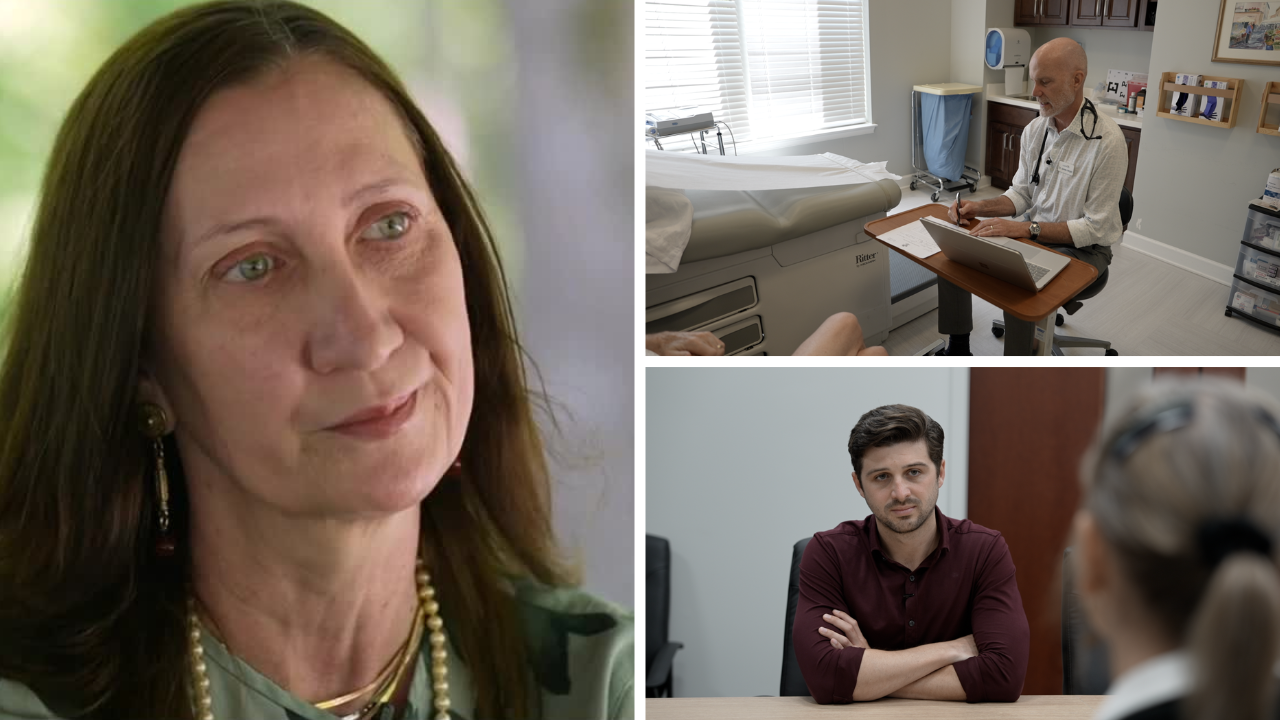


RICHMOND, Va. — When registered nurse Wendy March reported for work at a local nursing home, she was unprepared for what she'd find: a pervasive odor of feces and urine, residents with unkempt appearances, and wounds that she said were in bad shape.
By the time she went home that night, March said she was in tears. Her experience reflects a broader problem across the Commonwealth, where a CBS 6 investigation found that inadequate staffing in nursing homes has pushed healthcare workers beyond their limits and put residents' safety in jeopardy.
'We really have lost our way'
Wendy March said it's hard to believe her nursing career has spanned 25 years.
“I became a nurse because I care about people," she said.
She said the oath she took as a young graduate, to "devote myself to the welfare of those committed to my care," remains a guiding principle.
But her confidence to carry out that mission has been shaken by what she observes in area nursing homes, where she picks up per diem shifts as a registered nurse.
"You see the deficits in staffing, you see the deficits in dietary and in health services, and I just feel like we really have lost our way with the care of the elderly," March said.
She specifically remembers working an evening shift in April at Wonder City Rehabilitation and Nursing Center in Hopewell, a one-out-of-five star for-profit facility according to federal data, that left her in tears.
March said she was so troubled by the conditions that she would never return.
"I saw a shoddy environment, a shoddy building, the overwhelming smell of urine, feces, people that were very unkempt, bad wounds. The dietary tray that came out for dinner was atrocious," March said. "When I got in my car that evening— I didn't leave until around midnight because there was just so much to do— I was crying, Tyler. We can't treat people like this."
Other staff at Wonder City had also raised concerns, according to a health inspection report.
In April, some nurse aides, responsible for daily care like feeding and toileting, walked out of the facility to protest "chronic staffing issues."
Two of those employees, with a combined 61 years of experience there, said they were "tired" of having just two certified nursing assistants caring for 60 residents at a time.
“That's not reasonable at all. I mean, that's a constant merry-go-round right there," March, who was not involved in the walkout, said about the cited staffing ratio.
A staffing coordinator told health inspectors the nursing home was short-staffed 70% of the time between January and April 2026.
Administrative staff reported their requests to bring in more help when staffing was short were denied by corporate management, according to inspectors.
A spokesperson for Wonder City did not return CBS 6's requests for comment. The facility underwent an operator change in June.
Virginia performs worse than most states on federal staffing measures
A nursing home's staffing level is the number one indicator of quality of care, according to long-term care physician Dr. Jim Wright.
"You go below a certain number of hours per day of staffing, you end up with more bed sores, more bladder infections, weight loss, and even increased numbers of deaths," Wright said.
Wright is currently the medical director at the non-profit Lakewood Retirement Community. He was formerly the medical director at the for-profit Canterbury Rehabilitation and Healthcare Center when it was at the center of a deadly COVID-19 outbreak at the start of the pandemic.
“Are you seeing that most facilities are staffing their facilities up to what would be a safe minimum?” reporter Tyler Layne asked.
“Oh, absolutely not. Absolutely not. I've seen, I think the typical practice for Virginia nursing homes, especially the for-profit nursing homes, is to staff as low as possible," Dr. Wright answered.
But industry consultant Melissa Green, who formerly operated facilities and was in charge of the state government office that inspects nursing homes, has a different take.
"I think a lot of them staff at adequate levels. [Are] there folks that staff at levels maybe not up to par? There may be," Green said.
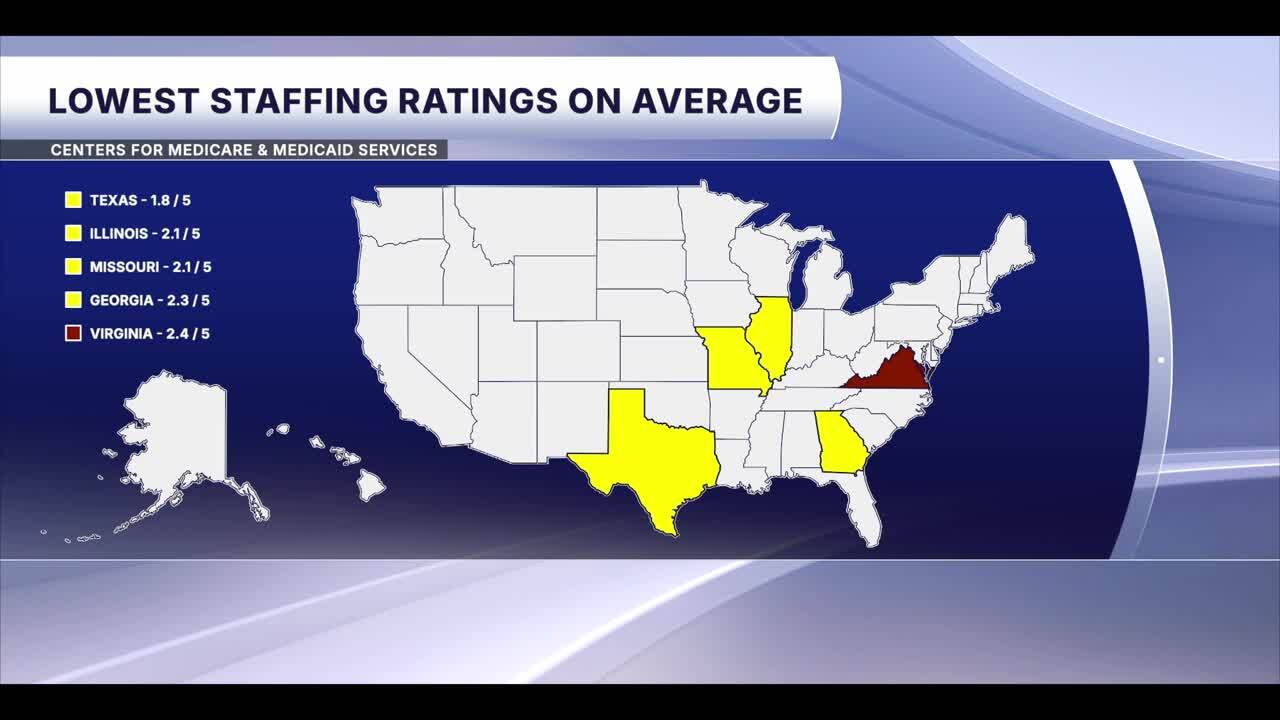
Federal data shows Virginia nursing homes, on average, have one of the lowest staffing ratings in the country — only higher than four other states. The Commonwealth has an average staffing rating, a score based on amounts of staff and rates of turnover, of 2.4-out-of-five-stars.
Virginia's Long-term Care Ombudsman Joani Latimer said of the more than 5,000 complaints her office received in 2025, nearly 40% were tied to staffing-related issues. Latimer's office is responsible for upholding residents' rights in nursing homes and helps resolve disputes between patients and facilities.
She said the most commonly cited category of complaints includes issues like resident falls, lack of response to patient needs, and failures in incontinence care. Insufficient staffing, Latimer said, is a "major driver" of those complaints.
"We have still far too many situations where families and residents are encountering care that is not what it needs to be, it's not what they're expecting, and it's not what I believe that we agreed to deliver when a provider accepts Medicaid and Medicare payments," Latimer said.

Staffing issues have also been a focus of concerns many nursing home residents and their families have shared with CBS 6 over the past two years:
- "There [weren't] enough nurses there." -Family member of a resident
- "You can ring that call bell, and it might be an hour and a half, two hours before they come." -Resident
- "The ratio of nurses to residents— it needs to be done better." -Resident
Inspection reports document patient harms, risks
CBS 6 reviewed Virginia Department of Health (VDH) inspection reports for the 14 facilities that VDH formally cited for having insufficient staffing over the past year and a half. Every single one was a for-profit nursing home. The cited violations ranged from isolated to systemic in scope and varied in severity level.
At Shalom Gardens in Henrico, inspectors said no registered nurse was assigned to care for a resident on the morning of August 14, 2025. The resident received no medications or assessments and was found unresponsive later that afternoon.
Staff pronounced her dead without performing any required life-saving measures, according to an inspection report.
Regulators cited the facility for insufficient staffing at the highest severity level, meaning they determined the violation caused or was likely to cause serious injury or death. Violations cited at this level typically carry the most serious federal penalties.
In response, senior administrator Nathan Libassi said the "issues were not recurring" and that Shalom Garden's staffing level "has been consistently at or above average for the registered nurses and licensed practical nurses."
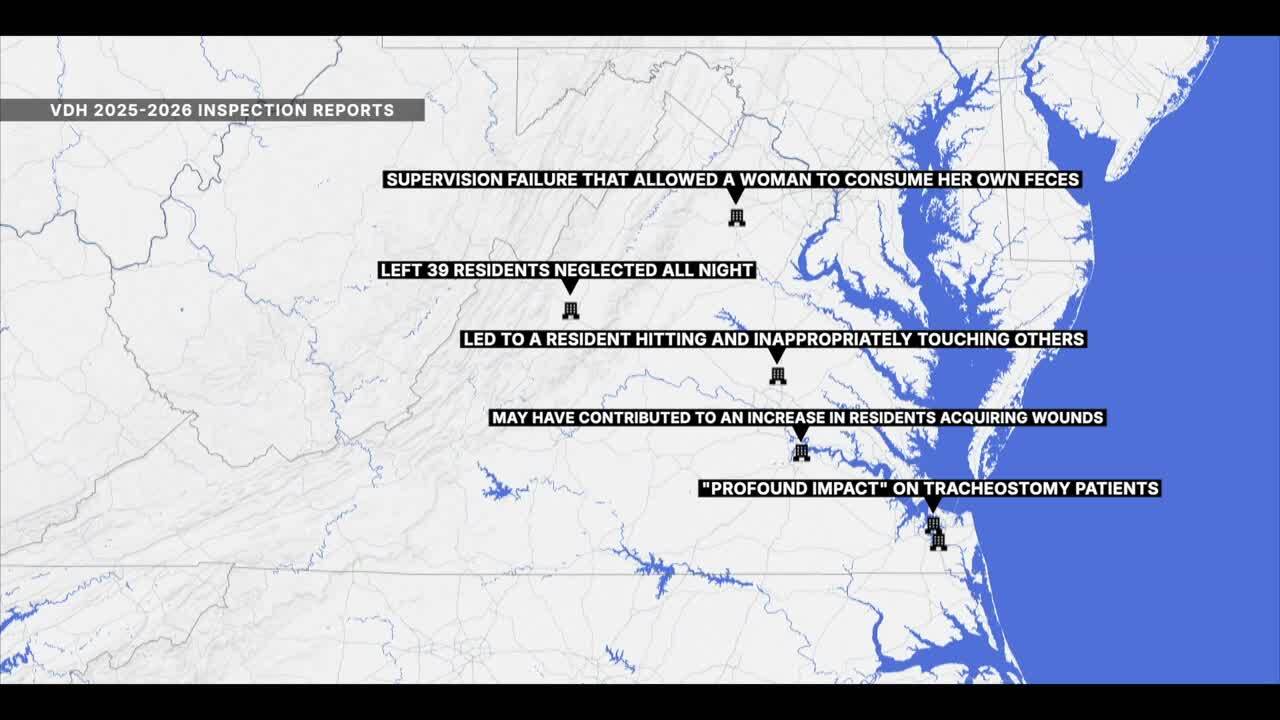
Across the state from Staunton to Chesapeake, VDH inspectors documented in reports that inadequate staffing in various facilities also:
- Left 39 residents neglected all night, some with untreated pain and no medication
- Inspectors said an entire unit operated with no licensed nursing coverage for a 12-hour period.
- May have contributed to an increase in residents acquiring wounds
- Had a "profound impact" on tracheostomy patients, who died, not receiving the proper care
- In the absence of registered nurse coverage, certified nursing assistants reported they were "not always sure" when tracheostomy residents "were exhibiting signs of distress or worsening conditions until the residents were seriously ill.
- Led to "multiple incidents" of a resident hitting and inappropriately touching other residents
- Resulted in a supervision failure that allowed a woman to consume her own feces
- Caused a lack of showers and toileting care for residents
Another facility, according to inspectors, failed to maintain enough staff to provide sleeping hour snacks to residents. Inspectors asked the nursing home's former staffing coordinator if she ever utilized temporary employees from outside staffing agencies. The former staffing coordinator responded that "corporate did not allow her to use agency staff," according to the report.
In interviews with inspectors, nursing home employees were upfront with their limitations and frustrations. On multiple occasions, they described being put in impossible positions to carry out their assignments.
One certified nursing assistant (CNA) said "it was like robbing Peter to Paul" to ensure there's coverage for residents on a secure unit who require one-on-one supervision.
A CNA at another facility stated that "often the residents do not get the care they need because they did not have enough staff to get everything done" which impacts their ability to turn and reposition residents, provide water, and answer call lights. A licensed practical nurse (LPN) at this same facility reported that "staffing is horrible," when asked why a smoking resident was not supervised.
An LPN at another facility said, "we just get burnt out as nurses" when talking about issues at her nursing home of "staffing and callouts."
In all of these instances, inspectors cited violations of a federal regulation that broadly requires nursing homes to maintain adequate staffing levels in order to meet the needs of residents.
But according to Joani Latimer, the absence of a defined minimum staffing requirement at the state and federal levels leaves regulators "hard-pressed at times to call out staffing that would seem to be inadequate" and is an "obstacle to accountability."
Melissa Green said in her experience at VDH, it was difficult for inspectors to capture staffing-related deficiencies. Without a requirement that calls for a specific number of nursing staff hours, she said regulators use complex investigative strategies to cite staffing violations.
“If there's a complaint on staffing, and then you go into the facility to try to correlate that with a deficient practice, that may be challenging," Green said.
No staffing standard in Virginia
Virginia remains in the minority of states without a minimum staffing standard. Latimer and Dr. Wright believe that contributes to patient suffering.
“It’s time for Virginia to get that in place," Latimer said. "I think it's a bottom line protection for all the residents, and it seems based on what we have observed, that without that clear standard, we're not ensuring that foundation for every resident that's in every nursing home.”
“It’s a travesty," Wright said. "I believe if we focus on one thing to improve the care of our residents, if we simply focus on staffing and nothing else, we would see an improvement in quality throughout the entire state.”
Green, however, believes individual facility operators should set their staffing levels based on the needs of their patients.
She adds that operators are struggling with workforce challenges.
"It's very hard for providers to find staffing, even with bonus and incentives," Green said. "There are not a lot of folks that determine that they want to go into long-term care right out of nursing school when they graduate."
A study commissioned by the state legislature in 2021 noted that a "shrinking number" of CNAs and LPNs contributed to nursing home staffing shortages. Since then, Virginia's leading nursing home trade group, the Virginia Health Care Association (VHCA), has said there's been "substantial recovery" in the workforce, but "significant challenges" remain.
But registered nurse Wendy March said the voices of care staff are being left out of the conversation.
“I feel we're not being heard, and I don't quite know if we actually have this nursing shortage everyone's talking about. I think what we have a shortage of is proper management and proper programs to deliver the care that we want to deliver," March said.
During the 2026 legislative session, a proposal to implement a minimum staffing requirement was reduced to directing a study of the topic by the Joint Commission on Health Care. The commission already studied this issue in 2021.
Delegate Rodney Willett (D-Henrico), who proposed the bill, said the outcome was due to a lack of Medicaid funding. But the adopted budget added a one-time $70 million increase to Medicaid reimbursement rates. The additional funding exceeded what a state budget analysis estimated the staffing standard would cost in its first year; however, the VHCA noted a staffing standard would require ongoing additional funding year after year.
Dr. Wright blames the inability for the Commonwealth to establish standards, in his view, on industry lobbyists.
"What the VHCA lobbyists for the for-profit industry have done is to create a perfect gold mine for out of state private equity groups to come in and make millions of dollars off of the back of poor elderly Virginians," Wright said. "While we do another useless study, how many hundreds or thousands of residents will die as a result of understaffing? We just have to remind ourselves that that's what we're choosing here. We're choosing a business model that hurts other people and we're allowing it to continue year after year."
The VHCA did not respond to interview requests for this story.
In a written statement, when asked for a response to Wright's comment, VHCA spokesperson Amy Hewett said the association is "proud to represent a diverse range of long-term care providers including for-profit, non-profit, and government-operated facilities."
She said the group "has been working with the General Assembly for a number of years to develop a commonsense and achievable staffing standard for nursing homes."
Hewett added it is critical that any staffing mandate be funded. The industry has long maintained that Medicaid rates do not fully cover the costs of care.
“I do know that that has been kind of like a spoke in the wheel for a lot of the providers. I have experienced it in some ways, especially rural facilities, their reimbursement is less," Green said.
Latimer said while she has heard those concerns regarding costs, insufficient nursing home staffing may drive up healthcare costs in other ways, such as preventable hospitalizations stemming from inadequate care.
"I think sometimes we fail to look at where the money is going when we don't have enough staff," Latimer said.
March said, for the sake of professionals like herself and the patients they care for, something must change.
“Why is it important for you to speak out?” reporter Tyler Layne asked.
“Because I want to make a difference. I'm sad, I'm tired of hearing it. These are human lives," March said.
CBS 6 is committed to sharing community voices on this important topic. Email your thoughts to the CBS 6 Newsroom.
Share your nursing home stories with the CBS 6 Investigative Team: Email Melissa Hipolit and Tyler Layne

-
Giving You A Voice
-
Your Voice, Your Story
🎙️ WTVR Podcasts
-
Eat It, Virginia! with Scott and Robey
Untold with Catie Beck
-
 Facebook
  TikTok
  YouTube
 Blue Sky
 Instagram
 Threads
 X
X


