


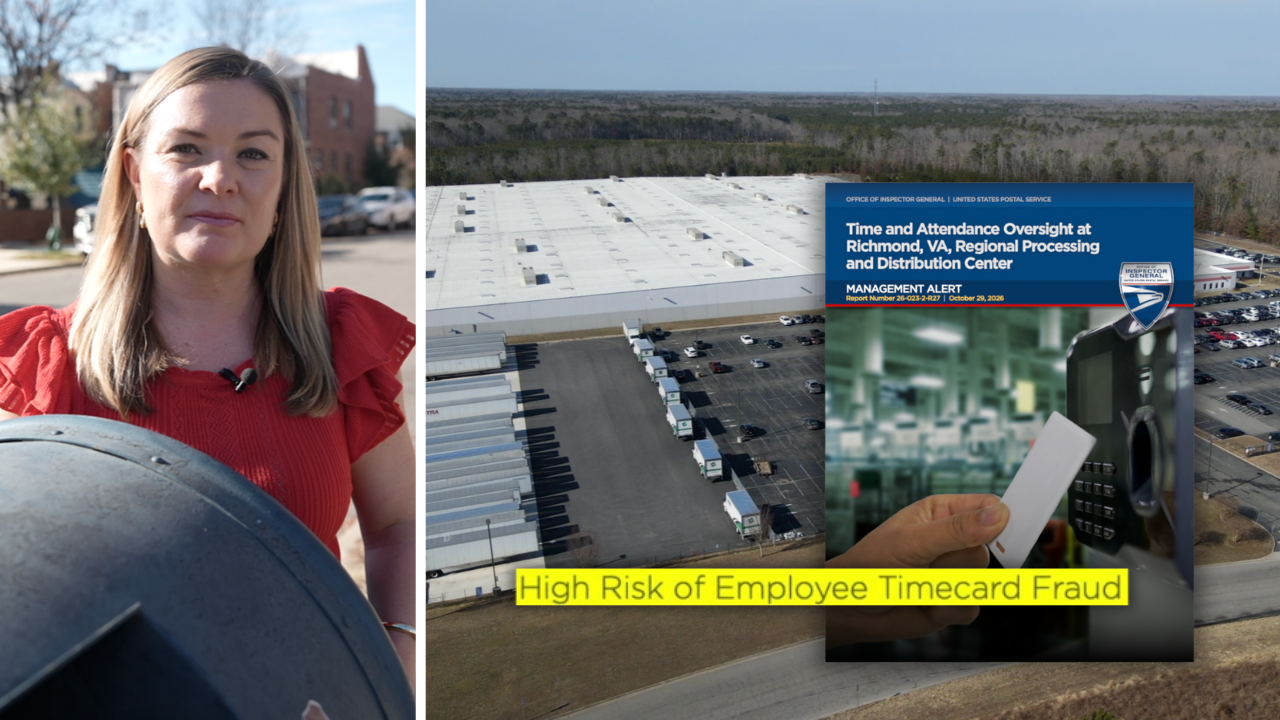


SANDSTON, Va. — Federal auditors found employees at the U.S. Postal Service's Richmond Regional Processing and Distribution Center were paid for nearly 12,000 hours while away from the facility, resulting in almost $430,000 in questioned salaries and benefits.
The findings are part of a new management alert from the U.S. Postal Service Office of Inspector General examining time and attendance oversight at the Sandston processing center.
Auditors compared employee timecard records with electronic records showing when workers entered and exited the facility from Jan. 1 through Aug. 31, 2026.
Of the more than 1,300 employees at the Richmond center, auditors were able to analyze records for 521.
They identified 340 employees, or 65%, who had at least one flagged incident in which they left the building for an hour or more while still on the clock.
The report classified 139 employees as "frequent offenders," meaning they had at least 10 such incidents.
Another 35 were classified as "severe offenders." Those employees were away from the facility for an average of at least an hour and a half while on the clock each day they worked, according to the audit.
Auditors found the 139 frequent and severe offenders left the building for an hour or more 5,017 times across 4,334 work shifts.
After accounting for approved lunch time, auditors determined those employees were paid for 11,867 work hours while away from the facility, totaling $429,973 in questioned salaries and benefits.
The Inspector General characterized the findings as a "high risk of employee timecard fraud."
Audit finds problems concentrated overnight
The problems were particularly prevalent overnight.
The audit found more than 60% of the time and attendance issues occurred late at night during overnight shifts, even though that shift accounted for about 30% of the facility's daily work hours.
Auditors uncovered another concerning pattern: 38 employees were clocked in for 239 shifts even though there was no corresponding electronic badge record showing them entering the facility.
The report said that averaged to about one shift per day and "could indicate that someone other than the employee is recording the time" in the Postal Service's timekeeping system.
In one case detailed in the report, an employee clocked in at 11:34 a.m. and left the facility at 12:57 p.m. without clocking out. The employee did not return for the rest of the shift, according to auditors.
Another employee later clocked that person out at 10:09 p.m.
Six employees admit to timecard fraud
The Inspector General's Office of Investigations focused on the six employees identified as the top offenders.
Investigators interviewed four of them on Sept. 9. According to the report, all four admitted to actions related to timecard fraud.
The other two employees did not report for their scheduled shifts that day. Investigators returned later in September and interviewed them separately. Both also admitted to timecard fraud, according to the report.
All six were removed from duty pending further investigation by Postal Service management.
Audit points to failures in supervision
But the Inspector General found the problem went beyond individual employees.
The report blamed "inadequate supervisory oversight" for failing to prevent or detect employees remaining on the clock while away from the facility.
According to the audit, the plant manager told investigators that "overarching supervision has failed" and said supervisors and managers are required to run reports showing who is on the clock and visually verify those employees are present and working.
The plant manager also told auditors that personal relationships between supervisors and employees could have affected efforts to hold workers accountable for unauthorized absences.
The audit also raises broader concerns about instability in management at the facility.
Since 2020, three plant managers, eight managers of Distribution Operations and 20 supervisors of Distribution Operations have left their positions, according to the report. That count does not include people who served in temporary or acting roles.
The Inspector General noted that when employees are being paid but are not physically present, the effects can extend beyond payroll costs, saying missed work hours can increase costs, delay mail processing, increase workloads for other employees and reduce service reliability.
A facility previously scrutinized over mail delays
CBS 6 has reported extensively on mail delays connected to the Sandston facility.
The facility became the Postal Service's first Regional Processing and Distribution Center in July 2023 as USPS began overhauling its national processing network.
Customers have since told CBS 6 about going days without receiving mail and experiencing delays involving letters, bills and other important items.
The Inspector General has also previously scrutinized operations and service at the Richmond center.
The new audit does not establish that the time and attendance problems identified in this report caused specific mail delays.
USPS agrees with recommendations
The Inspector General made four recommendations, calling on USPS to:
- Enforce attendance checks for employees who are clocked in and take administrative action when employees are not present.
- Hold plant managers and supervisors accountable for monitoring employee time and attendance.
- Develop an effective way for managers to use timecards, building-access records, cameras and other tools to identify attendance problems.
- Stabilize leadership and management retention at the Richmond processing center.
Postal Service management agreed with the findings, all four recommendations and the $429,973 monetary impact.
USPS set a target date of Aug. 31, 2027, to implement the recommendations.
The Inspector General called that timeline "excessive," saying some of the corrective actions involve basic supervisory oversight and enforcement that could be implemented sooner.
The report noted one indication that intervention is already having an effect: in the month following the audit's review, the number of hours employees were clocked in but outside the facility dropped by 65%.
Watch Melissa Hipolit's reporting on CBS 6 and WTVR.com. Have something for Melissa to investigate? Email her.

-
-
Eat It, Virginia! with Scott and RobeyUntold with Catie Beck
-
-
-
This story was initially reported by a journalist and has been converted to this platform with the assistance of AI. Our editorial team verifies all reporting on all platforms for fairness and accuracy. To learn more about how we use AI in our newsroom, click here.
 Facebook
 TikTok
 YouTube
 Blue Sky
 Instagram
 Threads
 X

