


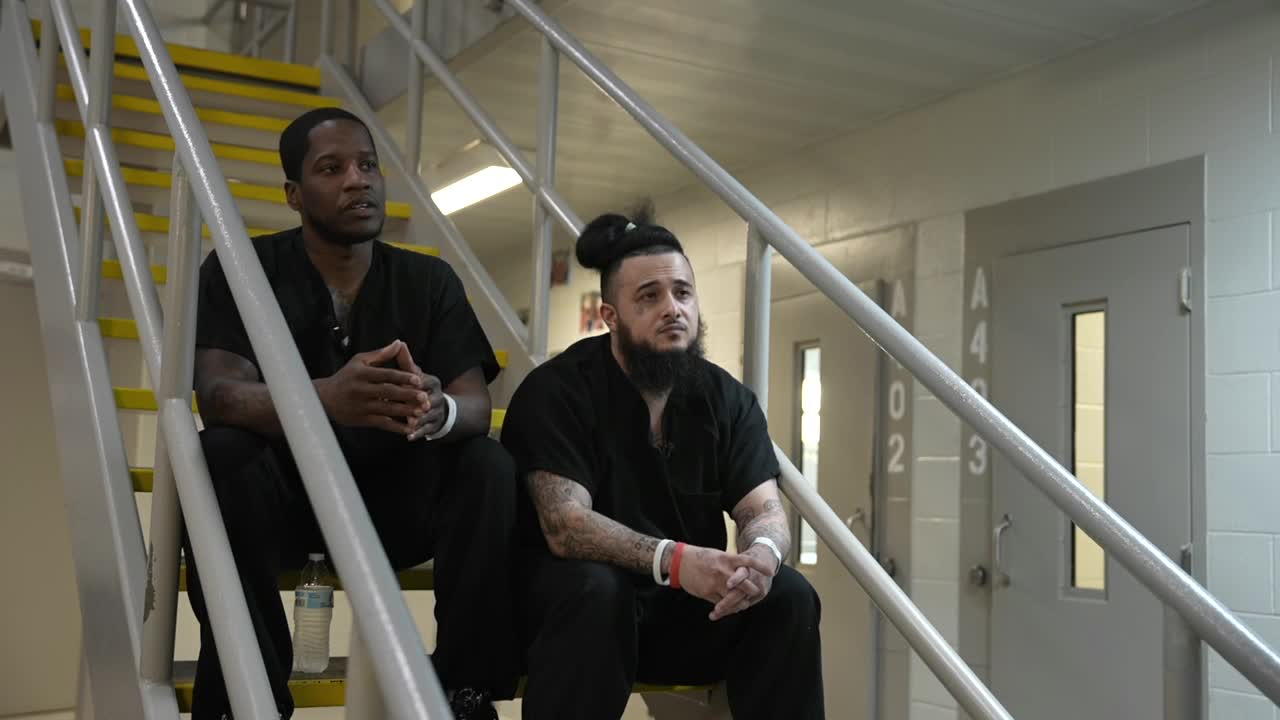


CHESTERFIELD COUNTY, Va. — "Who can explain to them what these pictures on the wall represent to you all?" Chesterfield County Sheriff Karl Leonard asked the more than 70 inmates gathered in a day room at the Chesterfield County Jail last week.
It seemed like just another day at the jail where two visitors were there to learn more about the groundbreaking addiction program called HARP.
"The pictures on the wall are former alumni that were part of HARP and unfortunately passed away by using on the outside," said one inmate. "My uncle is actually on the wall right here. His picture looking at me every day is a reminder: I got to do something different. I got to get it right."
HARP, or Helping Addicts Recover Progressively, began a decade ago out of necessity.
"By early 2016, we were seeing 20 to 25 people being brought into our jail every day where their underlying issue was heroin addiction," Leonard explained. "I realized I was doing them a disservice, because all I was releasing from jail after they served their sentence was a sober or clean addict, but an addict nonetheless."

So how does the HARP program engender trust among inmates?
"We stand in a gap because people die in those gaps," said jail therapist Kerri Rhodes. "And we've been able to create just really innovative things. I think in mental health we've missed the boat for a long time. We've tried to have people talk and think their way out. You heard one inmate say, "I'm a big feeler." They're all big feelers in here. They have beautiful hearts, which is why they have to numb themselves when the feelings are bigger than what they have the capacity to deal with."
Rhodes, whose title is Director of Behavioral and Mental Health in the Chesterfield County Jail and the HARP program, says inmates feel comfortable sharing those feelings, even with visitors.
"Being able to be in a place where you feel safe to actually open up and share everything that you've been feeling, leads to healing, " said an inmate.
That revelation a decade ago was the start of Sheriff Leonard's experiment which he and Rhodes call an ongoing work in progress.
With group sharing sessions, telling stories through music and art, therapies such as tapping, and civilian visits from former inmates, HARP removes many of the barriers between inmates, between inmates and jail staff, and between inmates and the outside community.
To call it unconventional is an understatement. More like convention-busting.
Through social media, their efforts caught the attention of Jason DeFord, also known as country star Jelly Roll, who has visited the jail several times.
During one visit, four inmates sang one of his songs while DeFord sat in the audience.
The music star, who battled addiction and incarceration himself, later invited those four inmates to join him on stage for a concert in Charlottesville.
A lyric from a song that night had special resonance for everyone on that stage: "Nobody walks through these doors on a winning streak."
That moment - on a stage in front of a packed arena with one of music's biggest stars- would be the experience of a lifetime for anyone; for active inmates, it was an impossibility that could only happen through the innovative, taboo-busting nature of HARP.
And a sheriff willing to experiment.
"A lot of these folks have never had hope in their life," said Leonard. "They never had an opportunity to even find hope. So what we found is, if you can plant that seed of hope, it grows exponentially within them."
"The program, it means hope," said inmate Craig Fordham. "It's that love and the grace that the sheriff showed by starting the program, by caring about people. The staff that he got with him, by them caring about people. That's what will bring about the saving. Before I ever heard of HARP, I never even knew I wanted to change."
"He's just open to us, and I'm very grateful for that because not a lot of people, especially other prisons or jails that I've been to, people don't do that," said inmate Amin Wright, talking about the sheriff.
For Leonard the results have been stark.
"This is beyond anything we can even have imagined," said Leonard. "There was no plan for this. The national average of recidivism in this country is about 75%. In Chesterfield County, our recidivism rate is 18%. 18%. Those are thousands of lives being saved in here, becoming productive members of our community out there, and not coming through that revolving door anymore. It costs $46,000 a year to house one inmate for a year. When you start having a recidivism rate of 18% and they're not coming back, the cost savings to my taxpayers in Chesterfield is in the millions of dollars."
It turned out this day, with two visitors walking among the inmates, was unusual because the inmates led by Rhodes, were off to the movies - sort of.
They were getting a preview of a documentary featuring the HARP program and some of their fellow inmates, that will premiere Tuesday at Richmond's Byrd Theatre.

Rhodes explained to the inmates what they were about to see.
"The movie's called 'What it Takes,' and it's about what addiction takes from you; it's what addiction takes from your family, what it takes to get yourself out and what it takes to hold your recovery," said Rhodes.
For the documentary director, the subject was personal.
"I have somebody I care about that suffers from addiction and seeing that, I felt hopeless," said Jeff Shulman. "I felt guilty. I felt alone. Like, how, how could this happen? I must be the only one."
Shulman, a professor at the University of Washington, says addiction doesn't discriminate, as even those with seemingly every advantage can find themselves at a loss in trying to help a loved one.
"My dream is that I could get this person to see the movie and to admit that they have a problem and want to find a better way forward," said Shulman. "But if that doesn't happen, I hope that anybody who's feeling like I'm feeling, or anybody that's going through the addiction themselves, that they know and see recovery is possible. That's the real vision of this film: to show people that recovery is possible and it's worth striving for."
As the film played in a semi-darkened room on a giant flat screen TV, inmates heard some rather grim admissions.
"Pretty much rolling the dice on leaving it up to chance on whether I was going to wake up," said one inmate no longer at the jail.
"I had some traumatic experiences that happened and I went back to my coping mechanism, alcohol," said Fordham.
Fordham and Wright were among the inmates featured in "What it Takes." They said seeing themselves on screen reminded them how far they've come and how long the road ahead remains.

"It was emotional, you know. I tried to hold in a lot, but just seeing myself and just reminiscing about everything that happened in our journey from when I got incarcerated until now," said Wright. "I've seen a lot of growth with the help of my brothers here in the program and the staff. And it's always going to be a journey for the rest of my life."
As for their star turn at the John Paul Jones Arena in Charlottesville, Wright said it humbled them and would add to their determination to stay sober.
"Jelly Roll is the definition of being victorious," Wright said. "Coming from where we all come from, being in the same situation— drugs, incarceration-- and hearing his story when I met him was amazing. For him to just give us a moment of his time on his platform and on his stage was just a blessing, honestly. It was a dream come true. I still get high off just thinking about it. It's probably one of the best moments of my life ever."
"You can't — you don't recover alone," said Fordham. "I seen myself up there, I seen the response from the guys around me. The messages, it was empowering."
"I know they saw themselves. I know they saw their families, and the pain that their addictions caused," Rhodes said. "They have a lot of shame, and a lot of guilt about the pain that their addictions caused the people that they love the most. Part of their work here is learning to hold that, learning to make amends and forgive themselves and ask for forgiveness from the people that love them."
Rhodes, who lost her 20-year-old son Taylor in 2019 to addiction and accidental overdose, said she, like director Shulman, had felt helpless in trying to keep her loved one safe, and she was a therapist.

She said her journey from personal tragedy through the development of the HARP program has focused her life's mission: seeing inmates stay clean after their release.
For her, that offers far more validation than a movie ever could.
"I need it to matter," she said. "I need Taylor's life and our struggle to matter. HARP gives me a place to do that every day. And that's not nothing. As far as healing, there's no fix for what happened to me. There's no fix for what's happened to a lot of the inmates. But I always think the last stage of healing is when you use the terrible things that happen to you to help other people. And I get paid to do it. I love what I do. I say all the time, I'd do it for nothing. If I could afford to do it for nothing, I'd do it for nothing. I love them. I love being in here."
Leonard points out that HARP is a journey that in many ways even the longer-term inmates have just begun.
"They're not going to be left to go out here on their own, and fend for themselves," said Leonard. "They know they got a huge support group waiting out there for them."
"What it Takes" premieres Tuesday, April 28 at 6 p.m. at the Byrd Theatre.
Tickets are $9.99 and can be purchased here. Part of the proceeds will benefit HARP RVA.
This is a developing story. Email the CBS 6 Newsroom if you have additional information to share.
CBS 6 is committed to sharing community voices on this important topic. Email your thoughts to the CBS 6 Newsroom.
📲: CONNECT WITH US
Blue Sky | Facebook | Instagram | X | Threads | TikTok | YouTube

This story was initially reported by a journalist and has been converted to this platform with the assistance of AI. Our editorial team verifies all reporting on all platforms for fairness and accuracy. To learn more about how we use AI in our newsroom, click here.

