


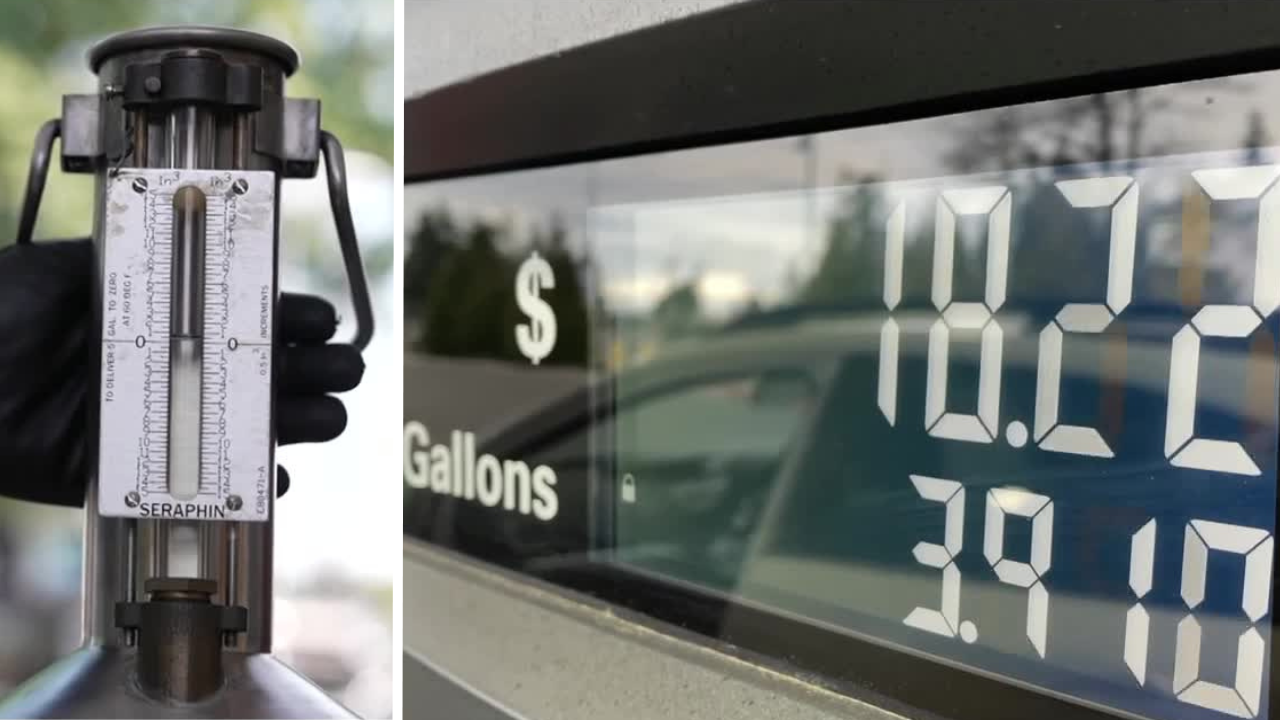


RICHMOND, Va. — When you fill up at the gas station, how much thought do you give to whether the price on the pump display matches what you're actually getting?
"I really never think about like if what the gas I'm getting equals the amount that it should be based on the price," a customer named Terry told CBS 6.
That's where the Virginia Department of Agriculture and Consumer Services steps in.
Anthony Ramsey leads the agency's Office of Weights and Measures. His team of 23 is responsible for inspecting all 109,000 gas station meters in the state.
"We do test the pump in the most like consumer experience possible, because we're here for the consumer," Ramsey said.
CBS 6 followed one crew as they investigated for pump problems, starting with a check of the inside wiring.
"Make sure there's no skimmers or any Bluetooth devices that would be in a way for fraud, deception devices, anything like that," Ramsey said during the inspection.
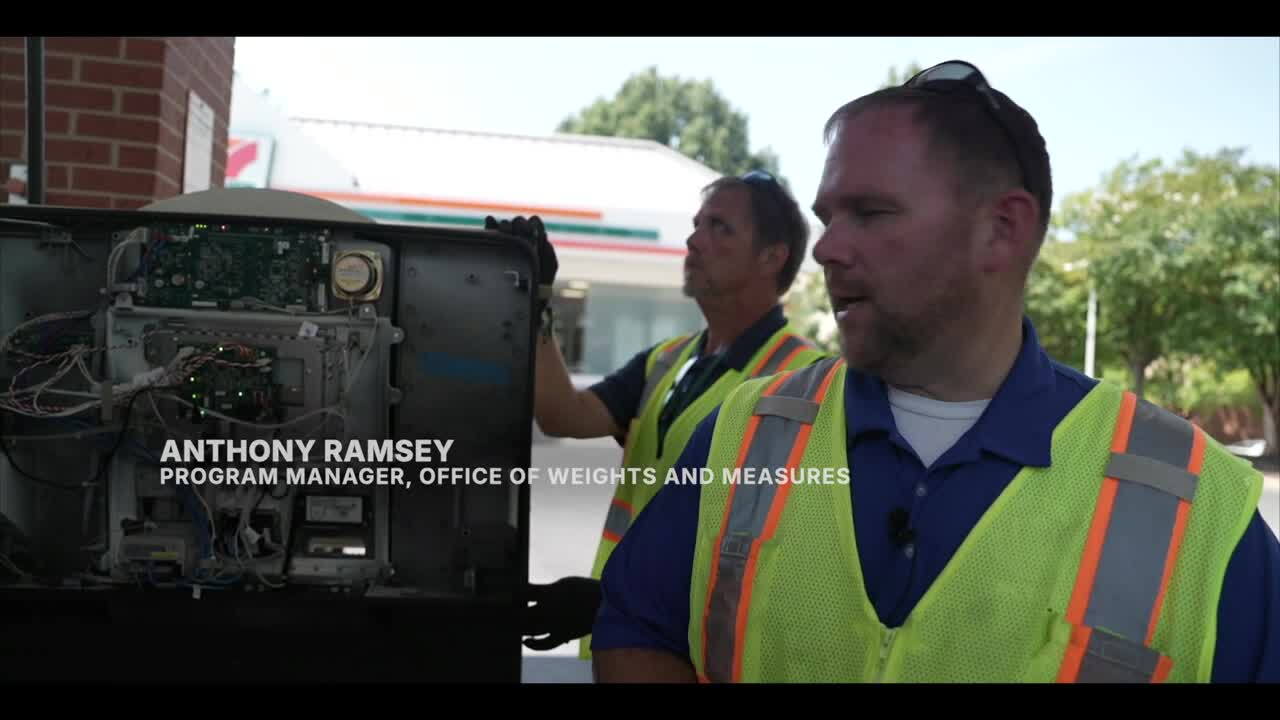
Inspectors then conducted a safety scan of the exterior before running a 5-gallon test to ensure customers get every drop they pay for.
During one test, inspectors measured what they called a "plus two cubic inch" result, meaning the dispenser was giving customers slightly more gas than what it charged — by a few pennies. Because the error was so small, it did not rise to the level of a violation.
But CBS 6 found cases, through a Freedom of Information Act request, where the problems were more serious, including three that resulted in enforcement letters the state sent some gas stations in March.
A BP on Eltham Road in Lanexa was cited for water contamination in the fuel, which caused the state to stop sales at the gas station until the problem was resolved. Records showed this same location had already been cited for water contamination in 2025.
A 7-Eleven Exxon on W. Hundred Road in Chester was cited for charging $2.79 at the pump, even though the street sign advertised $2.32.
A Wawa on South Shore Point Drive in Midlothian was flagged for a minus 64 cubic inch error on a diesel pump — an error that would equate to a customer overpaying about $1 on 5 gallons.
"That would really bother me, especially Wawa, because that's one of the places I will stop if I'm not in my regular neighborhood," Terry said.
Ramsey said the Wawa error was so significant it did not even register on inspectors' initial test.
"So it was so far out of tolerance that we went to a secondary kind of method. Regardless, it's condemned. It's shorting the customer," Ramsey said.
CBS 6 attempted to reach all three gas stations for comment but only heard back from Wawa, which said it took "immediate action" to fix the pump and had it back in working order that same day.
The state confirmed all three made the required corrections.
Only the BP case resulted in a fine — $500.
"How often do you find it where the state is having to impose a penalty?" CBS 6 asked Ramsey.
"Based on the number of inspections that we have, very few. The station owners do want to comply, and they want the ability to continue fair trade and be marketable to the consumers," Ramsey said.
CBS 6 also reviewed inspection reports from May, which showed state inspectors condemned pumps for calibration inaccuracies in both directions.
Each cubic inch of a calibration error equates to about a penny and a half of money on five gallons of gas, if the price of gas was $4.00 per gallon, according to Ramsey.
At Market Place Cafe on Nuckols Road in Glen Allen, inspectors found errors ranging from minus 13 to minus 32 cubic inches on one dispenser. That equates to the customer getting shorted by about 19 cents and 48 cents.
At the Sheetz on East Hundred Road in Chester, inspectors found a minus 12 and a minus 14. That equates to the customer getting shorted by about 18 cents and 21 cents.
At Goldy's on West Broad Street in Richmond, inspectors found a "plus 14" error — meaning the gas station, not the customer, lost out.
CBS 6 reached out to all three companies. All said they fixed the cited issues. Sheetz added that it "continues to conduct its own follow-up inspection of" its dispensers.
Overall, Ramsey said most inspections conclude without major issues.
"A lot of the gas stations are well taken care of," Ramsey said.
For customers like Terry — already frustrated with rising gas prices — the last thing she wants is to worry about being cheated.
"It's the worst, right? I want to trust who I'm buying my gas from," Terry said.
The next time you're at the gas station, look for an inspection sticker on the pump, which will indicate whether the dispenser passed inspection and when.
Pumps are required to be inspected every two years.
If you suspect a problem at the pump, you can file a complaint by calling the Office of Weights and Measures at 804-786-2476.
CBS 6 is committed to sharing community voices on this important topic. Email your thoughts to the CBS 6 Newsroom.
-
-
Eat It, Virginia! with Scott and RobeyUntold with Catie Beck
-
-
-
This story was initially reported by a journalist and has been converted to this platform with the assistance of AI. Our editorial team verifies all reporting on all platforms for fairness and accuracy. To learn more about how we use AI in our newsroom, click here.
 Facebook
  TikTok
  YouTube
 Blue Sky
 Instagram
 Threads
 X
X
