


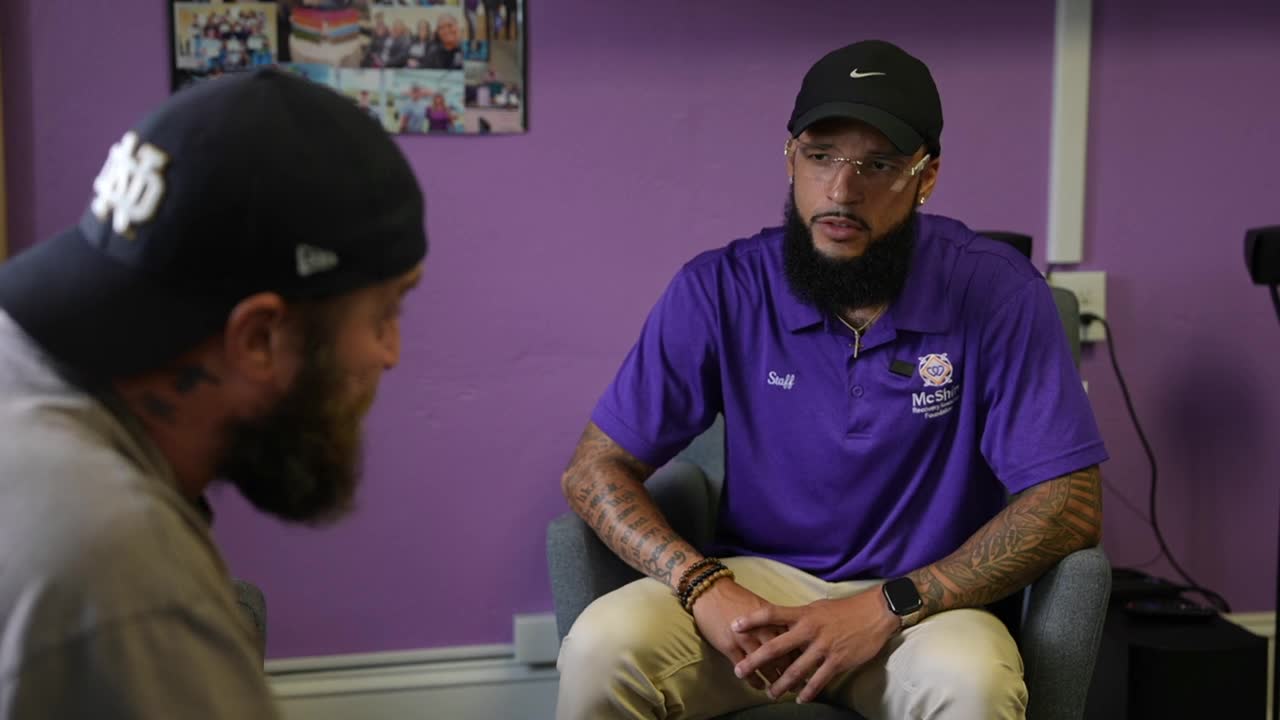


RICHMOND, Va. — A peer recovery specialist at the McShin Foundation on Dumbarton Road in Richmond is helping others find sobriety — and his path to that work began with a crash that killed a young mother.
On November 26, 2016, the day after Thanksgiving, Tory Branch was driving along Route 15 in Buckingham County to visit a friend. He had been drinking, passed out behind the wheel and hit another car head-on.
Nineteen-year-old Shelly Warner was in that car with her husband and their 1-year-old son, Timothy. She died at the scene. Her husband and son were also seriously injured.
Branch was airlifted to UVA.
"They were hooking my IV up and one guy looked at me when I opened my eyes and he said, I'm Tory Branch, and I just looked at him because I was still kind of confused. It just felt like a bad dream and he said, you realize you killed somebody tonight," Branch said. "I didn't know. You know, I just looked at him and I went back out. I went back into shock."
Three months after the crash, Branch was charged with involuntary DUI manslaughter. Nearly a year later, he rejected a plea deal.
"I didn't take it, and I just said that I plead guilty and I would like the judge to sentence me," Branch said.
He also asked to take the stand to speak directly to Warner's family.
"I wanted to be as genuine as possible, but what do you say? And you're the cause of that. I went up and you know, I looked at him and I said, 'I'm sorry, I apologize and if I could trade places I would, if I could go back and it was me, I would do that,'" Branch said.
Branch received a 12.5-year prison sentence, spending the majority of his 20s behind bars away from his family and friends in the small town of Burkeville.
The day he reported to prison, he promised himself he would never use drugs or alcohol again.
"I have to change. Like this is my breaking point, you know, not only for me, but to honor the life that was lost in the accident," Branch said.
"It's not fair to her if, if, if I keep going on like I'm going. I want people to say when I come home that prison was the best thing that happened to me," Branch said.
His commitment was noticed by those around him.
"Another inmate, they would come up to us and say, Excuse me, I just wanted to tell you that what a light he is in here and just it's always so positive and uplifting," another person said.
In his final 2 years, Branch was transferred to Indian Creek, a therapeutic drug community. He was initially in denial that he needed help, having been clean for six years, and was hesitant to participate in group sessions. That changed when the topic of grief came up and he decided to share his story.
"After I told my story, this guy came to me after the group and he said, 'Tory, can I talk to you?' And I was like, 'Yeah,'" Branch said.
"He said, 'A drunk driver killed my son,'" Branch said.
"I didn't know what to say because I didn't know if he was coming from a negative standpoint and he was gonna say I hate people like you or if he was, I, I didn't know. I, I didn't know how that could be positive, you know, so I was listening to him and he said, you know, I've never forgiven the guy who killed my son, he said, but if I knew that he was telling the story and just shedding light on it and maybe preventing it from happening to somebody else, he said, I think I would be able to forgive him a little bit more," Branch said.
That conversation inspired Branch to seek training to become a peer mentor. While still incarcerated, he earned the state certification to become a peer recovery specialist.
Catina Macklin, the cognitive program manager for the Department of Corrections, has worked with inmates like Branch for almost 20 years.
"That's the joy of this work, hearing and witnessing people like Mr. Branch, you know, he exemplifies servanthood," Macklin said.
"It's a great example that if you, you put in the work and you stay committed and utilize your resources, right, there is hope. I can do that too," Macklin said.
Since his release from prison in September 2025, Branch has returned to the jails he once called home to share his story.
"I didn't forget about them because they need a voice too. It's a lot of people in prison who are just like me. They made a mistake. And they've really changed in there. And they're just looking for a second chance," Branch said.
Now working at the McShin Foundation, Branch coaches clients through the steps to recovery — including Robert Russell, who recently marked 30 days sober.
"That's what recovery is. Recovery is freedom, man. You've got that control back now. Tory's an amazing coach. I couldn't put a value on it," Russell said.
Branch said he still thinks about Warner and the family she left behind.
"I just hope they can forgive me. And I just hope that I'm doing it any kind of justice," Branch said.
Warner's parents said they have chosen to forgive Branch, but they haven't forgotten and are still mourning the loss of their daughter.
Branch urges anyone struggling with addiction to seek help before it's too late.
"I would say not to get a case of it yet like you haven't done it. Tomorrow is never promised, and your life and somebody else's life can change or even be taken," Branch said.
Branch has also started his own transformational speaking organization, where he hopes to show others that one bad decision should not define their future.
"You aren't defined by your mistakes," Branch said.
CBS 6 is committed to sharing community voices on this important topic. Email your thoughts to the CBS 6 Newsroom.
Watch for Caroline Coleburn's reporting on CBS 6 and WTVR.com. Have a story idea or tip for Caroline Email her.

-
Giving You A Voice
-
Your Voice, Your Story
🎙️ WTVR Podcasts
-
Eat It, Virginia! with Scott and Robey
Untold with Catie Beck
This story was initially reported by a journalist and has been converted to this platform with the assistance of AI. Our editorial team verifies all reporting on all platforms for fairness and accuracy. To learn more about how we use AI in our newsroom, click here.
-
 Facebook
  TikTok
  YouTube
 Blue Sky
 Instagram
 Threads
 X
X

