


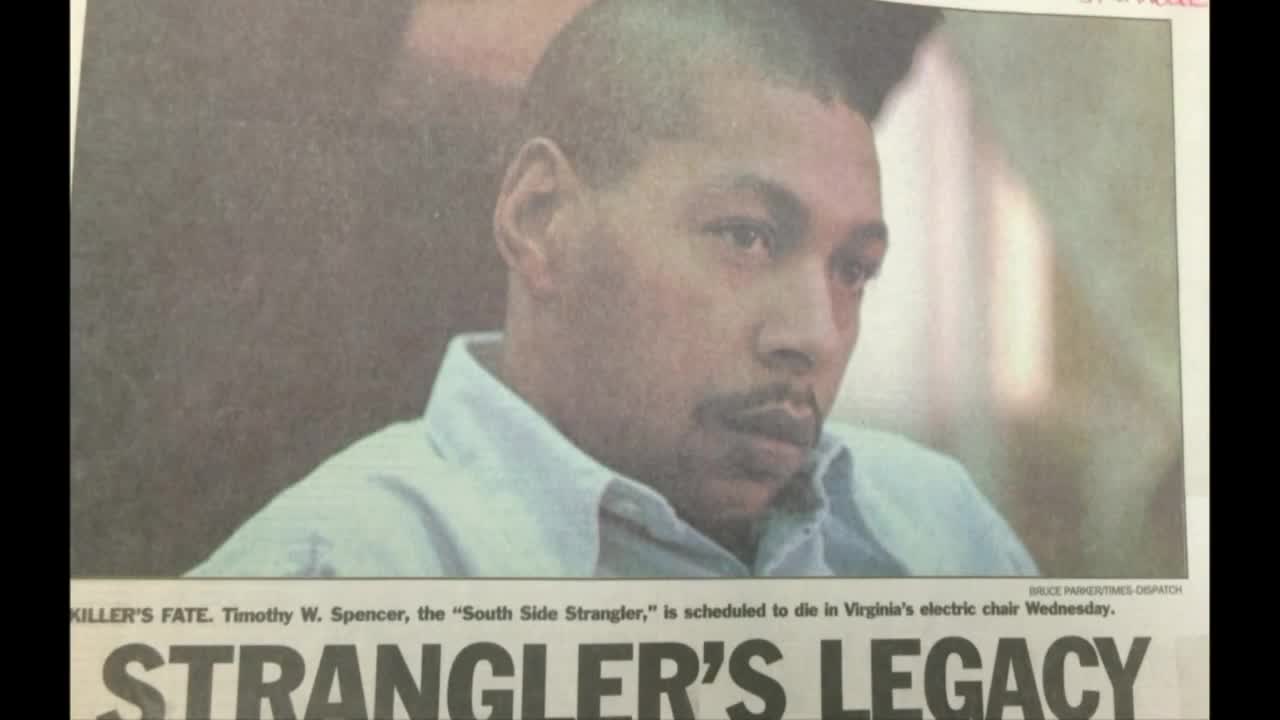

RICHMOND, Va. -- The serial rapist and murderer who terrorized Richmond for a year was convicted and sentenced to death — and in doing so, changed the way crimes are solved across the United States.
Timothy Spencer, known as the Southside Strangler, committed a series of rapes and murders across Central Virginia in 1987 before being captured in Arlington, Virginia, where he also killed a woman.
One year later, he was convicted of capital murder in what became the first capital murder case in the United States to be successfully prosecuted on the basis of DNA evidence.
Spencer was executed in 1994, showing no remorse.
But the case he left behind helped build a legal and scientific framework that has since helped catch countless rapists and murderers — and clear many others wrongfully accused.
Watch: Neighbors meet at a Forest Hill apartment complex in Oct.1987 to discuss fears about the Southside Strangler
In September 1987, Spencer first struck near Forest Hill Park in Richmond, raping, torturing, and murdering 35-year-old Debbie Davis in her Devonshire Road apartment.
Two weeks later, Dr. Susan Hellams, 32, suffered the same fate in her home nearby on West 31st Street.
The following month, 15-year-old Diane Cho was raped and strangled to death in her family's Chesterfield County apartment on Gavilan Court.
Richmond was gripped by fear. People stayed home, locked their doors, and got dogs from the pound.
Criminal profilers were certain the ghost-like serial killer was a local white man.
Police ran down every lead but came up empty.
"It was so random and it was so illogical," Richmond attorney David Baugh said.
Four days after Cho's murder, 44-year-old Susan Tucker was raped and murdered in her Arlington, Virginia apartment.
The detective who caught that case, Joe Horgas, was able to link it to a series of unsolved rape cases involving a Black suspect who tortured his victims but did not kill them.
"As soon as you look at the crime scene photos and everything, it sticks out," Horgas said.
He was convinced Richmond's cases were the same man's work.
He pushed to have the evidence tested using DNA technology that was emerging at the time and asked Timothy Spencer, an Arlington burglar then serving out the rest of his sentence in a South Richmond halfway house, for a sample.
Spencer agreed.
At the same time, members of the Virginia General Assembly were debating whether the state should establish a DNA database.
It was a really complicated thing back then. Nobody really understood it that well.
Then news broke that a Northern Virginia lab had matched all the Strangler cases and pinned them on Spencer.
That breakthrough came just as Dr. Paul Ferrara, director of the state forensic lab, was working to convince legislators to write the laws that would make a DNA database, and the collection of samples from violent felons, legal.
Ferrara was convinced a DNA database would revolutionize crime fighting, catching and convicting violent criminals while clearing innocent suspects.
"While controversial at the time, it was such a no-brainer in terms of what it could do from an investigative lead," Ferrara, who passed away in 2011, said in a previous interview on the topic.
He not only had to convince legislators to write groundbreaking new laws, he also needed funding.
The arrest of the Southside Strangler broke down any remaining resistance.
"It wasn't a question of whether it was going to be funded, but are you sure this is enough to get you started?" Pete Marone, the director of the Virginia Department of Forensic Science said in a 2012 interview.
Virginia's success quickly spread across the country. Cold hits kept coming, snaring rapists and murderers and clearing a growing list of those wrongfully accused.
Spencer's victims did not die in vain.

