


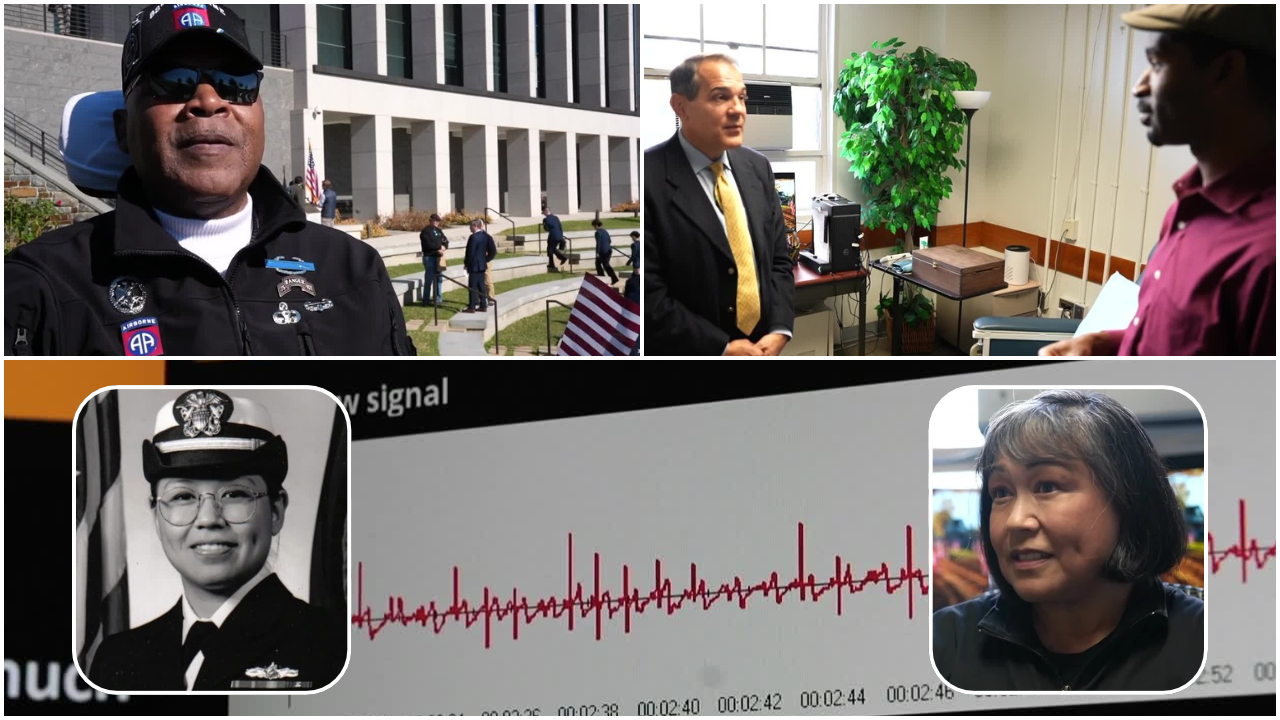


RICHMOND, Va. — Researchers at Virginia Commonwealth University are studying whether breathing exercises could help ease the long-term effects of concussions in veterans, and they are recruiting local service members to take part.
The effort, called the Hero Study, is exploring whether guided breathing can shift a body coping with concussion symptoms into a healing state.
Edward Barlow, an 82nd Airborne Division veteran, is proud of his 20 years of military service. But he said he is still living with its physical toll today.
"You learn how to parachute landing fall, you learn how to jump out of an airplane, you learn how to react," Barlow said.
Barlow said years of hard landings took a lasting toll on his health.
"Your parachute takes you fast and you land pretty hard. Numerous amounts of concussions, which led to Parkinson's, head injuries, and I'm being seen at the VA right now," Barlow said.
Raouf Gharbo, VCU's director of autonomic rehabilitation, said many veterans are struggling with the aftereffects of service.
"They are in need, they are struggling in their transition after these health and emotional difficulties, and we're looking for veterans and service members in the area to participate," Gharbo said.
The study measures how concussions affect the body, including heart rate, respiration and hand temperature. The goal is to move those measurements toward a healthier state through breathing exercises.
Gharbo said the body has a natural ability to recover.
"The brain and the body have an amazing ability to repair and recover, and this is a way for people to learn how to do it with a very, very specific breathing skill," Gharbo said. "How to shift your body into a healing state, until over time you can create a healing state as opposed to an unhealthy state."
Jennifer Weggen, a Navy veteran and VCU clinical research scientist, said the study looks at a range of possible improvements.
"We're looking for changes like that, as well as things like do they improve their sleep, is their pain lowered, do they feel less fatigued?" Weggen said.
Weggen said one benefit of the study is that it does not require intrusive procedures or medications, relying instead on the body's ability to heal through learned physical exercises.
"What we're trying to do is find a very effective and helpful way that can address not just their concussion symptoms that they may be worried about, but other parts of their lives that they may not realize are related to their concussions," Weggen said.
The study began in 2024 and is actively recruiting veterans to participate over the next several months.
Barlow said he hopes the research opens the door to alternative treatments for veterans like him.
"Less pills, more studies, more programs is what we need," Barlow said.
Gharbo said he believes the approach could be a turning point.
"I do think this is the starting point for health trajectory change in a safe, evidence-based method that promotes your own healing," Gharbo said.
For Weggen, the work is personal.
"This is who we're doing this for," Weggen said. "I think that is something that should resonate with service members."
Veterans who are dealing with the long-term effects of a concussion and want to learn more about the study can find information through VCU.
Watch for A.J. Nwoko's reporting on CBS 6 and WTVR.com. Have a story idea or tip for A.J.? Email him.

-
-
Eat It, Virginia! with Scott and RobeyUntold with Catie Beck
-
-
-
This story was initially reported by a journalist and has been converted to this platform with the assistance of AI. Our editorial team verifies all reporting on all platforms for fairness and accuracy. To learn more about how we use AI in our newsroom, click here.
 Facebook
 TikTok
 YouTube
 Blue Sky
 Instagram
 Threads
 X
