




RICHMOND, Va. — The Virginia Department of Health (VDH) has not answered questions about how much money it erroneously overbilled a pharmaceutical manufacturer and may have to pay back, despite the issue triggering significant cuts to HIV services for low-income Virginians. CBS 6 submitted a public records request in an effort to obtain that information, but the agency's response revealed little.
Some clinic directors across the commonwealth, like at the Health Brigade in Richmond, said they've had to greatly scale back emergency and support services — such as housing, food, and transportation assistance — to patients with HIV due to funding reductions under the Ryan White Part B program. The federal program, managed by VDH, pays for medical care and other services for people with HIV who are poor, uninsured, or underinsured — when no other funding source is available.
“When that news came, and came suddenly, it was devastating," said Karen Legato, executive director of Health Brigade. "You go into a crisis mode at that point.”
Other providers, like the LGBT Life Center in Hampton Roads, lost all of their funding and were completely removed from the program. The organization's director Stacie Walls said that left dozens of the center's clients in a gap as her staff worked to get them reconnected to continued care.
“I think that we suffered, but I think the real reality of it is the community suffered," Walls said.
Feb. 2025 letter reveals a requested repayment
Ryan White Part B is funded by two main sources: federal grants and rebates that VDH receives from drug makers. While the amount in federal grants did not change much year over year, there was a significant drop in rebates, and that's what caused a reduction in program funding and triggered the cuts that Legato, Walls, and many other providers experienced.
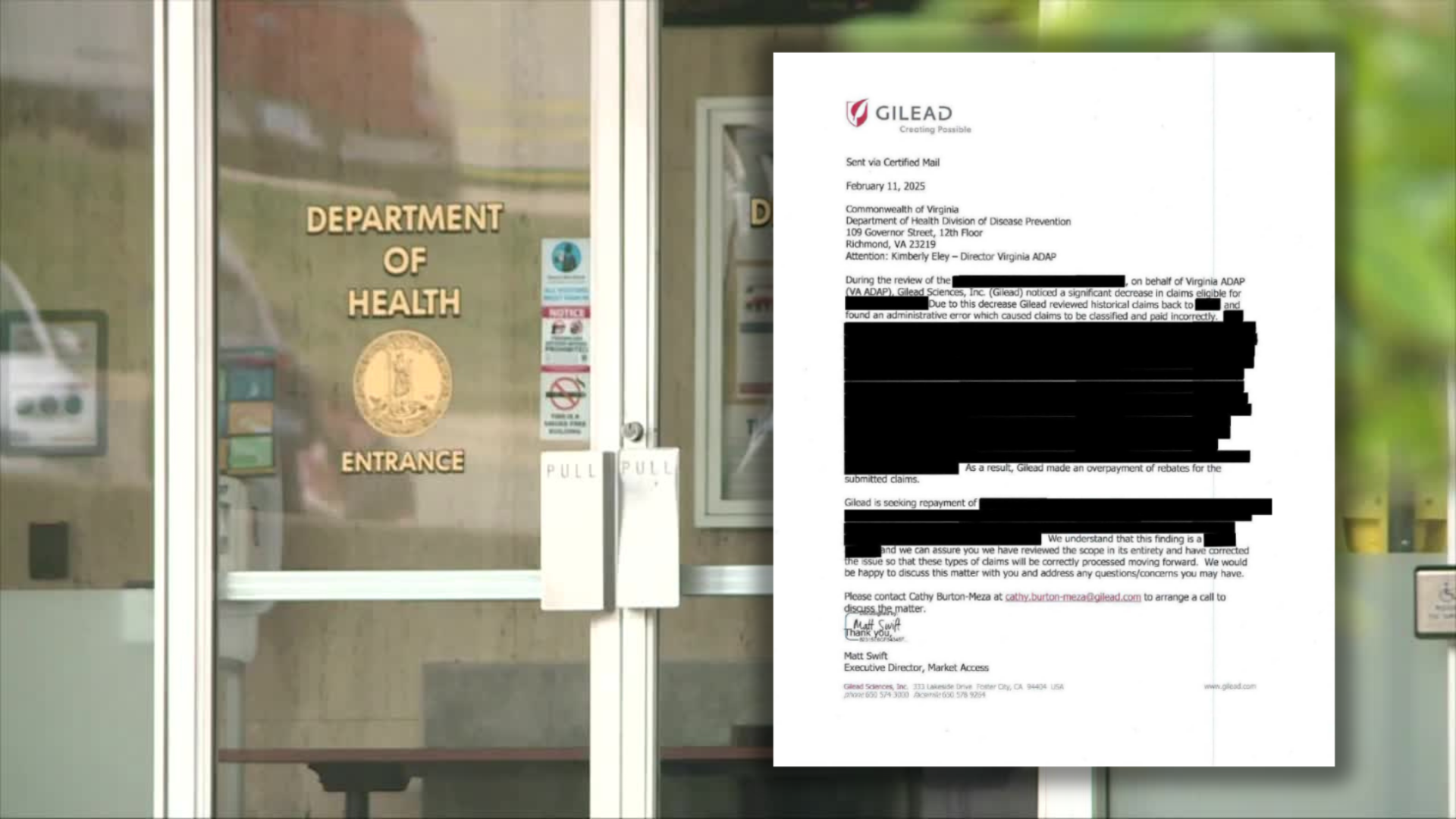
Gilead Sciences, a pharmaceutical manufacturer, first confirmed a rebate issue to CBS 6 last month. Now, we've learned through a Freedom of Information Act (FOIA) request that Gilead sent a letter to VDH in February 2025 alerting the agency of "an administrative error which caused claims to be classified and paid incorrectly." That resulted in Gilead overpaying rebates to VDH, according to the letter.
Watch: VDH 'billing error' triggers significant cuts to HIV services for poor Virginians
The company said the billing errors occurred from 2021 through 2023, and the letter stated the company identified the issue after noticing a "significant decrease in claims." Gilead told CBS 6 the overbilling problem did not occur with any other state.
Multiple providers have told CBS 6 the billing error was never mentioned when VDH suddenly notified them of significant cuts to their Ryan White disbursements in May of 2025.
"Had no idea. In fact, this is the first time I've heard," Legato told CBS 6.
“I was incredibly surprised to hear it," Walls said. "And I could never really get a sense of what had happened, and so that's when it really started to feel like there's something that's just not adding up, and somebody's probably not being honest about it.”
Even State Sen. Barbara Favola (D-Arlington), who had submitted a budget request in an attempt to fill the funding hole, said she was "completely unaware" of a billing error until CBS 6 told her about it.
As to how much money VDH may owe back to Gilead, the agency has not said. VDH heavily redacted the February 2025 letter from Gilead that may contain that information. The letter says, "Gilead is seeking repayment of..." and rest of the sentence is blacked out.
In explaining the redactions, VDH cited a discretionary FOIA exemption meant to protect certain economic development information. VDH suggested the agency promised Gilead that it would keep the redacted information confidential to use for "business purposes." The language of the cited exemption shields business "development or retention" from mandatory disclosure.
Megan Rhyne, a FOIA expert and transparency advocate with the Virginia Coalition for Open Government, said it did not appear that the agency appropriately applied the cited exemption.
"The public body cannot contract away the public's rights to public records. They can't promise not to disclose non-exempt material," Rhyne said.
Alen Gernhardt, executive director of the state's FOIA Council, also reviewed the exemption and letter at CBS 6's request and said, "'business ... development or retention' would appear to be more narrow than 'business purposes,' but there would definitely be overlap since business development or retention would be two types of 'business purposes.'" He added while it's unclear whether the cited exemption applies in this context, "generally speaking, the correction of existing billing errors would not appear to be 'development' or 'retention.'"
CBS 6 asked Gilead if it would share an unredacted version of the letter. A company spokesperson said it could not "as it contains proprietary information that is exempt from disclosure."
We further asked if Gilead requested confidentiality of the repayment amount in question and whether the company would disclose that number. A spokesperson responded, “These questions are best directed to the State of Virginia. In good faith, Gilead and VDH have been working together since early 2025 to resolve a billing error for rebates from Q2 2021 through Q2 2023.”
When CBS 6 asked VDH for the overpayment and requested repayment amount, a spokesperson said, "VDH has not yet finalized the amount of rebates that were unintentionally paid to VDH in prior grant years. We are working directly with the manufacturer to resolve the matter."
On February 20, the newly appointed State Health Commissioner Dr. Cameron Webb sent a message to Ryan White providers acknowledging that media had reported on "historical billing irregularities." He said that even though the billing issue happened before his time in leadership, VDH "owe[s] the public clarity, accountability, and action."
"As a physician and a public health leader, I approach this work with the same ethos I use in clinical care: diagnose the problem, communicate frankly, and mobilize solutions grounded in science and compassion," Webb said in his message. "We are accountable — not because something went wrong before I arrived — but because Virginia’s health department must earn and keep the public’s trust."
Webb emphasized that core medical care will continue under the program.
Federal government flags fiscal oversight concerns
CBS 6 also obtained an April 2025 federal inspection of VDH's Ryan White program that identified several other financial oversight issues.
It found that VDH has provided no fiscal monitoring of contracted providers "over the past two years," was not exhausting its rebate income before drawing down federal grant money due to generating "substantial program income" through a federal drug discount program, and was not paying providers in advance or in a timely manner.
Walls said providers have experienced untimely payments and contracts from VDH in recent years.
“Many of us have contracted with VDH for many, many years, and over the last three to four years, it's just been difficult," she said.
The inspection report further noted that VDH “has struggled with fiscal staff vacancies for the last several years."
Additionally, it stated VDH was "assessing whether anticipated reductions in some funds may increase risks of service rescissions, delays to entering or receiving HIV care, or waitlists.”
The agency submitted a corrective action plan that included several steps to address the cited findings including hiring an employee responsible for fiscal oversight of contracted providers and making changes to the program's control of rebates and pace of spending.
The corrective action plan, which was created in July 2025, said VDH would update "the rebate invoice frequency for non-Gilead claims" but that Gilead claims would remain on the current schedule. The plan referenced "9 months in arrears" as it related to Gilead claims, but the agency did not directly answer CBS 6's questions about what that comment meant.
VDH also initially set a goal of offering advance payments to providers at the beginning of 2026 but had to push back its target implementation date due to "numerous programmatic challenges related to funding resources and program stability, and the uncertainty of operational funding" heading into the 2026 grant year.
CBS 6 requested an interview with a VDH official to discuss the billing error, Gilead letter, and federal inspection report. A spokesperson responded by providing CBS 6 with the message that Dr. Webb sent to providers on February 20.
His message noted that moving forward, VDH would take steps to stabilize funding, finalize a repayment plan with Gilead, and strengthen rebate claim controls.
"We are actively working on funding solutions to restore additional support services where possible while assuring medication and insurance coverage for Ryan White Clients eligible," Webb said in the statement. "Community partners remain critical to service delivery — and we are committed to strengthening those partnerships."
Walls said the providers, and their clients, impacted by the cuts deserve more answers surrounding the magnitude of the rebate billing error and the funding loss.
“It's not really just about us, it's about the people that we serve, and we have significantly less programs now because of the way VDH managed this," Walls said. "It's like, this is crazy that it's cut this much, and nobody's explaining why.”
CBS 6 is committed to sharing community voices on this important topic. Email your thoughts to the CBS 6 Newsroom.
📲: CONNECT WITH US
Blue Sky | Facebook | Instagram | X | Threads | TikTok | YouTube


