


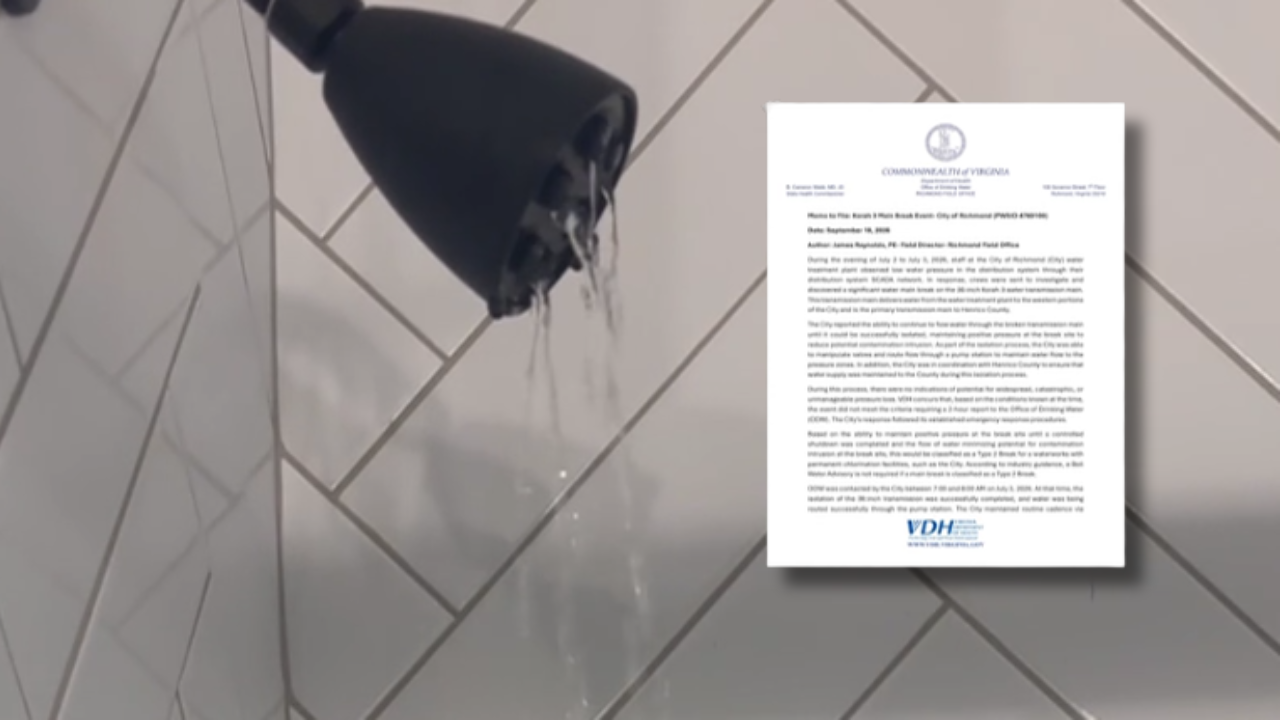


RICHMOND, Va — A state after-action report found the City of Richmond did not violate any regulations when a water main break over the summer left some residents without water, or with very little water, for up to 36 hours. However, it did suggest ways the city could better handle and respond to a similar event in the future.
A memo dated September 18 and authored by James Reynolds with the Virginia Department of Health's (VDH) Office of Drinking Water, which regulates waterworks entities such as the city, laid out a detailed timeline of the incident and examined why some customers experienced water pressure issues.
According to the report, Richmond's Department of Public Utilities (DPU) first noticed low water pressure in the distribution system the evening of July 2.
Crews then responded and found a "significant" leak in the main pipe that delivers water from the treatment plant to western Richmond and Henrico.
The city isolated the break to prevent contamination and adjusted valves to keep water flowing, according to the memo.
DPU initially communicated the water pressure issues to the public on July 3, and later that same day, officials announced that they had restored pressure.
However, multiple people in the city's Near West End told CBS 6 they continued to experience low water pressure in their homes on July 4, despite the city's announcement.
“They're saying everyone's got it back. We don't. My block does not, we're concerned," one resident said at the time. "I felt that there was a bit of a victory lap before there was a victory. I think that was the frustrating part as one of the people that was kind of left out.”
In his memo, Reynolds wrote that the city's pressure readings stayed above 20 pounds per square inch (psi), the regulatory threshold that could trigger a boil water advisory.
However, VDH said it received some "unverified" customer reports of low or no water pressure in certain areas. In response, the city took quality samples that confirmed the water was safe, according to the report.
In a previous statement, DPU said it diverted water to the impacted area to boost pressure and tested the psi at a nearby fire hydrant, saying the psi did not dip below 20.
CBS 6 previously asked whether DPU tested the pressure before or after it diverted water. VDH's top drinking water official Dwayne Roadcap said he did not know.
"Would that have made a difference? Because if they did the testing after they sent more water to that area, how would we know whether the PSI dipped below 20?" reporter Tyler Layne previously asked Roadcap in July.
"It's hard to know, and that's really a question for the city," Roadcap responded.
The September memo still does not confirm the timing of the city's tests. Roadcap told CBS 6 on Tuesday that DPU at no point observed findings under 20 psi through both field testing and system monitoring.
VDH offered several possible explanations for the continued low water pressure in the Near West End, all pointing to customer-owned pipes and fixtures, not the city's distribution system.
The memo further suggested that it's possible homes in higher elevation areas experienced lower pressure than what was measured in the fire hydrant.
The report concluded no boil water advisory was ever necessary, and the city did not violate any waterworks regulations in the incident.
Reynolds credited the city for quickly finding the problem, making repairs, and maintaining system pressure.
The report also recommended improvements to how the city communicates with the public and handles call center complaints, to include geotagging specific locations of reports of low water pressure.
When asked about the report on Tuesday, Richmond Mayor Danny Avula acknowledged the city's communication issues and said the recommendations were "super helpful."
"We recognize really in real time in July that the cycle and the rapidity of our communications out to people needed improvement, right? I think it took us a few hours to get the word out and to help people understand who might be affected by that. Now, it took us a few hours to actually figure that out too," Avula said.
The VDH report further recommended the city review that the fire hydrants used for sampling accurately reflect their relevant pressure zones, install continuous pressure monitoring at key points in the system, and better understand potential low-pressure areas when isolating major breaks.
In a statement to CBS 6 Tuesday, DPU said the report affirmed it took appropriate actions and that it will evaluate the recommendations going forward.
CBS 6 is committed to sharing community voices on this important topic. Email your thoughts to the CBS 6 Newsroom.
-
-
Eat It, Virginia! with Scott and RobeyUntold with Catie Beck
-
-
-
This story was initially reported by a journalist and has been converted to this platform with the assistance of AI. Our editorial team verifies all reporting on all platforms for fairness and accuracy. To learn more about how we use AI in our newsroom, click here.
 Facebook
  TikTok
  YouTube
 Blue Sky
 Instagram
 Threads
 X
X