


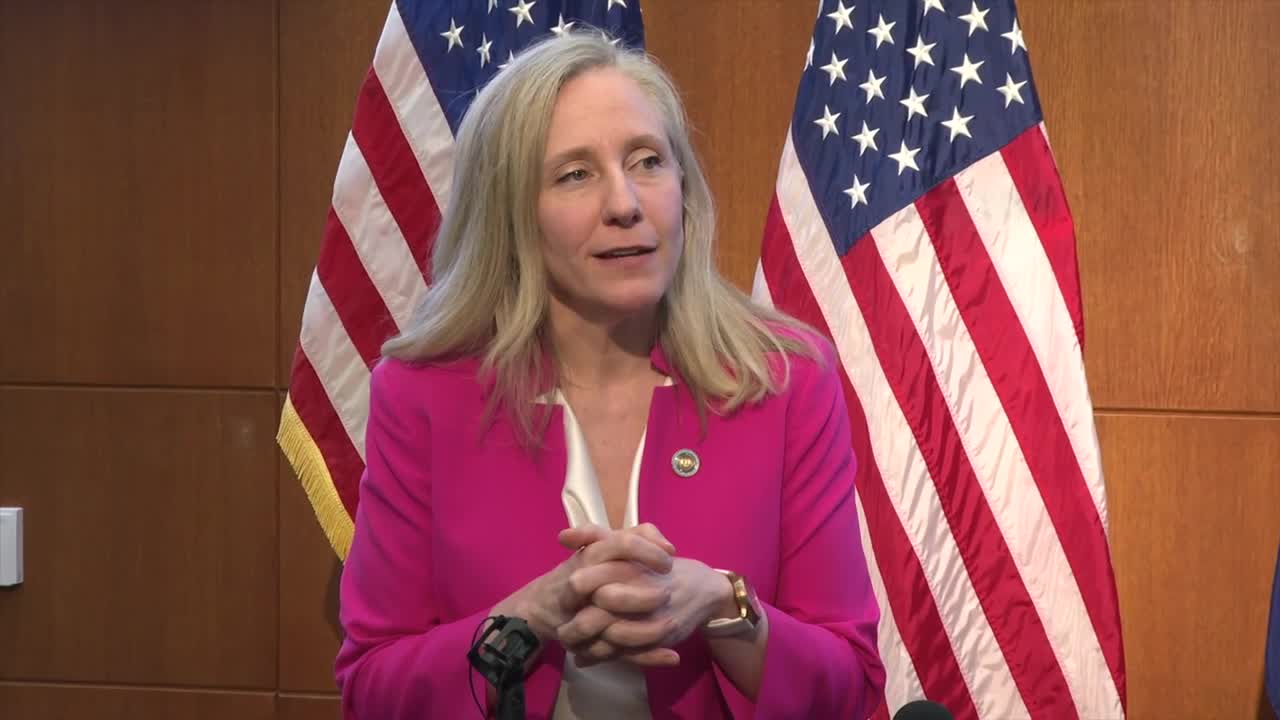


RICHMOND, Va. — Virginia Gov. Abigail Spanberger has a pointed response for Republicans who feel disenfranchised by Tuesday's narrow redistricting referendum: demand better representation from politicians of both parties.
"The construct where we accept this notion that there's Democratic representatives who just represent Democrats and there are Republican representatives who just represent Republicans is kind of essential and consequential to what I think is at the heart of the problems facing the United States Congress," Spanberger said in an interview one day after the 51% - 49% vote.
The governor's comments came after Virginia voters narrowly approved a mid-decade redistricting plan that could boost Democrats' chances of winning four additional U.S. House seats in November's midterm elections. The constitutional amendment bypasses a bipartisan redistricting commission to allow the use of new districts drawn by Virginia's Democratic-led General Assembly.
But Spanberger pushed back against the idea that the new maps would leave some Virginians without effective representation. She drew on her own experience as a Democrat who represented a longtime Republican district, Virginia's 7th, in Congress.
"In 2018 when I won my election, it was an election that I won by 2 points, but my predecessor in his prior election had won by 15," she said.
Despite growing up in suburban Henrico County and admitting she "can barely keep my basil plants alive," Spanberger said she became the only Virginian to serve on the Agriculture Committee and worked extensively on rural and agricultural issues.
"I went out and spent a lot of time with various farmers and producers across the Commonwealth, learning from them," she said citing work on challenges facing the forestry industry, loggers, and cattlemen dealing with meat processor closures. "People across all of our communities should expect to see candidates showing up and listening to their issues."
National implications amid legal uncertainty
The Virginia redistricting referendum marked a setback for President Donald Trump, who kicked off a national redistricting battle last year by urging Republican officials in Texas to redraw districts.
Republicans believe they can win up to nine more House seats in newly redrawn districts in Texas, Missouri, North Carolina and Ohio, while Democrats think they can win up to five more seats in California and one more in Utah.
Virginia's vote could help Democrats offset some of those Republican gains.
Under the new plan, Democrats could win as many as 10 of Virginia's 11 House seats, up from the six they currently hold.
The new map includes five seats anchored in northern Virginia's Democratic stronghold, with revisions to four other districts across Richmond, southern Virginia and Hampton Roads designed to dilute conservative voting power.
However, the public vote may not be the final word.
The state Supreme Court is considering whether the plan is illegal in a case that could make the referendum results meaningless.
A Tazewell County judge has already ruled that the redistricting push was illegal, finding that lawmakers failed to follow proper procedures for adding the amendment to a special session.
"Serious legal questions remain about both the wording of this referendum and the process used to put it before voters," Virginia House Republican Minority Leader Terry Kilgore said. "Those questions have not been resolved, and they now move where they belong: to the courts."
Temporary measure with built-in expiration
Spanberger emphasized that the redistricting change is explicitly temporary and the bipartisan commission will return after the 2030 census.
"This is a temporary one-time responsive action and that the bipartisan redistricting commission, which is in our state constitution now will be restored after the next redistricting," she said. "The thing that we talked about and the reality that people voted for...was that this was a responsive step that importantly preserves the commission into the future."
The governor said she always expected the referendum would pass with a smaller margin than her own 58% - 42% election victory in 2025.
"Virginia is typically a place where we're a purple state and margins typically aren't as large as what we saw in November," she said.
Democratic state House Speaker Don Scott celebrated the results as changing "the trajectory of the 2026 midterms," while U.S. Rep. Richard Hudson, chair of the National Republican Congressional Committee, said the "close margin reinforces that Virginia is a purple state that shouldn't be represented by a severe partisan gerrymander."
The redistricting battle is expected to continue, with ongoing court challenges in Virginia and potential new maps emerging from a special legislative session in Florida scheduled for April 28.
Despite the political intensity surrounding the referendum, Spanberger said budget negotiations with the General Assembly have not been affected. "All indications are that they're going well," she said, though she added with a laugh that she "would have wanted a budget yesterday."
The Associated Press contributed to this report.
📲: CONNECT WITH US
Blue Sky | Facebook | Instagram | X | Threads | TikTok | YouTube

This story was initially reported by a journalist and has been converted to this platform with the assistance of AI. Our editorial team verifies all reporting on all platforms for fairness and accuracy. To learn more about how we use AI in our newsroom, click here.

