


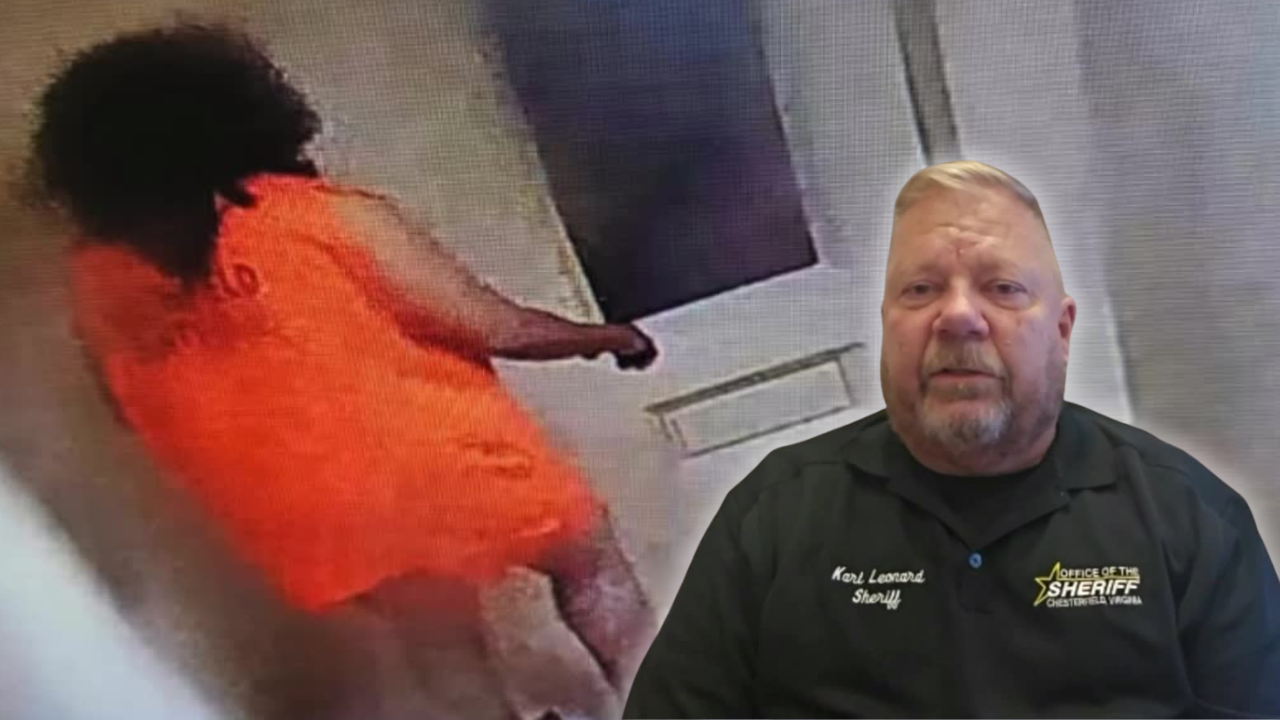


CHESTERFIELD COUNTY, Va — For three days, a woman in a mental health crisis remained at the Chesterfield County Jail with no access to treatment that she desperately needed, according to Sheriff Karl Leonard.
Leonard, in charge of running the jail, called the situation a "disservice" and a "failure." Meanwhile, the state's mental health agency said it's facing significant pressures, in part due to an increase in the number of people in the criminal justice system who require mental health services.
In a social media post, Sheriff Leonard shared pictures of an unidentified inmate in her cell while she was under a temporary detention order (TDO).
A TDO is a court order authorized by a magistrate that requires someone in crisis to receive mental health treatment in a psychiatric facility for up to 72 hours. In this case, the woman's TDO found she was likely to cause harm to herself or others and needed to be in a hospital rather than a correctional facility.
But 72 hours came and went, and Leonard said she never made it to a hospital.
“She never got a call that a bed was open. We never got her the help she needed, and still to this day, I don't know if she ever received really the help she needs for her condition," Leonard said.
Leonard said the woman initially was booked to the jail on two misdemeanor assault charges, which he believes were directly brought on by her mental illness, and then she was placed under a TDO while at the jail.
The woman's paperwork showed she was supposed to be taken to Central State Hospital, a public psychiatric hospital operated by the Virginia Department of Behavioral Health and Developmental Services (DBHDS).
Leonard said she was number five on a wait list for admission.
“At the end of 72 hours, she was still number five. That means four other people ahead of her, and how many behind her in crisis, also didn't get the help they need. This is not helping the individual, their loved ones, their families. This is not how we should treat people suffering from a mental illness," Leonard said.
Leonard said 70% of the Chesterfield jail population is made up of inmates with a mental health condition, and that TDO failures have become commonplace.
“I think we've all become accustomed to it, and now we just say, 'Well, that's just the way it is,' and when we get to the point to say 'that's just the way it is,' we have failed," he said.
Statistics on DBHDS's website showed that as of Tuesday, Central State Hospital was completely full, with forensic patients making up 91% of filled beds. Forensic patients are those involved in the criminal justice system, including people who come to the hospital from jail.
The data showed 169 adults and children were waiting for a bed to open up across Virginia's nine state-run facilities.
A report submitted by DBHDS to the General Assembly in June 2026 cited concerns that people with mental illness were being arrested on minor charges because admission to state hospitals through jail "is perceived to be faster than the civil TDO and commitment process and requires less law enforcement time."
The report said this practice "leads to an overall criminalization of the mentally ill."
Leonard shared similar concerns in an interview with CBS 6.
“We've become the dumping grounds, and I hate to say it like that, but that's what we've done with people suffering from severe mental illness. We put them in jail, and we've criminalized the mental illness," Leonard said.
In a statement to CBS 6, DBHDS said it could not comment on an individual case, citing privacy laws.
However, the agency generally acknowledged that a “rise in forensic patients and the Bed of Last resort law,” which requires state hospitals to take in TDO patients when private facilities do not, “have strained our system significantly.”
"DBHDS staff, in partnership with Virginia’s 40 CSBs, have been working hard to alleviate the strain on the system and ensure Virginians are able to access the care they need as quickly as possible and as close to their community as possible. Through continued development of the crisis system and Virginia’s behavioral health workforce, in addition to ongoing efforts to reduce the number of forensic patients in state hospitals, we remain focused on ensuring people across the Commonwealth are able to access the care they need to move forward in recovery and live lives of possibility," DBHDS spokesperson Lauren Cunningham said in a statement.
CBS 6 is committed to sharing community voices on this important topic. Email your thoughts to the CBS 6 Newsroom.
