


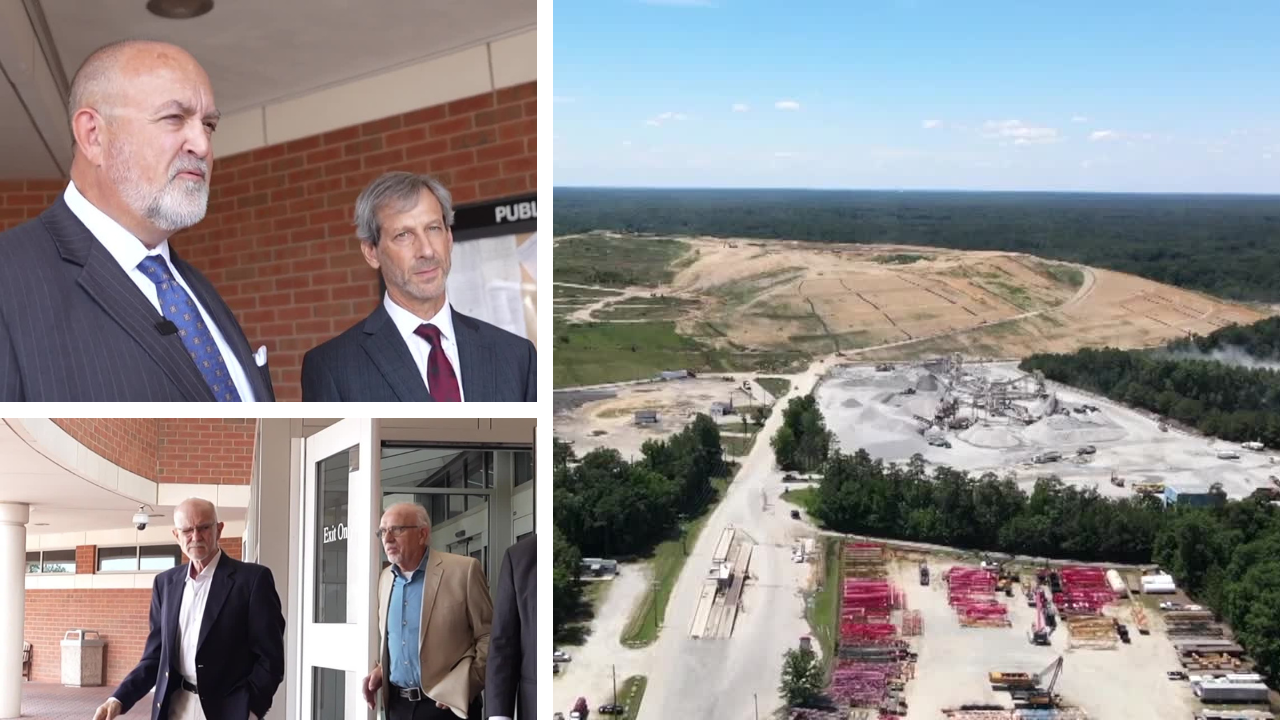


CHESTERFIELD COUNTY, Va. — A federal bankruptcy judge has ordered companies connected to the Shoosmith landfill bankruptcy to turn over financial records as the court-appointed trustee tries to trace where the landfill’s money and other assets went.
Former Shoosmith owners Fred Nichols and Lawrence McGee, along with Volunteer Enterprises and related companies, fought trustee Lynn Tavenner’s effort to obtain the records.
In an Oct. 19 order, U.S. Bankruptcy Judge Keith L. Phillips ruled that the corporate entities cannot claim Fifth Amendment protection and must comply with the trustee’s subpoenas.
The records could help Tavenner determine who ultimately received money, property and other assets involved in the transactions she is examining.
Where did Shoosmith’s money go?
That question has taken on added significance because of the enormous financial challenge surrounding the Chesterfield County landfill.
An engineering group working for Tavenner estimated that closing the landfill, taking corrective measures and providing post-closure care could cost more than $172 million over 30 years.
Available bond funds total only slightly more than $19 million.
The state has already stepped in. After CBS 6’s initial reporting, Virginia lawmakers allocated $10.6 million to help address environmental problems at Shoosmith. That allocation still falls far short of the engineering estimate.
Bob Olsen, a Chesterfield resident and member of Chesterfield Citizens for Responsible Government, previously told CBS 6 he feared citizens could be left with the consequences.
“It all seems to be a plan. Have planned all along, and the citizens are left holding the bag,” Olsen said.
Trustee traces nearly $30 million
The court order says Tavenner is trying to trace millions of dollars transferred from the Shoosmith companies before the bankruptcy filings.
According to the order, Shoosmith Bros. sold the Dale Quarry, property adjacent to the landfill, for approximately $25 million in April 2024. The trustee says approximately $23 million from that sale was transferred to Volunteer Enterprises.
Bankruptcy records cited by the court also reflect other transfers to Volunteer Enterprises, including approximately $700,000 in April 2024 and approximately $4.5 million in November 2024.
Altogether, the trustee identifies approximately $29.88 million transferred to Volunteer Enterprises during the year before the bankruptcy.
Tavenner wants financial records that could help determine who ultimately received that money and other Shoosmith assets.
The judge emphasized that the court has not determined whether the alleged transfers occurred or whether any transfer was improper. The court was deciding what information the trustee could obtain, not ruling on the truth of the underlying allegations.
A separate $150 million debt transaction
The court order also describes a separate transaction involving approximately $150 million of secured Shoosmith and VWS Holco debt.
The trustee alleges certain insiders, acting through Volunteer Enterprises, acquired that debt for approximately $10 million. She further alleges the $10 million used in the transaction came from one or more of the debtor companies and was diverted for insiders’ benefit and to the companies’ detriment.
Those allegations have not been established as facts by the court.
Tavenner contends assets that could have helped address the landfill’s environmental needs appear to have been diverted to insiders and affiliated companies while, in her words, “the landfill was left to fail.”
The trustee has argued that potential lawsuits and other legal claims could be among the most valuable assets remaining in the bankruptcy estates. Any money recovered could potentially be available to creditors and help fund what she has called the landfill’s “desperately needed” remediation.
Companies ordered to produce records
Under the judge’s order, the companies must provide records concerning the transactions being examined and information identifying those who received related property, proceeds and other assets.
That could allow the trustee to follow the money beyond its initial recipient and identify other people or entities involved in the transactions.
Nichols and McGee argued that producing certain personally held documents could violate their Fifth Amendment rights against self-incrimination.
The judge found they had not yet provided the evidence or sworn statements needed to establish that protection for specific records. The court gave them until Nov. 30 to make that case.
The companies cannot claim that same Fifth Amendment protection and were ordered to comply with the trustee’s subpoenas.
Attorney disputes allegations about landfill money
CBS 6 previously pressed Dale Mullen, an attorney representing Nichols, about allegations from the trustee and lawyers for the Virginia Department of Environmental Quality that millions of dollars were removed from the Shoosmith companies instead of being invested in the landfill.
“There have been allegations made by the trustee as well as by lawyers for the DEQ that these men took millions of dollars out of the landfill that should have been going into the care of the landfill and took it for their own personal use. Do you have a response to that?” CBS 6 investigative reporter Melissa Hipolit asked.
“We dispute that. We look forward to defending these charges,” Mullen said. [https://ww...oct-9-2026]
In earlier bankruptcy filings, DEQ lawyers alleged Nichols and McGee “pocketed millions of dollars” instead of investing in necessary infrastructure and remediation, including a pretreatment plant for leachate.
Attorneys for the former owners have denied wrongdoing. Previous reporting documented an earlier filing from their attorney stating there was “no proof or evidence of anything.”
Criminal charges pending
Nichols and McGee are also facing separate criminal charges related to the landfill.
A Chesterfield County grand jury indicted each man on one Class 4 felony count of unlawfully abandoning a waste facility and two misdemeanor counts of willfully violating Virginia’s Water Control Act. Shoosmith Bros. Inc. faces the same three charges.
Nichols and McGee turned themselves in at the Chesterfield County Jail early Oct. 7. Both men live in Texas.
Their attorneys have said they strongly dispute the charges and intend to defend the cases. A judge allowed the two men to return to Texas while the criminal proceedings are pending.
The criminal cases and the bankruptcy dispute are separate proceedings.
Years of environmental concerns
CBS 6 has been investigating the environmental and financial problems surrounding Shoosmith for months.
The landfill generates approximately 65,000 gallons of leachate daily. Leachate is liquid produced as waste decomposes and must be collected and transported for treatment to prevent it from reaching surrounding waterways.
CBS 6 previously uncovered DEQ enforcement records showing landfill gas condensate discharging into Swift Creek in June 2021. State staff collected samples from a receiving stream and found elevated levels of BOD-5 and ammonia, which can indicate pollutants and landfill wastewater.
Barlaz, an NC State professor who has researched solid waste for more than four decades, told CBS 6 that condensate can contain higher chemical concentrations than leachate.
“So discharging it to a creek, again, it’s a no-no,” Barlaz said.When Hipolit asked whether potentially toxic elements had reached the creek, Barlaz pointed to DEQ’s findings.
“According to DEQ they did. They didn’t analyze for toxic elements, but they observed a discharge and they observed an impact. So yes,” Barlaz said.Jamie Brunkow with the James River Association previously noted that Swift Creek and connected waterways have recreational and drinking-water uses.
“We’ve got recreation public use here, we’ve got drinking water use in this part of the river, so it’s really concerning how much leachate is getting into the water,” Brunkow said.DEQ records also documented repeated leachate seeps at the landfill, including incidents in 2021, 2022 and 2024.
The landfill’s owners filed for Chapter 7 bankruptcy in July 2025. Tavenner later described conditions there as a potential “environmental catastrophe.”
The judge’s Oct. 19 order now gives the trustee access to additional corporate records as she tries to trace where Shoosmith’s money went and determine whether assets can be recovered.
This is a developing story, so check back with WTVR.com for updates. Email the CBS 6 Newsroom if you have info, photos or videos to share.
-
-
Eat It, Virginia! with Scott and RobeyUntold with Catie Beck
-
-
-
This story was initially reported by a journalist and has been converted to this platform with the assistance of AI. Our editorial team verifies all reporting on all platforms for fairness and accuracy. To learn more about how we use AI in our newsroom, click here.
 Facebook
 TikTok
 YouTube
 Blue Sky
 Instagram
 Threads
 X
