


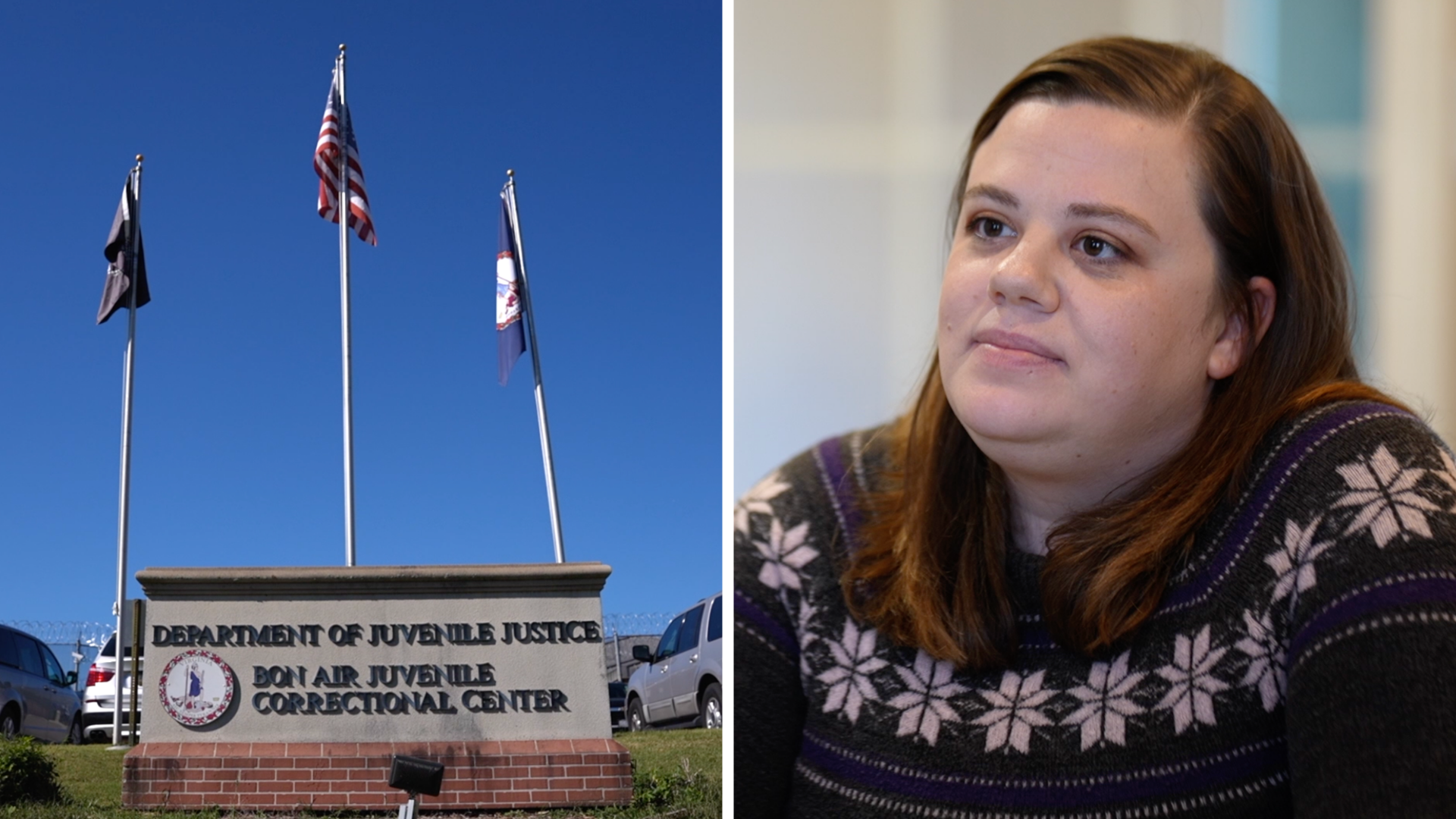


CHESTERFIELD COUNTY, Va. — Over the past year and a half, CBS 6 has reported on safety and conditions at Bon Air Juvenile Correctional Center in Chesterfield County, which serves young people convicted of serious crimes in Virginia. Concerns have included documented conditions of confinement for the youth, critically low staffing levels, and reports of residents lighting fires in their cells.
Now for the first time, a former employee is speaking on the record about what she observed during her time as a correctional specialist and why she worried about the rehabilitative outcomes for the young residents housed in the facility.
Charlotte Crumpler knows what it's like to be a young person involved in the juvenile justice system, as she said she was an incarcerated youth herself at one point stemming from undiagnosed mental health issues. But she said spending time in a Virginia detention center and completing a court-ordered drug treatment program in 2009 put her on a better path.
"It really led me to resources that I needed and things that I needed, and when I graduated high school, my probation officer was there, my lawyer was there. It was amazing," Crumpler said.

So many years later, when she saw a job posting from the Department of Juvenile Justice (DJJ), she jumped at the opportunity. In June 2025, Crumpler was hired as a juvenile correctional specialist at Bon Air. Job duties included overseeing residents, ensuring safety and security, and providing mentorship to the youth.
But when she arrived to the facility following training, she said she felt uneasy.
"I became very, sort of stressed and upset because I was concerned I wasn't going to be prepared for this job," Crumpler said.
Crumpler said she primarily worked evenings and nights, and occasionally filled in during the day, in a 16-resident housing unit.
She said she tried to implement some of the therapeutic practices like check-ins, mutual health groups, and circle-ups— which were expected to occur four times a day, per training documents Crumpler shared—but said she was met with fierce resistance.
"My residents immediately were just angry and aggressive, and were like, 'We haven't done this in years. We don't want to do this. We're not used to this,'" Crumpler recalled.
She said that when she reported concerns about the practices not happening to supervisors, they were dismissed.
Crumpler told CBS 6 she was also frustrated by an apparent lack of activities for the residents.
"All these kids were doing was sitting around playing Uno and spades all day. They were so bored," Crumpler said. "They had just so much built up, just anger and energy and things like that. My unit actually did not go to the cafeteria whatsoever. They ate in their units."
Crumpler described days when residents were confined to their cells for nearly the entire day, with only a brief break.
"I've seen residents completely secured, except for showers - so showers are supposed to be at five minutes - for 24 hours, excluding five minutes to your shower," she said.
“There can be a whole day where they’re locked behind their door?” reporter Tyler Layne asked.
“Absolutely," Crumpler said.
CBS 6 asked DJJ to respond to each of Crumpler's specific claims.
DJJ Director Bob Bermingham, who was appointed in January 2026, said Crumpler primarily worked during "residents' shower time, evening snack time, and sleeping hours, though she may have worked during other shifts."
He said juvenile correctional specialists who work during the day are "expected to engage residents in meaningful ways, which may include structured activities." Bermingham said all staff receive training for appropriate resident interactions.
Issues at Bon Air have been thoroughly documented by external auditors. In 2024, a report by outside consultants with the Moss Group revealed an "abundant lack" of meaningful engagement for the youth, high levels of boredom among residents, lacking programming, staff who felt unsafe and exhausted, and a negative work culture.
More recently, a December 2025 state inspector general report revealed a lack of evidence that the facility was performing required wellness checks on residents, allowing residents daily exercise, or delivering timely and appropriate therapeutic services. The report noted that the programming issues can compromise rehabilitation outcomes.
"Do you feel like these kids were getting rehabilitated?" Layne asked Crumpler.
"Absolutely not. Absolutely not," she said.
At the time the report was released, former DJJ Director Amy Floriano characterized the findings as primarily documentation issues and the effects of resource constraints. She maintained the rehabilitation and well-being of residents did not suffer as a result.
Many of the findings in both reports could be tied back to staffing challenges, a problem seen in correctional facilities nationwide and one that DJJ said it has been working tirelessly to address.
The inspector general's office found 43% of DJJ staff leave their jobs within six months, a statistic Crumpler is a part of, and it cited low pay as a factor leading to high rates of turnover.

CBS 6 is giving you a voice. Have a news tip or concern in your community?
Connect with WTVR: newstips@wtvr.com
"Operating a correctional center, juvenile or adult, is no simple task given the many complexities involved when combining day-to-day operations and the effective delivery of rehabilitative services," Bermingham said.
Crumpler said the demands of working long hours to ensure enough security coverage left her feeling exhausted and burned out.
"We were delirious. We were not in a rested or alert situation to be able to properly, I think, sort of manage the residents and do our duties," she said.
She resigned this past October. Because of her personal connections to juvenile justice, she said she knows the importance of youth getting a proper second chance, and that compelled her to speak out.
"There was a time where I got off work and I literally sobbed. I was sobbing at just the empathy for these kids, because I recall what it's like being behind that door, and how frustrating that is," Crumpler said. "They are behind those doors just completely helpless and without any sort of autonomy or power or anything. And I am very much hoping to be the voice that they don't have."
Bermingham said he has begun a "comprehensive review" of all department operations with a focus on staffing levels and quality of services. He said DJJ is committed to balancing safety with delivery of rehabilitative services.
Watch Tyler Layne's reporting on CBS 6 and WTVR.com. Have something for Tyler to investigate? Email him.

This story was initially reported by a journalist and has been converted to this platform with the assistance of AI. Our editorial team verifies all reporting on all platforms for fairness and accuracy. To learn more about how we use AI in our newsroom, click here.

