


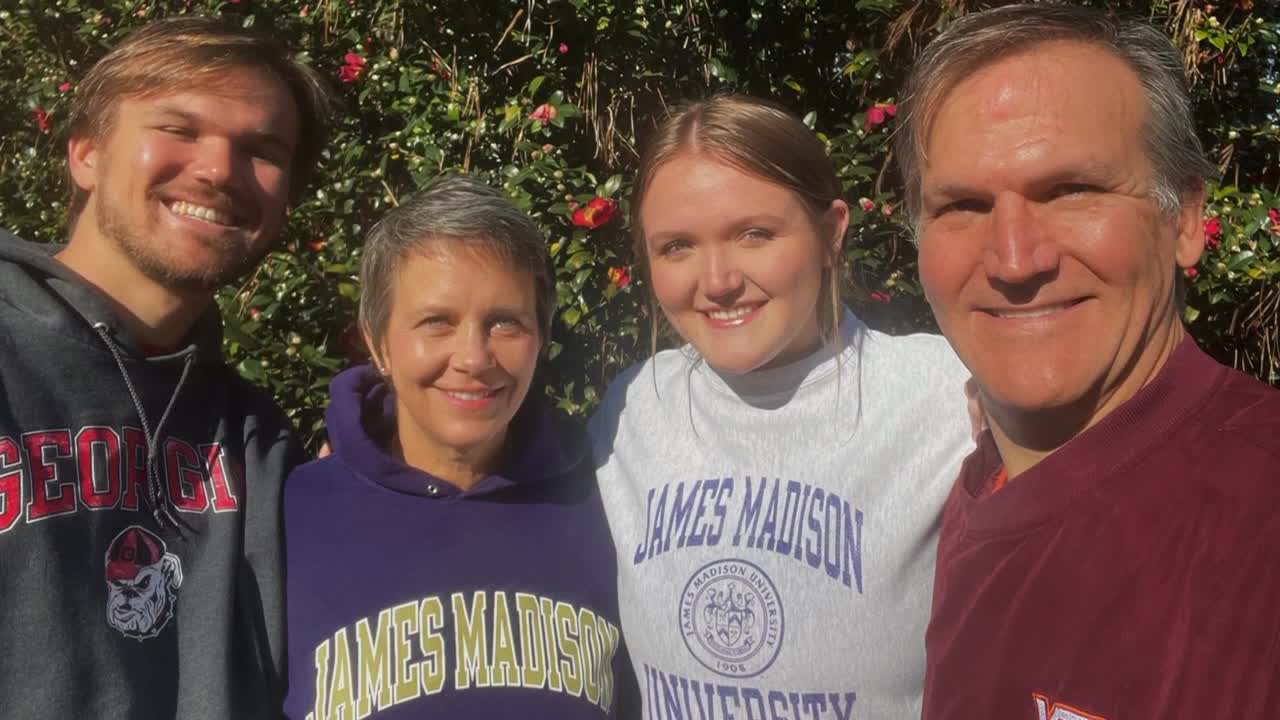


HENRICO COUNTY, Va. — R.J. Gilson thinks about his wife every day.
Angie Gilson died on Sept. 15, 2024, after a nearly two-year battle with Stage 4 ovarian cancer.
She was 55.
Now, R.J. is channeling his grief into action — raising money for a nonprofit devoted to funding research into the prevention and early detection of ovarian cancer.
R.J. and Angie met at a party in 1987 with classmates from Douglas Freeman High School.
"I wrestled and she was a wrestling cheerleader as they called the Grapelettes back then," R.J. said.
Even though both were graduating that spring, they continued dating through college.
At 22, R.J. proposed.
"It was Christmas time in 1992," R.J. said.
The couple had two children and settled in the Tuckahoe area of Henrico County, where they built a full and happy life guided by Angie's version of her favorite Bible verse: What a beautiful day the Lord has made — let us rejoice in it.
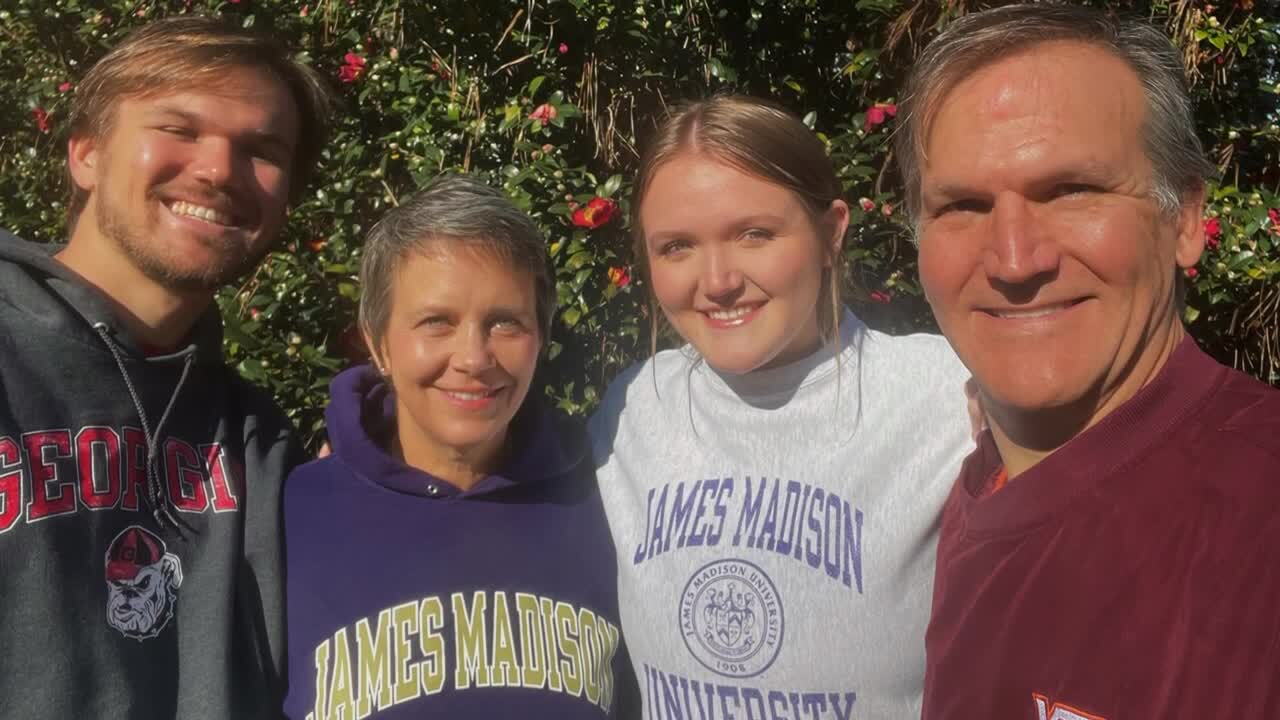
"It was really just a reminder of, you know, every day is a gift, and focusing in on what beauty there is, and within that day, and to live your life, live the years that you have," R.J. said.
With both children away at college, Angie returned to work full time. But she soon began feeling discomfort in her abdominal region. For eight months, doctors could not determine the cause of her pain or why she had become breathless during her runs. Then her abdomen began to swell.
"It was really the ascites fluid that was building up that created the most pronounced symptoms: the swelling in the abdomen, and then, and later on, collapsing part of her lung," R.J. said.
A doctor ordered a CT scan, and in September 2022, Angie was diagnosed with Stage 4 ovarian cancer.
"It was scary, but you know, she was young. You know, she was...53 at that point, and healthy, and you know, strong, and a determined, a determined woman. And I think we were hopeful," R.J. said.
Angie underwent chemotherapy and surgery, completing her treatment in June 2023 with no evidence of disease. Within six months, the cancer returned.
"I remember that was Christmas of 2023, and we were having, as we often did, everybody was here. All of my wife's extended family, and she didn't want to tell them. She wanted to wait because she wanted to have a happy Christmas and everybody to have a joyful time," R.J. said.
"Through that period, that was the most challenging part. As I think Angie began to recognize that she may not be able to beat this," R.J. said.
The cancer ultimately left Angie unable to eat. She died on Sept. 15, 2024.
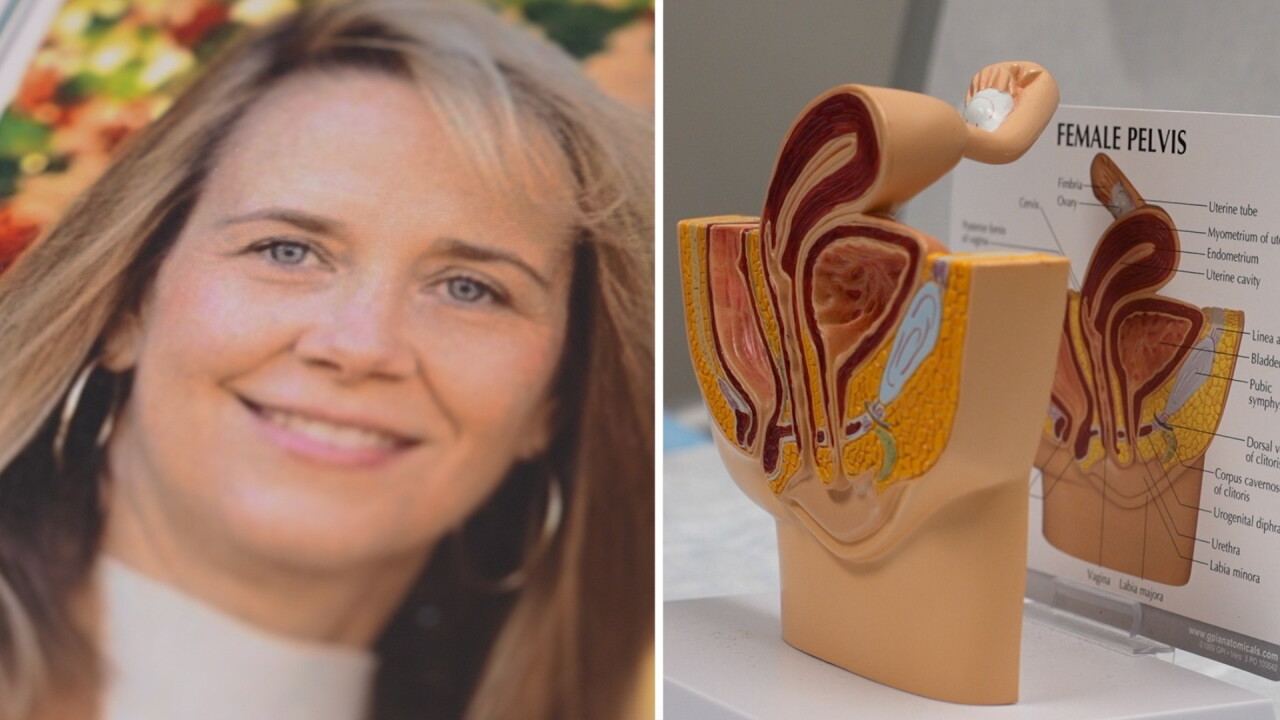
"I think of her often. I mean, every day for sure," R.J. said.
CBS 6 investigative reporter Melissa Hipolit knows this story firsthand, which is why she wanted to share the Gilson’s story.
Her mother, Constance Hipolit, died from ovarian cancer in October 2025. "Watching her endure the advanced stages of this disease was heartbreaking for our family — and it taught me that there is currently no way to screen for ovarian cancer early, which is why it is so often deadly,” Hipolit said.
No screening test exists for ovarian cancer
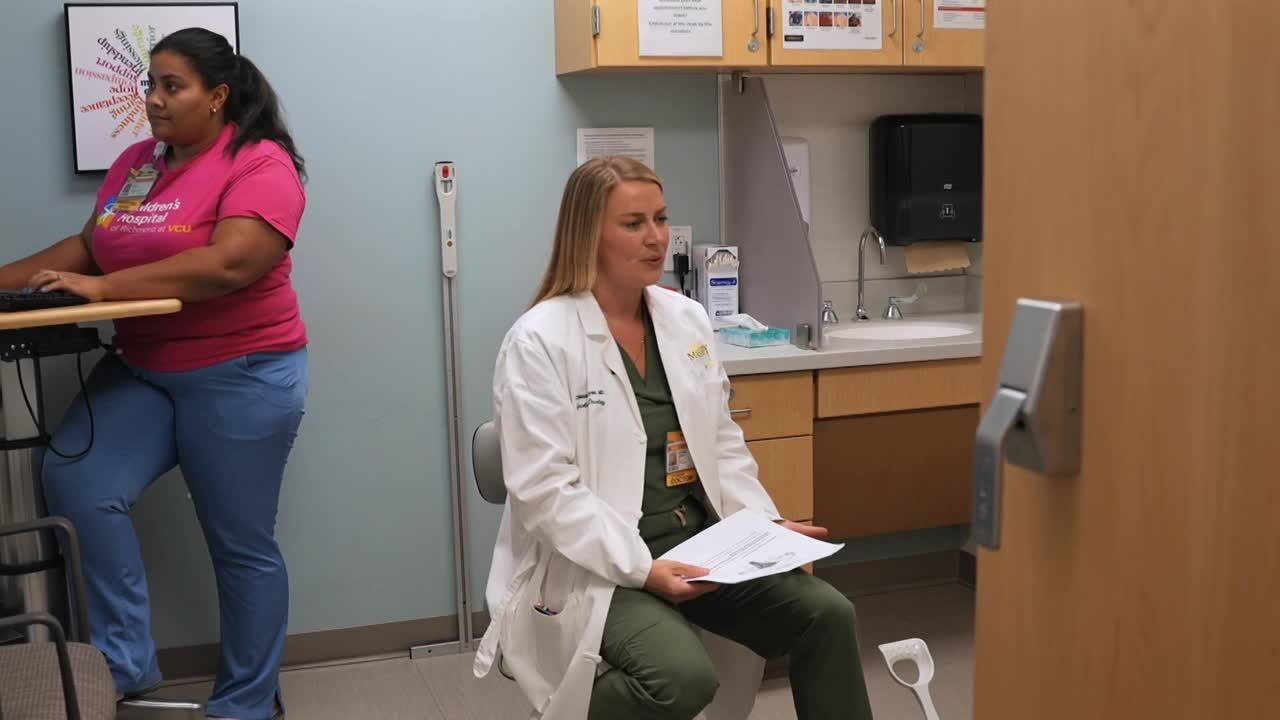
Angie's story is one Dr. Chelsea Salyer sees repeatedly as a gynecologic oncologist at VCU's Massey Cancer Center.
"It's, you know, not something I would wish on my worst enemy," Salyer said.
Salyer says most of her patients with ovarian cancer arrive with advanced-stage disease.
"We detect most ovarian cancers when they're advanced, and chances of survival are often low," Salyer said.
Unlike cervical, breast, colon, and lung cancers, there is currently no way to screen for ovarian cancer.
"The key to reducing, you know, mortality and losing our mothers and family members and loved ones is to focus on early detection," Salyer said.
When caught in Stage 1 or Stage 2, the outlook is significantly better.
"Yes, it can be [curable] because you can often get all the cancer out with surgery, and then give some additional treatments afterwards to prevent the cancer from coming back," Salyer said.
Salyer says research into gynecological cancers is underfunded.
"We don't get as much attention to do the research to make those advances that we so desperately need," Salyer said.
R.J. raises money for Tina's Wish
To help change that, R.J. is now working to raise money for Tina's Wish, a nonprofit created in memory of the Honorable Tina Brozman, a chief judge of the SDNY Bankruptcy Court, who died after a two-year battle with ovarian cancer. The organization is devoted to funding research into the prevention and early detection of ovarian cancer. Its slogan: Know Early. Know Hope.
"It's incredibly important for me because I have a daughter, you know, and I have many women in my life that I care about, friends and family, that I don't want to say have to go through this," R.J. said.
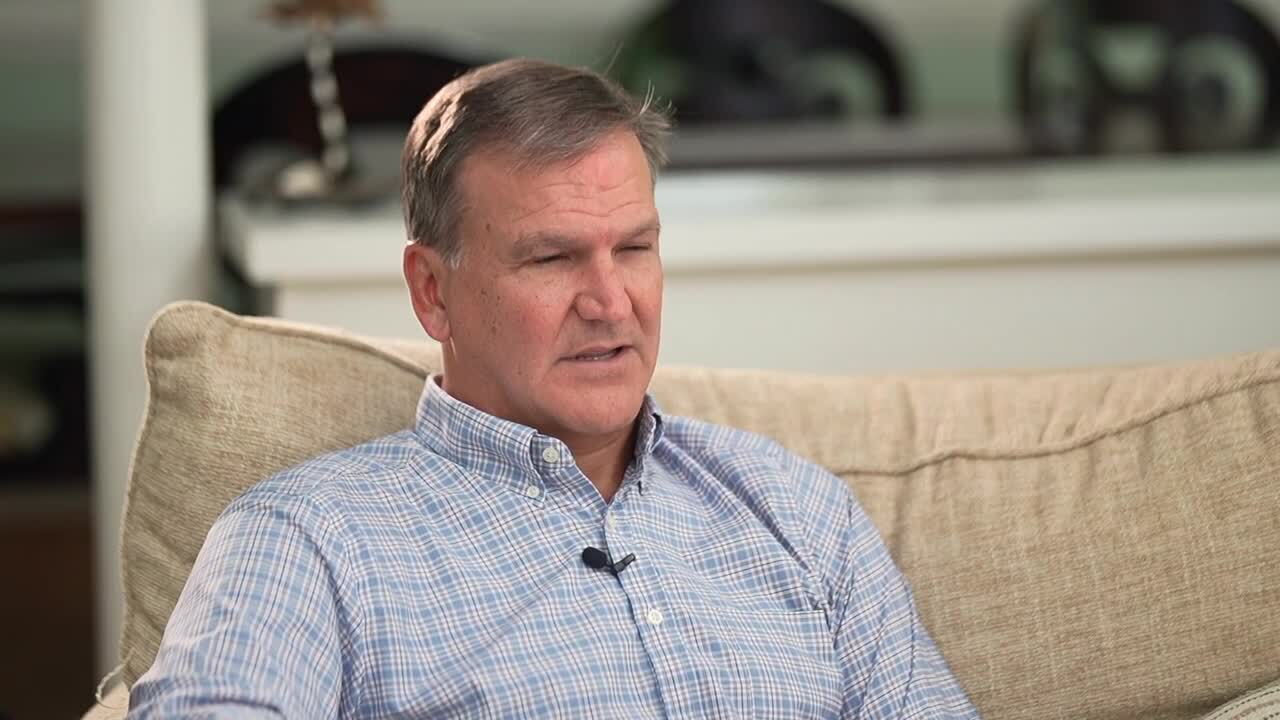
"If we can have a non-invasive test that can help physicians identify this earlier, these women have a much better chance to survive this," R.J. said.
For R.J., the work is also a way of keeping Angie's spirit alive.
"For a while all I could think of her as was sick," R.J. said.
Now, he carries her legacy forward — embracing the cause and the faith she lived by.
"What a beautiful day the Lord has made, let us rejoice in it," R.J. said.
New guidance on prevention
Early detection is one piece of the puzzle. Prevention is another.
New guidance from the American College of Obstetrics and Gynecologists now strongly recommends that women who have completed childbearing consider having their fallopian tubes removed if they are already undergoing surgery for another reason. The recommendation is aimed at reducing the risk of ovarian cancer.
Salyer said experts believe the most common and aggressive form of ovarian cancer actually starts in the fallopian tubes, not the ovaries. According to ACOG, removal of both fallopian tubes can reduce the risk of ovarian cancer by as much as 78%.
CBS 6 is committed to sharing community voices on this important topic. Email your thoughts to the CBS 6 Newsroom.
-
-
Eat It, Virginia! with Scott and RobeyUntold with Catie Beck
-
-
-
This story was initially reported by a journalist and has been converted to this platform with the assistance of AI. Our editorial team verifies all reporting on all platforms for fairness and accuracy. To learn more about how we use AI in our newsroom, click here.
 Facebook
  TikTok
  YouTube
 Blue Sky
 Instagram
 Threads
 X
X
