


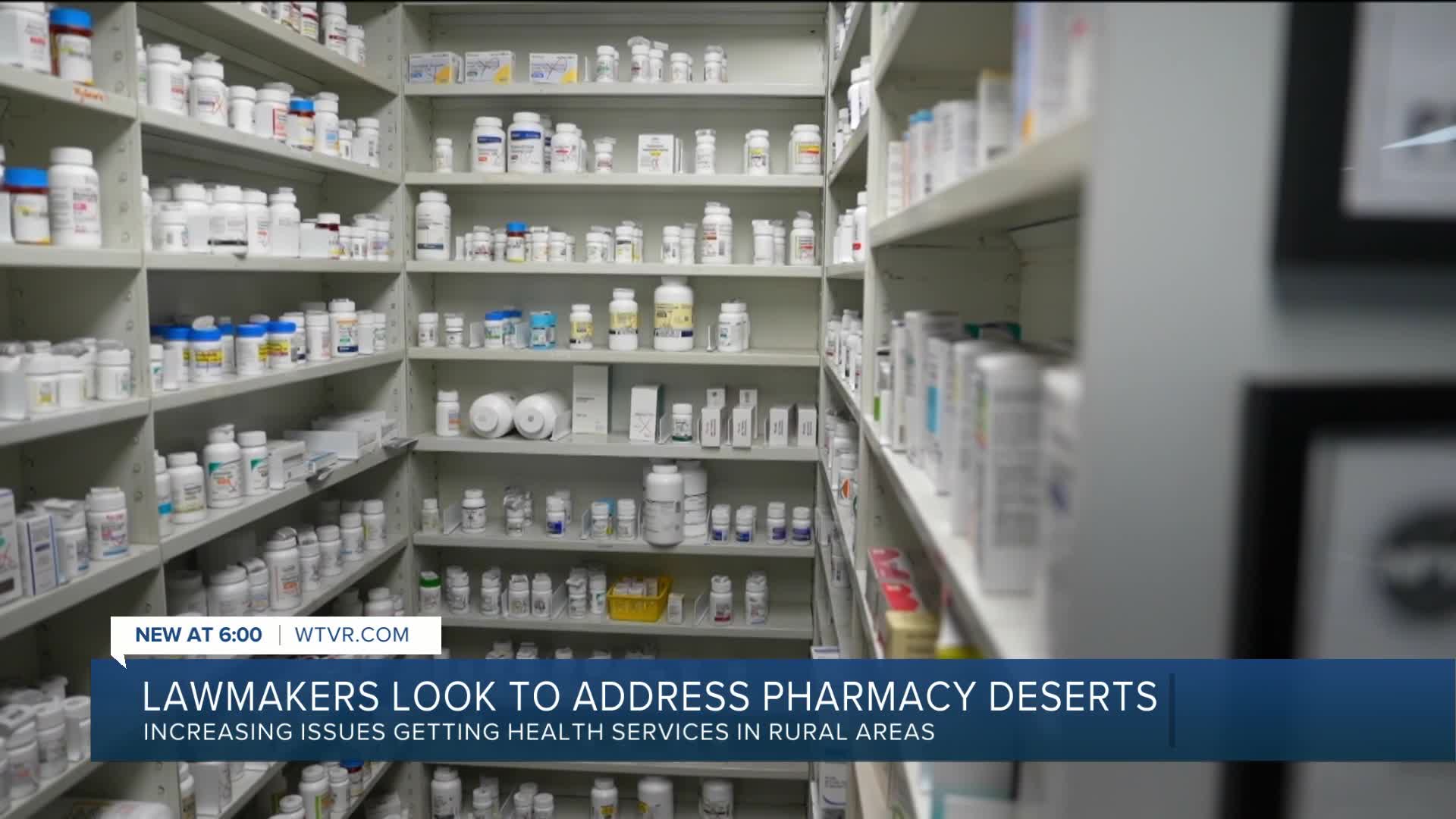


RICHMOND, Va. — State lawmakers are looking to take action after receiving new information about the growing number of Virginians who are losing access to pharmacy services and the pressures community drug stores are facing, which are particularly driven by the practices of pharmacy benefit managers.
According to a report from the Joint Commission on Health Care (JCHC), the number of community pharmacies operating in Virginia has steadily declined over the last decade, leaving 14% of the state's population with limited or no access to pharmacy services.
Sarah Abernathy, who lives in rural Brunswick County, is a part of that statistic after her county's only pharmacy closed earlier this year. The closure more than doubled the distance to the closest drug store, where she and her husband have 11 prescriptions that need to be regularly filled.
“I was angry because we were left with, it’s a 30-minute drive to South Hill or a 30-minute drive to Emporia," Abernathy said. "It's dire. What do the elderly in this county or in any county that doesn't have a pharmacy— what do they do?"
While mail order options are available, the commission's report emphasized the benefits of community pharmacies being in-person counseling and education, the opportunity to build long-term relationships with patients, and access to clinical services such as vaccinations and testing.
Declining access to these services can lead to negative health outcomes, such as reduced medication adherence and lower vaccination rates. In October, the State Board of Health declared pharmacy deserts in Virginia a public health threat.
“When you look at pharmacy and people taking their medications, it's actually the most cost-effective way to keep a person healthy, keep them away from a doctor's office. Pharmacists see more individuals and communicate with them more than any other health professional that's out there," said commission member Del. Keith Hodges (R-Essex).
The report found pharmacies associated with a large chain and pharmacies that are locally owned are declining at a similar rate; however, independent pharmacies are significantly more likely to go out of business within five years of opening.
Commission staff told lawmakers during a meeting on Wednesday one of the primary causes of closures is that pharmacy benefit managers (PBMs) are not reimbursing pharmacies enough money, which is oftentimes completely out of pharmacies' control.
A PBM is essentially a middleman that works with an insurance company to negotiate drug prices with manufacturers and then reimburses pharmacies for the cost to dispense those drugs. In some cases, an insurance company, PBM, and pharmacy may all be under the same parent company.
"We heard nearly unanimously from stakeholders that revenue generated by pharmacies through reimbursement fees is not keeping pace with the cost of pharmacy operations. Reimbursement rates fall below the pharmacy's acquisition costs for drugs and do not cover the labor, operational or supply costs needed for filling the prescription," said JCHC Deputy Director Jen Piver-Renna.
In a previous CBS 6 report, pharmacists at the locally owned Goochland Pharmacy said consistently low reimbursements threaten the viability of the business. In one example, they showed CBS 6 a claim they submitted for $493 for an inhaler, but the PBM reimbursed $472.
“You're either going to eat that cost or you're going to ultimately, unfortunately, have to turn the patient away," said co-owner DJ Johnson. "It makes it very creative as far as what you have to do day in and day out to keep the doors open."
PBMs have come under scrutiny in recent years by state and federal agencies who have accused them of profit-maximizing practices that contribute to rising drug costs and squeeze community pharmacies out of business. The PBM industry has largely rejected those claims and instead points to drug manufacturers for setting high prices.
Commission staff suggested lawmakers could take action to further regulate how PBMs reimburse pharmacies, especially when Medicaid is the payer.
For most Medicaid members, DMAS, the state Medicaid agency, contracts with managed care organizations (MCOs) to manage health plans. The MCOs then contract with PBMs to manage prescriptions, but the terms of those contracts are currently unknown, meaning there is little insight into how much PBMs are reimbursing for drug costs and dispensing fees. A dispensing fee is supposed to cover a pharmacy's operational costs.
DMAS administered a survey in 2024 to determine the cost of dispensing, as it does every five years, but the agency has not publicly released the survey and did not provide it to JCHC for its report. The withholding of the survey puzzled multiple lawmakers, who said they wanted its results to help guide their policy actions.
"It was supposed to be released a while ago, so we really need those numbers," said Del. Hodges.
"It is an enigma to me why they're holding it so close to the vest," said Sen. Barbara Favola (D-Arlington County).
CBS 6 also submitted a Freedom of Information Act request for the survey last month, but DMAS withheld it, citing it as a working paper of the Secretary of Health and Human Resources. DMAS has not responded to follow-up questions sent Wednesday about why the agency is declining to release it.
The commission's report estimated the current dispensing fee should be around $13-14; However, Piver-Renna said pharmacists reported they typically receive dispensing fees of "pennies" to $2.00 for Medicaid members within MCOs.
While commission members are pursuing actions that would set a specific reimbursement minimum for drug costs and dispensing fees for medications dispensed through Medicaid programs, they're also interested in setting a floor for all payers at large like West Virginia has done.
"Virginia or states can regulate PBMs, or middlemen, as long as they don't change the plan design. So I've been working on this for a number of years, and with today's meeting and the motion that I made, and with that policy option, we finally embraced that," Del. Hodges said.
Legislators ultimately adopted several policy options including measures that would set reimbursement floors that would impact Medicaid programs and other payers at large that fall under the General Assembly's authority.
CBS 6 is committed to sharing community voices on this important topic. Email your thoughts to the CBS 6 Newsroom.
📲: CONNECT WITH US
Blue Sky | Facebook | Instagram | X | Threads | TikTok | YouTube


