


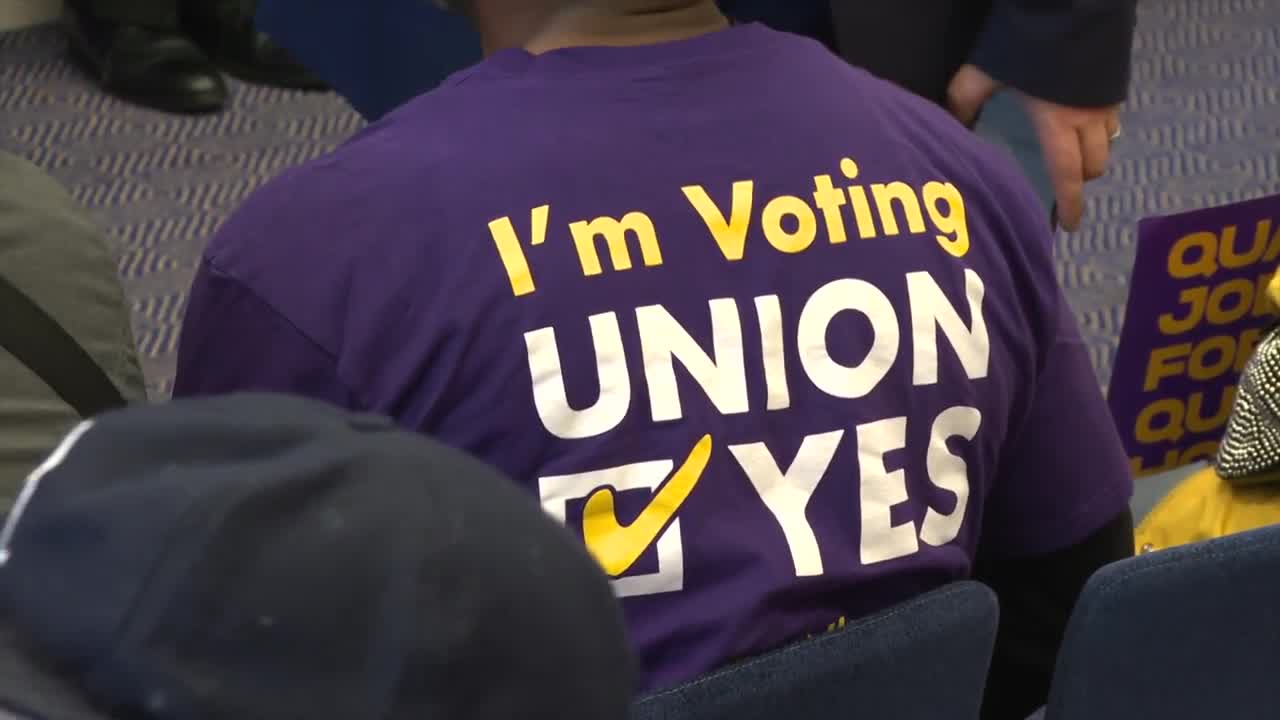


RICHMOND, Va. — Democratic lawmakers in the Virginia General Assembly are advancing competing measures to expand collective bargaining rights to public sector workers, but each version leaves some groups behind while Republican lawmakers say it will raise costs for localities.
Virginia has allowed local public sector workers to collectively bargain since 2021, but only if their local government or school board gives them permission to do so.
Legislation moving through the General Assembly would remove that requirement, expanding the right to almost all local public workers (for example, sheriff's deputies would still need the OK from their elected sheriff) and many state sector workers as well.
Democratic State Sen. Scott Surovell is carrying one version of the legislation.
"Almost one in five people who are employed in Virginia work for either the state or for local government. There's about 150,000 state employees, and there's another 600,000 or so that work for local government, mostly teachers," said Surovell. "Workers need to have a voice. Need to have somebody to stand up and speak for them, to negotiate, to frame up issues and have conversations about workplace conditions, about wages, about benefits, about hours and all kinds of things. And Virginia is an outlier when it comes to those things."
However, the House version excludes university employees, including those in university hospitals, and the Senate version excludes home healthcare workers from the expansion.
"My original senate bill had home health care workers in it. There was concern about the cost of having to administer a separate authority for them. It was $18-million a year according to one fiscal estimate," said Surovell. "Senate Finance Committee wanted to take that out, take a pause and look at and make sure there's a way we can do that affordably. The House completely removed our institutions of higher education from collective bargaining. That really concerns me."
On Wednesday, workers in those fields held a press conference to argue neither group should be left out.
"We need the power to demand an education that prioritizes teaching us to be the best doctors possible for Virginians," said Jake Mikesell, a medical student who will soon begin his residency. "We are public service workers in every sense of the word, yet we are denied the basic right for us to advocate for ourselves. We can't advocate for the conditions that we work in. And the core idea of a union is not radical. It's logical. Better working conditions make for more effective, more focused, better workers in medicine."
Republican lawmakers are opposed to both versions, arguing the legislation would lead to increased costs for localities and could result in higher taxes.
"Collective bargaining will be incredibly expensive for every Virginian. Make no mistake," Senate Minority Leader Ryan McDougle (R-Hanover) said.
The Virginia Association of Counties is also opposed, saying the legislation would "curtail local authority and create substantial local fiscal impact." The organization pointed to an estimate from some localities suggesting the expansion could add anywhere between $50,000 and $400 million to their budgets, depending on locality size.
"Chesterfield estimated their cost could go up over 25 cents for their real estate tax, if it's imposed. It is expensive for Virginians. It does not make their life more affordable, and we should not be passing it," McDougle said.
Surovell called that argument a red herring, noting the law would not require higher wages and excludes health and retirement benefits, it would only allow for conversations to take place.
"Any agreement that comes out of any mediation or arbitration is subject to funding," he said. "So if the government says we don't have the money, then they have to go back to the drawing board and redraw the agreement."
Because of the differences between the two bills, they will go to a conference committee, where both sides will work toward a compromise before sending legislation to the desk of Governor Spanberger.
CBS 6 is committed to sharing community voices on this important topic. Email your thoughts to the CBS 6 Newsroom.
📲: CONNECT WITH US
Blue Sky | Facebook | Instagram | X | Threads | TikTok | YouTube

This story was initially reported by a journalist and has been converted to this platform with the assistance of AI. Our editorial team verifies all reporting on all platforms for fairness and accuracy. To learn more about how we use AI in our newsroom, click here.

