


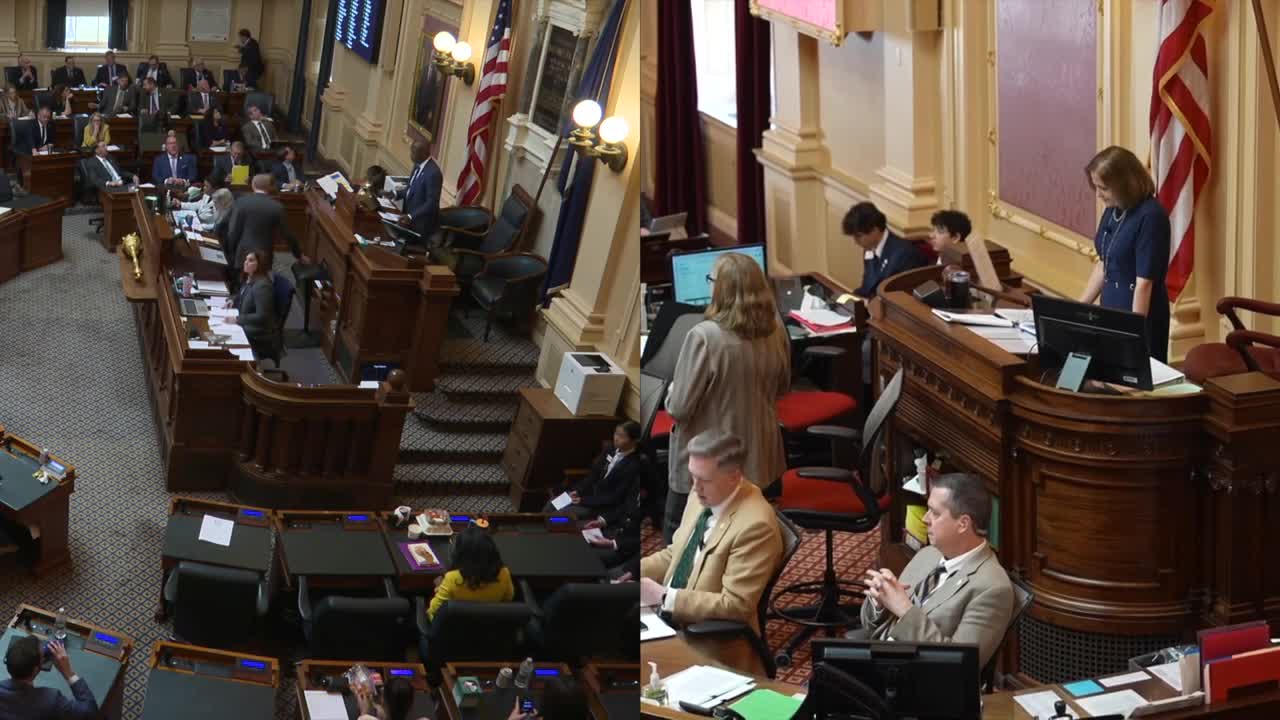


RICHMOND, Va. — The Virginia House and Senate have each released proposed changes to the state's new two-year budget, which is set to take effect July 1. The two chambers will now need to reconcile several key differences before sending a final version to Gov. Abigail Spanberger.
One difference between the two proposals involves pay raises for teachers and state workers.
Both chambers propose raises in each of the two budget years, but the House version sets that figure at 2%, while the Senate's version proposes 3%.
"I think one of the first things was ensuring that we're doing our very best to care for employees of the Commonwealth," said chair of the House Appropriations Committee Del. Luke Torian (D-Prince William).
"This raise is in addition to the additional $1,500 bonus in the caboose bill for these employees, which recognizes their dedication to keep us safe, educate our students, and keep the government running," said Senate Finance Chair Sen. L. Louise Lucas (D-Portsmouth).
The Senate version also includes several proposals not found in the House version, including a tax rebate of $100 for single filers and $200 for joint filers, an extension and increase of the standard deduction (an additional $450 for individual filers, bringing it to $9,200 and an additional $900 for joint filers, bringing it to $18,400), and an extension of earned income tax credit.
Funding for those measures comes in part from the creation of new taxable industries, including I-Gaming, retail marijuana, and skill games — some of which are written into the budget, have corresponding legislation, or both, according to Sen. Scott Surovell (D-Fairfax).
The Senate budget would also end tax exemptions for data centers on January 1, 2027 in the state, a provision not included in the House version.
"That tax exemption cost taxpayers between a billion and $2 billion depending on how you count or average, but it's grown exponentially since its original estimated cost of $1.6 million in 2010," said Surovell. "Data centers also come with a lot of other costs, and they take a lot of energy. We have to build a lot new transmission lines and energy generation facilities to deal with that, and you know, the cost of that is shared not only by data centers, but also by rate payers. And so, it's not just purely benefit. There is cost that comes along with it."
Torian said he would have discussions with the Senate about their approach.
"I live in Prince William County, where we have quite a few data centers. My locality depends on those resources tremendously, so we'll have a robust conversation about where we're going to go with that and where we're going to land," said Torian.
Senate Minority Leader Ryan McDougle (R-Hanover) also took issue with the plan.
"Through certain processes, whether it's been memorandums of understanding or the major employment initiatives, called MEIm Virginia made commitments to certain businesses," said McDougle. "Whether we like those commitments later on should not be the question. When you make a commitment, you should live by it, and we really need to analyze how that comes out in the words of the budget."
Both budgets include money to offset the impacts of federal-level changes to help Virginians with health insurance premiums and the state's share of the Supplemental Nutrition Assistance Program (SNAP). Both also contain funding to increase affordable housing and prevent eviction.
Both also contain language to allow localities to apply a 1% sales tax to fund school construction projects if it is approved by voters in a referendum.
McDougle praised the carryover of pay increases included in former Gov. Glenn Youngkin's proposed budget, including the pay increases for state workers and teachers, but said he has concerns about proposed tax increases on hunting and ammunition.
"I think there could have been more to focus on Virginians and their affordability. Collective Bargaining is going to drive up costs for Virginians. Taxes on hunting items drives up costs for Virginians. There's the opportunity to do more, like eliminate the grocery tax, address the car tax," McDougle said.
Each chamber is expected to pass its version of the budget sometime this week. The proposals will then go to a conference committee, where the two sides will work to reach a compromise before sending a final budget to Gov. Abigail Spanberger.
CBS 6 is committed to sharing community voices on this important topic. Email your thoughts to the CBS 6 Newsroom.
📲: CONNECT WITH US
Blue Sky | Facebook | Instagram | X | Threads | TikTok | YouTube

This story was initially reported by a journalist and has been converted to this platform with the assistance of AI. Our editorial team verifies all reporting on all platforms for fairness and accuracy. To learn more about how we use AI in our newsroom, click here.

