


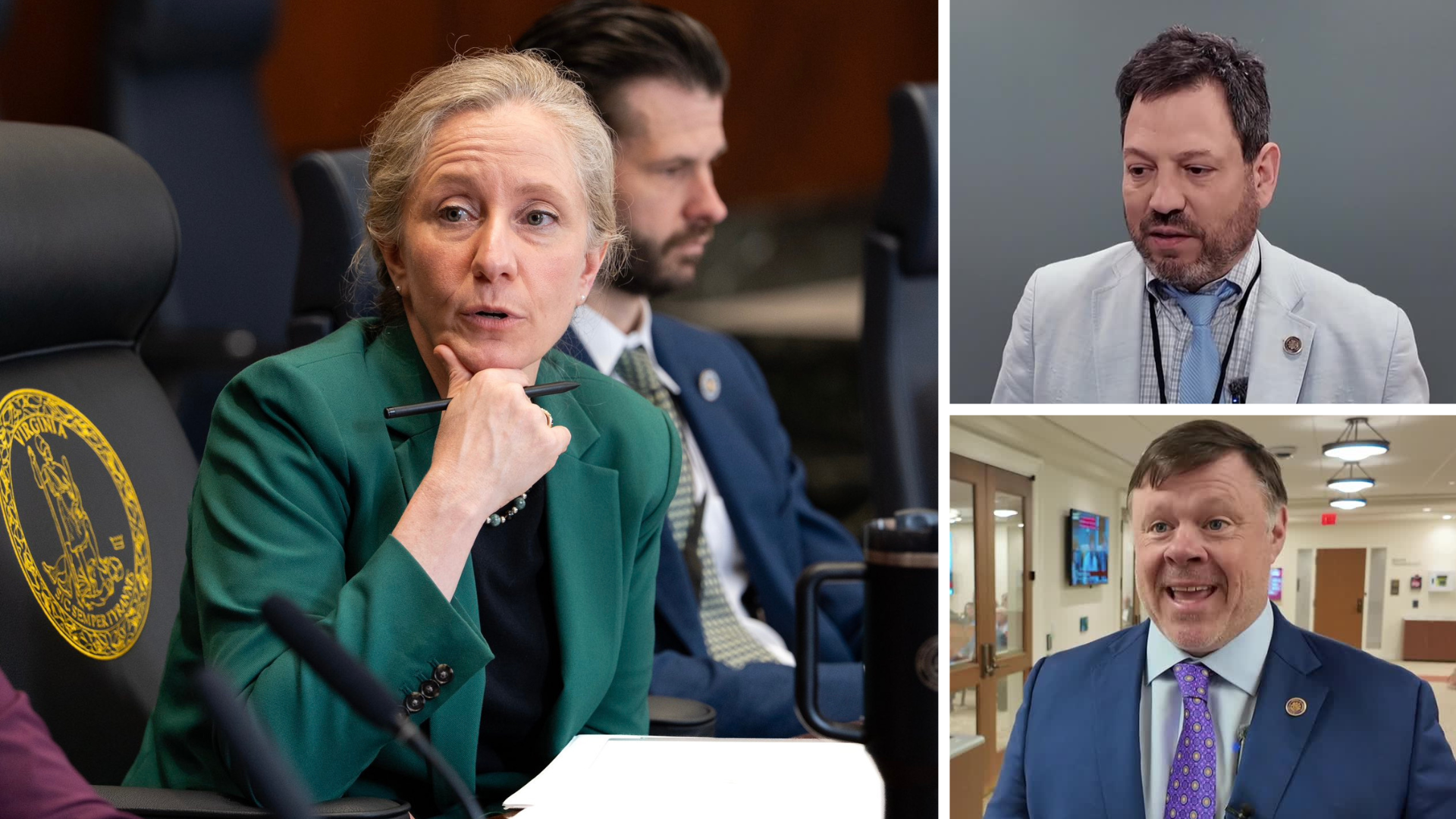


RICHMOND, Va. — Virginia Gov. Abigail Spanberger is facing pushback from Democratic lawmakers after proposing significant amendments to major legislation Monday, including bills on a retail recreational marijuana market and collective bargaining for some state and local public sector workers.
Senate Majority Leader Scott Surovell (D-Fairfax) said the changes were "basically entire rewrites," and that changes of this magnitude are normally proposed earlier in the legislative process.
"We've never really had the chance to sit down actually have a policy conversation. The conversation so far, we'll hear the 20 some changes I want to make in a very compressed period of time. So it's not really a lot of time for real serious policy dialogue," Surovell said. "There were changes made in addition to the changes that were suggested last week. I haven't had a chance to read them, but right now, I can say I'm strongly disinclined to accept them, but I have to talk to my caucus. I have to talk to stakeholders."
Surovell sponsored the bill to expand collective bargaining to state and local public sector workers. Localities currently have to opt-in to allow their employees to collectively bargain. Among the changes proposed would be delaying the removal of the opt-in until 2030.
Senate Minority Leader Ryan McDougle (R-Hanover) said he is opposed to the collective bargaining bill coming into law in any form and said it will lead to a tax increase.
"It is clear, whether you talk to Democratic jurisdictions or Republican jurisdictions, it will raise your taxes. It is bad policy. We should not institute it. Whether it's 2029, 2030, or forever," McDougle said.
On the recreational marijuana marketplace legislation, proposed changes from Spanberger include moving the start date from Jan. 1, 2027, to July 1; lowering the cap on the number of allowed stores from 350 to 200; and increasing the state's eventual portion of the tax rate from six to eight percent.
During a Senate Finance hearing Tuesday, Surovell told Finance Secretary Mark Sickles these changes impact the budget the General Assembly is still negotiating.
"It makes it very hard for us to plan when things like that are revealed to us after we've already passed bills," Surovell said.
Sickles said Spanberger had done her part and it was up to legislators to decide whether to accept or reject her proposals.
"But, I would encourage you to read it and look at it from a good government policy perspective, and maybe, maybe you'll find it it's makes sense," added Sickles.
In response to the push back, during a Tuesday afternoon news conference, Spanberger told reporters she took a line-by-line approach to the big issues.
"To making sure that the bills that I am implementing, ultimately the laws that I am signing, are something that I can set up for success," Spanberger said.
Spanberger said it will take time for the oversight board to get established and some state workers would still be allowed to bargain starting in 2028.
"I thought it was best to make sure that certainly, as the head of the executive branch, to have us take that step forward, learn from any of the hurdles that might be in our way, and set localities up for success if your workforce chooses to collectively bargain," Spanberger said.
Spanberger also made changes to bills regarding paid sick leave, paid family and medical leave, and an assault weapons ban. Democratic lawmakers said they approve of those changes.
“Assault weapons are designed for use on the battlefield to inflict maximal damage in minimal time. As long as criminals can easily get weapons that are more deadly than those carried by law enforcement, mass shootings will continue to happen more frequently in America than anywhere in the world," said Sen. Saddam Salim (D-Fairfax), the sponsor of the senate bill on the assault weapons ban. "I thank Governor Spanberger for proposing amendments that are consistent with my goal when I wrote the bill: to end the sale of these weapons without criminalizing what people own today or infringing their 2nd amendment rights. Every state already does this with fully automatic weapons, and the federal government did this with assault weapons in the 1990s and saw huge reductions in shootings and deaths. Virginians are ready to bring back a policy that will end the constant fear of mass shootings in our schools, houses of worship, and other public places. I look forward to seeing this bill signed into law and enacted this summer.”
Republicans criticized the changes, saying the new language in the assault weapons bill expands which guns would be considered illegal, including many handguns used for home self-defense.
"If there was any doubt that Governor Spanberger was coming for our firearms, this substitute removes it. Not only does it keep in place the de facto ban on some of the most common firearms in Virginia, it goes further and appears to create a ban on any firearm that can accept a magazine of more than 15 rounds. That includes the vast majority of firearms in Virginia that are in common use for legal purposes. As the Department of Justice has already said, this is an infringement on a core civil right, and should be overturned by a court under Bruen, Heller, and other Supreme Court precedents," said House Minority Leader Terry Kilgore.
Lawmakers will be back in Richmond next Wednesday to reject or accept the vetoes and amendments.
If they reject an amendment, the bill goes back to Spanberger, who can either accept the original bill or veto it. Lawmakers have the option to preemptively block that veto, but it would require a two-thirds majority, meaning Democrats would need Republican help.
Click the links below to view bills the Governor:
CBS 6 is committed to sharing community voices on this important topic. Email your thoughts to the CBS 6 Newsroom.
📲: CONNECT WITH US
Blue Sky | Facebook | Instagram | X | Threads | TikTok | YouTube

This story was initially reported by a journalist and has been converted to this platform with the assistance of AI. Our editorial team verifies all reporting on all platforms for fairness and accuracy. To learn more about how we use AI in our newsroom, click here.

