

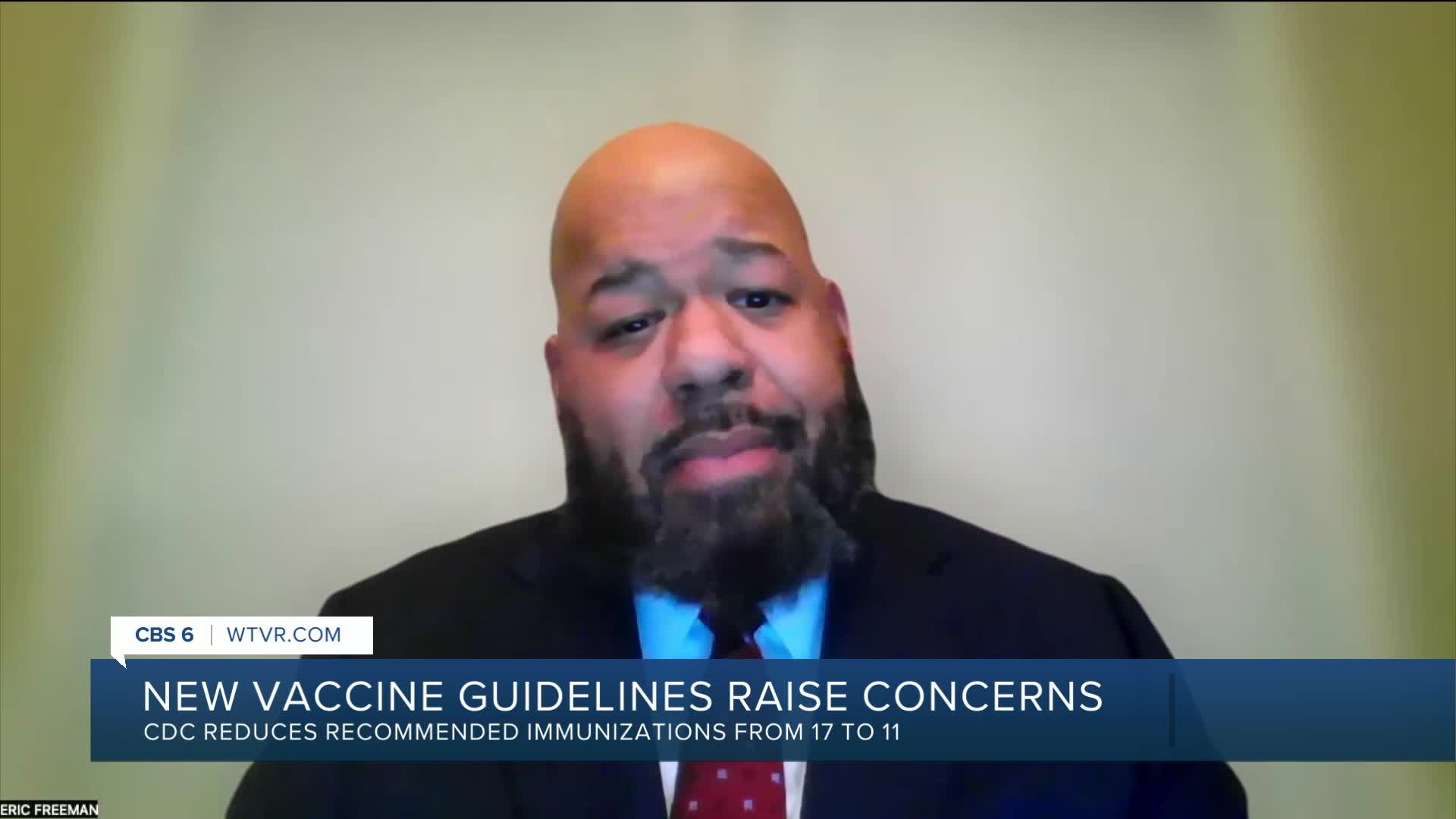


RICHMOND, Va. — The Centers for Disease Control and Prevention announced updated recommendations for childhood vaccines on Monday, reducing the number of required immunizations from 17 to 11 diseases and raising concerns among pediatricians and health care providers across the country.
The new vaccine guidelines come as cases of flu and RSV are surging in children and adolescents, according to Dr. Eric Freeman, a pediatrician with Old Dominion Pediatrics.
Rise in flu cases puts strain on Virginia hospital system: 'We are looking at having capacity constraints'
"I think some of these decisions can be premature and can really have complications in terms of ensuring the health and safety of our children," Freeman said.
Under the new guidelines, all children should receive vaccines for diphtheria, tetanus, pertussis, HIB, pneumococcal conjugate, polio, measles, mumps, rubella, HPV and chickenpox.
A second category recommends that only children in high-risk groups receive immunizations for RSV, hepatitis A and B, dengue and meningococcal disease.
In a third category, children not in high-risk groups should make decisions about certain vaccines through shared clinical decision-making between physicians and parents. Those immunizations include COVID-19, influenza, meningococcal disease and hepatitis A and B.
Freeman expressed alarm about the timing of the changes.
"One thing that really alarms us in these new recommendations from the CDC is that it's not based on any new science. There's not been any new research or evidence-based literature that have been used as a predicate to change these recommendations," Freeman said.
U.S. Secretary of Health and Human Services Robert F. Kennedy, a longtime vaccine critic, said in a statement that the announcement "protects children, respects families, and rebuilds trust in public health."
Kennedy said the assessment compared the U.S. vaccine schedule to those of 20 other developed nations and found that the U.S. is a "global outlier."
The American Academy of Pediatrics disagrees, saying the longstanding U.S. recommendations are "largely similar across developed countries," with some variance due to factors like disease threats, demographics and health care systems.
"The current recommendations that we see really mimic many of the recommendations in Denmark. However, it's important to highlight that it is really difficult to compare the United States and the needs of the children here, with the needs to children in other countries," Freeman said.
Freeman noted that while the CDC guidelines have changed, the current recommendations made by the Virginia Department of Health have not.
CBS 6 is committed to sharing community voices on this important topic. Email your thoughts to the CBS 6 Newsroom.
📲: CONNECT WITH US
Blue Sky | Facebook | Instagram | X | Threads | TikTok | YouTube

This story was initially reported by a journalist and has been converted to this platform with the assistance of AI. Our editorial team verifies all reporting on all platforms for fairness and accuracy. To learn more about how we use AI in our newsroom, click here.
