

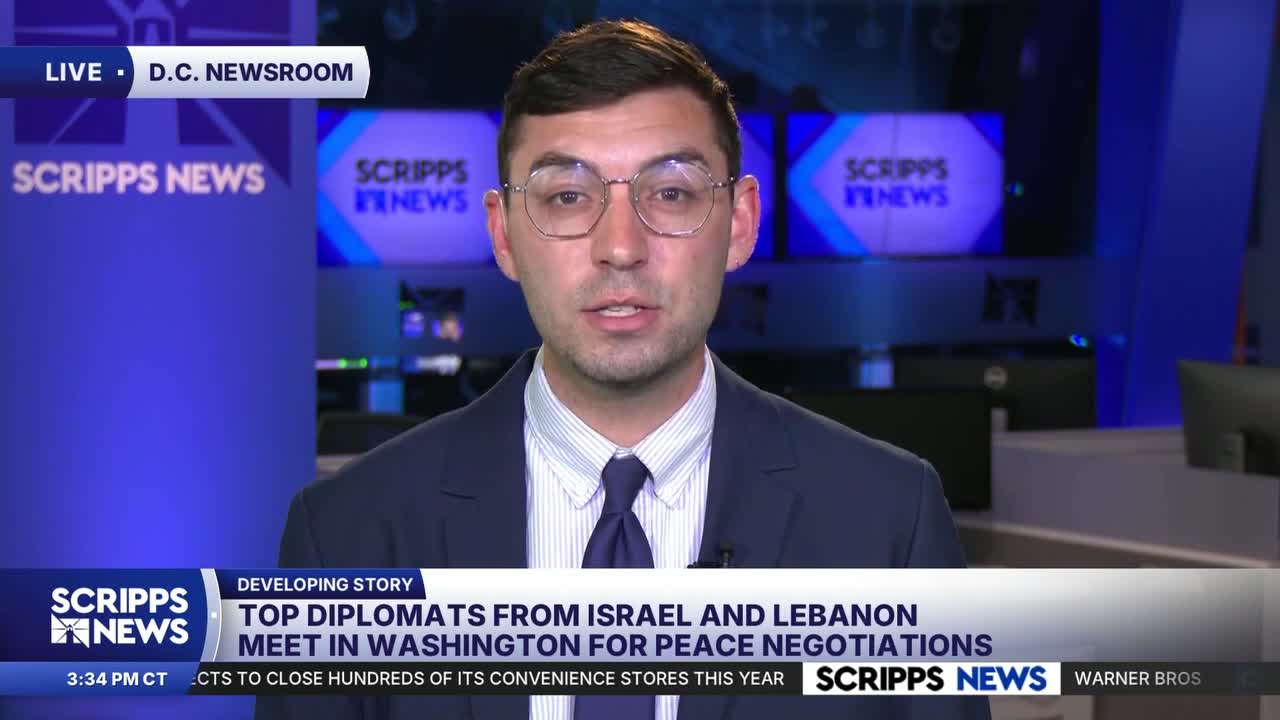


For the first time in over 30 years, senior Israeli and Lebanese officials held in-person talks about their countries’ diplomatic futures, as the Iran conflict continues to reshape decades of geopolitical precedent throughout the Middle East.
Hosted by Secretary of State Marco Rubio at the U.S. State Department, the meeting included Michael Leiter, Israeli Ambassador to the U.S., Nada Hamadeh, Lebanese Ambassador to the U.S., and Michel Issa, U.S. Ambassador to Lebanon. Mike Needham, Counselor to the State Department, also participated, and U.S Ambassador to the United Nations Mike Waltz was present for a photo opportunity as the discussion began.
Ahead of the conversation, Rubio said the talks represented the start of a “process,” noting that “all of the complexities of this matter are not going to be resolved in the next six hours.”
Rather, the officials were aiming to reach “something very permanent,” Rubio said, “so that the people of Lebanon can have the kind of future they deserve, and so that the people of Israel can live without fear of being struck by rocket attacks from a terrorist proxy of Iran.”
Asked by Scripps News whether the meeting might result in a ceasefire between Israel and Lebanon, Rubio said it was “a lot more than just about that.”
“This is about bringing a permanent end to 20 or 30 years of Hezbollah influence in this part of the world,” Rubio added.
A State Department official, granted anonymity to discuss sensitive diplomatic matters, said the meeting had been planned for a month, well before Vice President JD Vance failed to reach an agreement with Iranian leaders in Islamabad to reach a permanent end to the Iran war.
RELATED NEWS | Vance says talks with Iran have ended without an agreement to end war
The official also stressed that President Donald Trump sees these talks as distinct from the broader, ongoing negotiations on the Iran conflict. Iranian and Pakistani leaders have said the two-week, US-Iran ceasefire announced by President Trump on April 7 did cover Israel’s actions in Lebanon, though the U.S. and Israel have disputed such a characterization.
Hezbollah’s Secretary-General Naim Qassem, meanwhile, has rejected the meeting as a “free concession” to Israel and promised the group won't abide by any agreements reached in Washington. Hezbollah leaders made no public announcements after the meeting, though a TV channel run by the group indicated strikes on Israel were ongoing.
Leiter, for his part, told reporters upon leaving the State Dept. that the U.S., Israel and Lebanon were all “on the same side of the equation,” suggesting the leaders shared a goal of “liberating” Lebanon from Hezbollah’s control.
“The vision, the long term vision, where there will be a clearly delineated border between our countries and where the only reason we'll need to cross each other's territory will be in business suits to conduct business, or in bathing suits to go on vacation,” Leiter said.
The Israeli leader went on to reject the notion that Israel should moderate its attacks in Lebanon in the meantime: “Missiles are being fired at our civilians,” he said. “That will be put a stop to. We will not allow a terror organization to continually fire missiles into our population centers.”
And while a U.S. statement released Tuesday afternoon celebrated the “historic milestone” of the meeting, it made no call for a halt to Israeli strikes or withdrawal from Lebanese territory, instead affirming Israel’s “right to defend itself” from Hezbollah.
RELATED NEWS | Netanyahu authorizes direct talks with Lebanon in potential boost to ceasefire efforts
Earlier Tuesday, a joint statement from a coalition of 18 foreign ministers called on Hezbollah to cease its attacks on Israel but also condemned “massive Israeli strikes on Lebanon” and reaffirmed Lebanese territorial integrity.
“Civilians and civilian infrastructure must be protected in accordance with international humanitarian law,” the foreign leaders wrote.
Since the Iran conflict began, Israeli strikes have killed 2,124 people in Lebanon, the nation’s health ministry said Tuesday, including 254 women, 168 children and 88 health workers.
A State Dept. official told Scripps News the U.S. recently approved $58.8 million in new humanitarian aid to provide lifesaving assistance to displaced Lebanese, with a focus on “food, health, water, wastewater, shelter, and the emergency response needs of the most conflict-affected populations.”

