

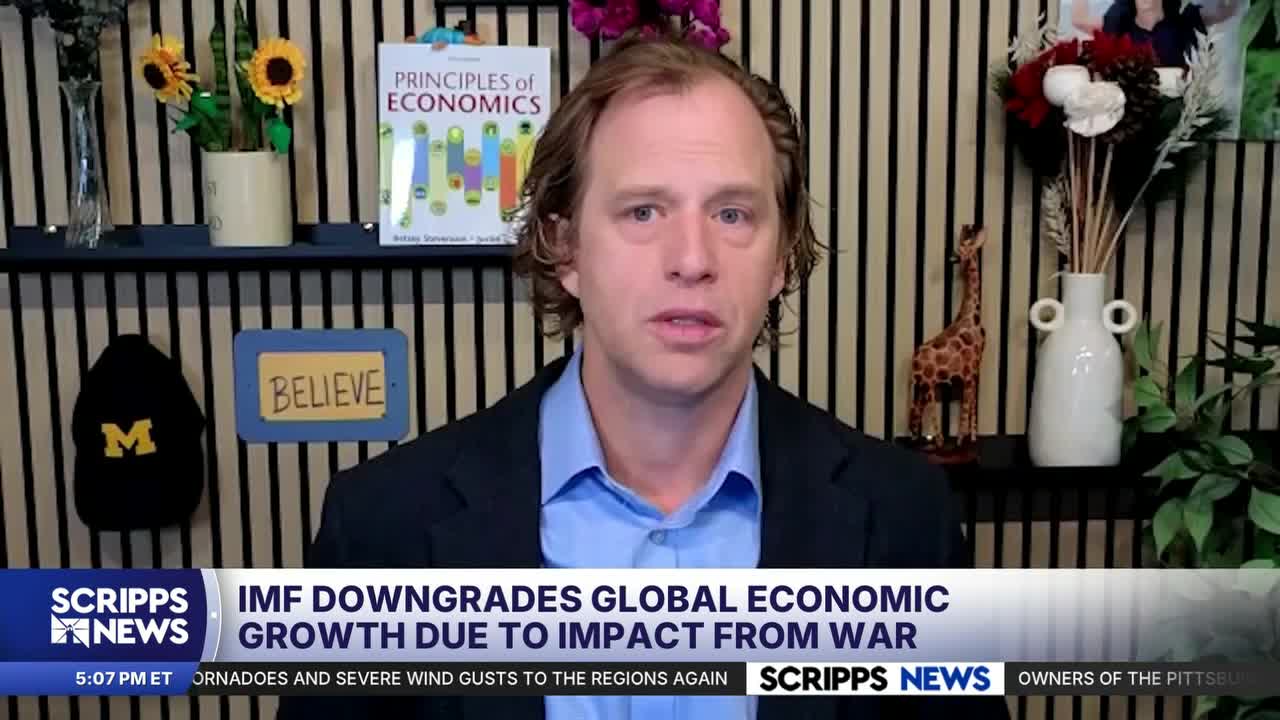


The war launched by the United States and Israel against Iran has disrupted the global economy and could have deep and long‑lasting effects, the International Monetary Fund warned Tuesday.
The IMF projects global growth will slow to 3.1% in 2026 and 3.2% in 2027, assuming the conflict ends quickly. That would amount to a 0.3‑percentage‑point drop from the previous year.
The impact could be much greater if the war drags on for months, the IMF cautioned.
RELATED STORY | Inflation was already high before Iran war drove up gas prices, new report shows
“Should the conflict become more protracted than assumed in the reference forecast, or the resumption of production and transport activities take longer than assumed because of possible scarring from closing of or damage to energy infrastructure, the impact on growth would be larger,” the report said.
Under one scenario, global growth could slow to 2.5%. In a more severe scenario, growth could fall to 2%, putting the global economy at risk of recession.
The IMF also noted that President Donald Trump’s tariff policies have sent additional shockwaves through the global economy.
Persisting conflict could send gas prices soaring, potentially doubling from prewar levels, the IMF warned. One key factor is the near‑shutdown of the Strait of Hormuz, a critical chokepoint where nearly one‑fifth of the world’s oil is transported. Such a disruption could ripple through other sectors, including food and agriculture, increasing costs worldwide.
“A longer shutdown of the Strait of Hormuz and further damage to drilling and refining facilities would disrupt the global economy more deeply and for longer,” the IMF said. “In an adverse scenario, assuming a sharper increase in energy prices this year coupled with rising inflation expectations and some tightening of financial conditions, growth falls to 2.5% this year and inflation rises to 5.4%.
“In a severe scenario where energy supply dislocations extend into next year, inflation expectations become markedly less anchored, and financial conditions tighten sharply, global growth would decline to 2% this year and next, while inflation would exceed 6%. Despite the recent news of a temporary ceasefire, some damage is already done, and the downside risks remain elevated.”
RELATED STORY | Inflation jumps on energy price surge after US attacks on Iran

