

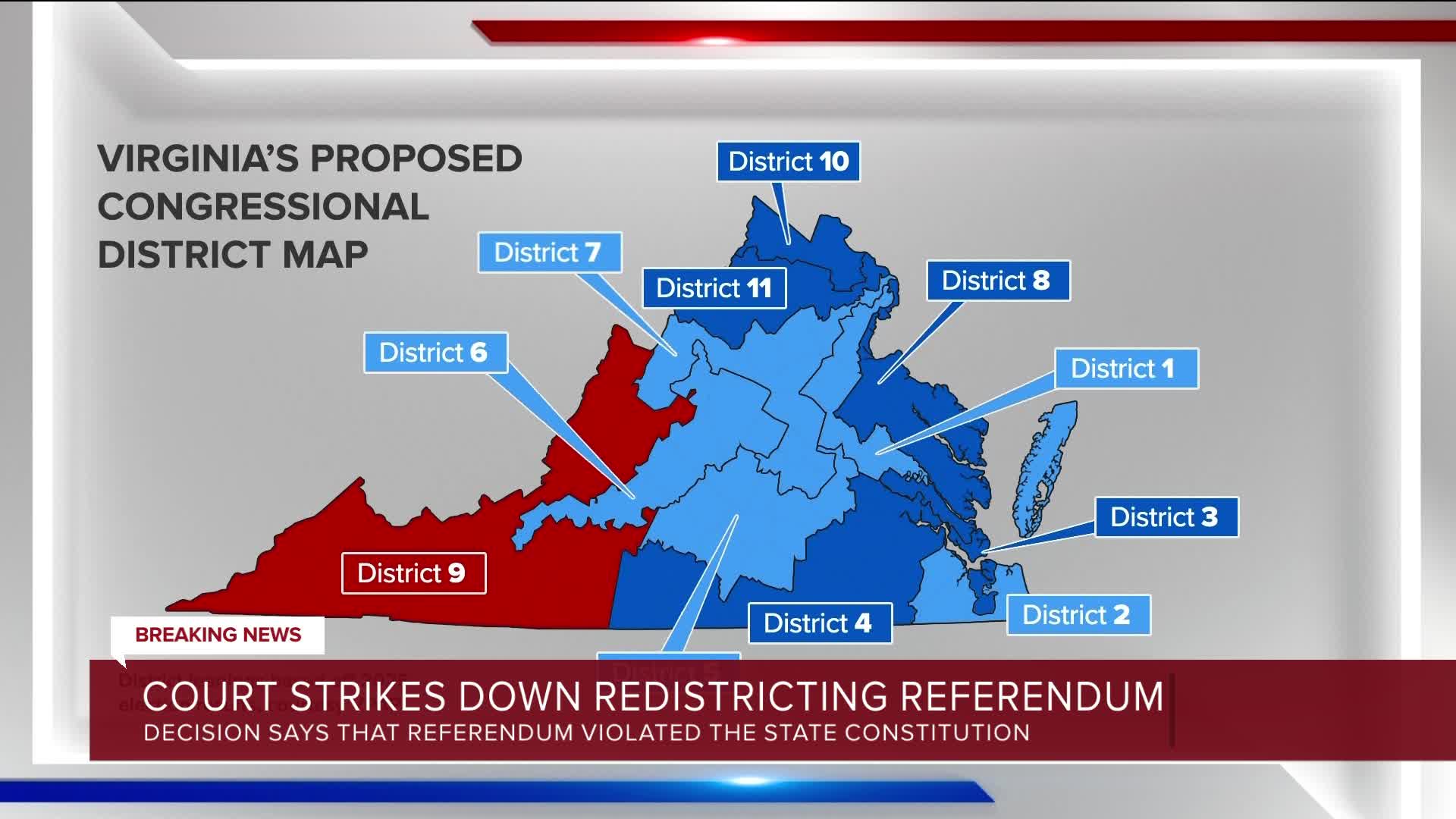


RICHMOND, Va. — The Supreme Court of Virginia struck down a redistricting referendum Friday that voters narrowly approved in a special election, ruling that Democratic lawmakers violated procedural rules when they referred a constitutional amendment to the ballot to create Virginia's new congressional map.
The map likely would have given Democrats four additional seats.
In a 46-page opinion, the court found that the process by which the referendum reached the ballot did not comply with constitutional requirements.
“This violation irreparably undermines the integrity of the resulting referendum vote and renders it null and void,” the court said in its opinion.
Cayce Myers, a professor at Virginia Tech, had previously explained the core of the Republicans' legal argument against the referendum.
"The Constitution prescribes a way by which a ballot referendum can occur. Generally speaking, the ballot referendum has to pass through the legislature, there has to be an intervening election, and then there's another passing of the vote, and then it goes on the ballot. That process, by just looking at it from a constitutional perspective, looks like a long process. This process was very fast because there was a special session," Myers said.
Myers had noted the significance of such a ruling before the court's decision came down.
"If the court were to find that the process was not done correctly, that does overturn an election in which a majority of people voted a particular way," Myers said. "So there is that implication there that I think is significant. Not sure that the court is really weighing that as part of the legal analysis, but that certainly is part of the kind of the larger political context."
Myers had also emphasized that the legal challenges were never about the fairness of the districts themselves.
"The issue is a very legalistic definitional issue around what happened and the process by which it happened, and to get to the point that there was a vote," Myers said.
With the referendum struck down, the congressional map will not shift from the current layout, which favors Democrats six to five. Myers had previously warned that more legal battles could follow regardless of the court's ruling.
"I think lawsuits are going to continue," Myers said. "I think that that's just been the nature of and some of them have traction and will go forward. We've seen this in other states where there's lawsuits around the elections and how votes are counted and how, you know, different processes. And so I wouldn't be surprised to see more lawsuits."
Attorney General Jay Jones said the court "put politics over the rule of law" with their decision.
"Today the Supreme Court of Virginia has chosen to put politics over the rule of law by issuing a ruling that overturns the April 21st special election on redistricting. This decision silences the voices of the millions of Virginians who cast their ballots in every corner of the Commonwealth, and it fuels the growing fears across our nation about the state of our democracy," Jones said in part.
House Minority Leader Terry Kilgore (R-Scott) issued a statement saying the ruling "establishes once again that the Constitution of Virginia means what it says."
Click here to see reactions from both sides.
This is a developing story. Email the CBS 6 Newsroom if you have additional information to share.
📲: CONNECT WITH US
Blue Sky | Facebook | Instagram | X | Threads | TikTok | YouTube

This story was initially reported by a journalist and has been converted to this platform with the assistance of AI. Our editorial team verifies all reporting on all platforms for fairness and accuracy. To learn more about how we use AI in our newsroom, click here.