

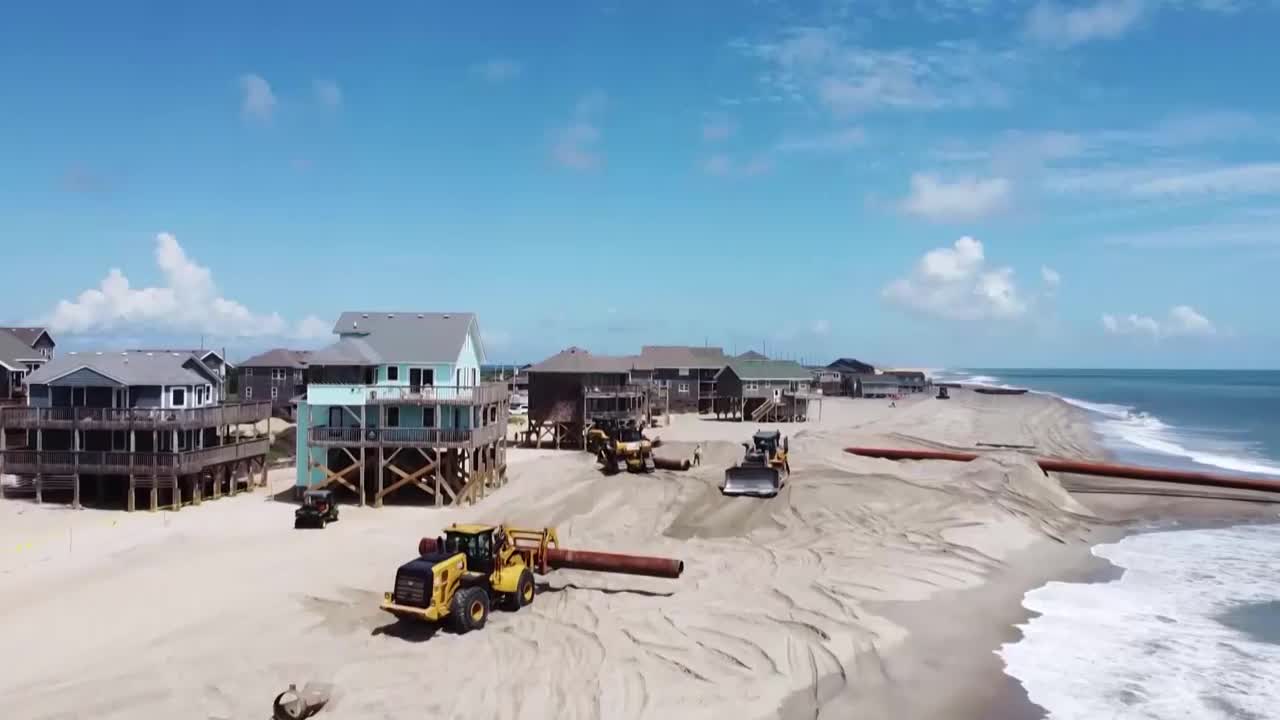


BUXTON, NC — Dare County is racing against the next storm — pumping millions of cubic yards of sand onto badly eroded beaches in a $50 million effort to protect the Outer Banks shoreline before it washes away.
Dare County Manager Bobby Outen is overseeing the project, which involves taking sand from the ocean bottom and pumping it onto a three-mile stretch of weathered and eroding beach.
When complete, two million cubic yards of sand will have been added to the shoreline, widening it by up to 75 feet in certain stretches to create a buffer for roads and surrounding homes.
Outen said the stakes could not be higher for the county's economy.
"We have a huge economy that we need to protect, and the only reason anybody comes to Dare County is to either fish, buy a boat, or go to the beach," Outen said.
He described the beaches and dunes as the county's first line of defense against flooding.
"Our beaches and our dunes are our levee system. That's what keeps the water out from damaging our infrastructure, protecting tourism, infrastructure," Outen said.
The urgency is not abstract. Last fall, hurricane flooding and powerful tides pummeled this same stretch of coastline, with ocean waves crashing 70 to 100 yards inland and homes toppling into the Atlantic. Erosion and rising sea levels have caused dozens of homes to be swallowed by the ocean in recent years.
Outen warned that without intervention, the damage would extend far beyond the beach itself.
"If you allow the ocean to continue to erode, it takes out the highway, it takes out the power lines, the water lines, the internet, all the things that you take for granted," Outen said.
This is the area's third beach nourishment project — and its most expensive, costing county taxpayers $50 million. The work will not last forever. In about five years, crews will have to return and do it again, a temporary fix in a never-ending cycle.
-
Giving You A Voice
-
Your Voice, Your Story
🎙️ WTVR Podcasts
-
Eat It, Virginia! with Scott and Robey
Untold with Catie Beck
This story was initially reported by a journalist and has been converted to this platform with the assistance of AI. Our editorial team verifies all reporting on all platforms for fairness and accuracy. To learn more about how we use AI in our newsroom, click here.
-
 Facebook
  TikTok
  YouTube
 Blue Sky
 Instagram
 Threads
 X
X

