


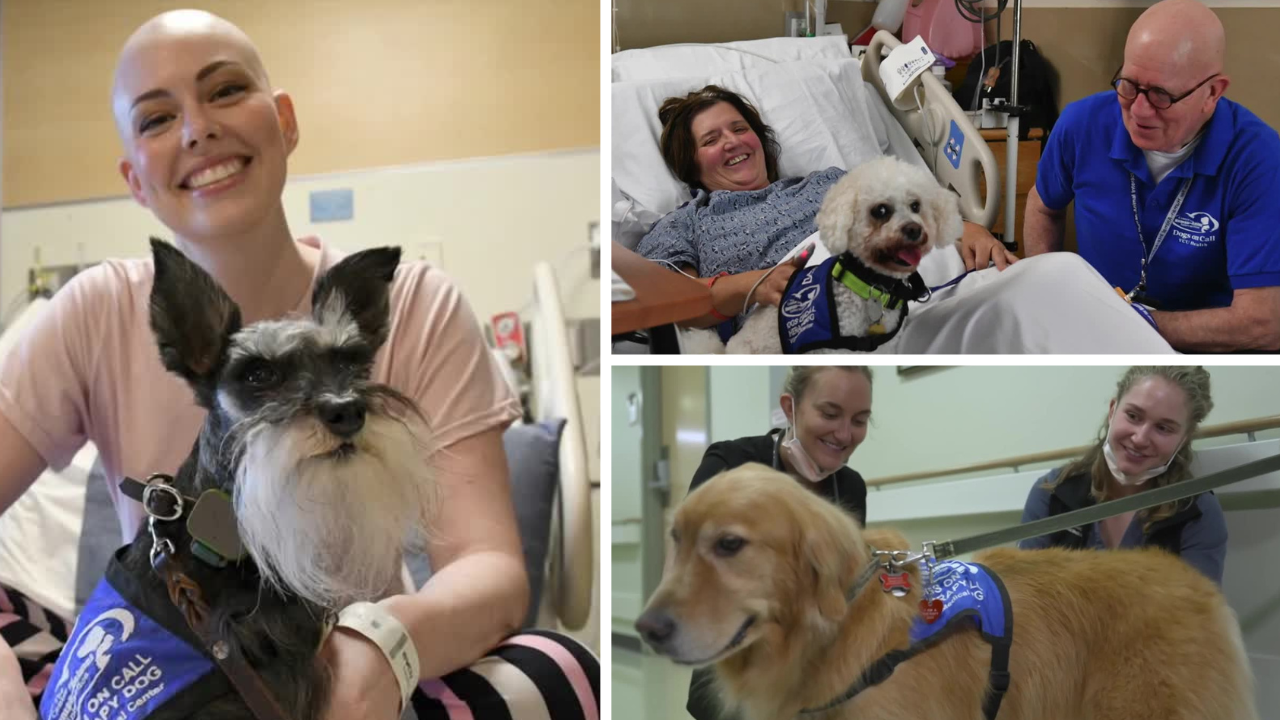


RICHMOND, Va. — For 25 years, VCU Medical Center's "Dogs on Call" therapy program has been sending certified therapy dogs into hospital rooms to provide companionship to patients. New research suggests those visits may be doing more than just lifting spirits.
Eliza Leitch and her dog Luna are regulars in the halls of VCU Medical Center, offering the kind of healing that can't come from a prescription.
"It just makes me so happy to know that we may have made their day," Leitch said.
The duo is one of more than 60 human-dog teams with VCU's Dogs on Call therapy program, a 25-year endeavor that certifies dogs to be safe in a hospital setting and pairs them with patients for companionship.
Nancy Gee, a researcher with VCU's Center for Human and Animal Interaction, says the visits offer patients something uniquely valuable.
"This is the only time someone walks into that room who doesn't want something from them. They're not going to take a blood sample, they're not there to give medication, they're not there to do anything, they're just there to relax and talk to that person," Gee said.
But Gee wanted to find out if there was evidence to show that dog visits were doing more than just making patients feel good.
Over the course of a year, Gee says VCU researchers evaluated 60 participants in the psychiatric unit suffering from depression and loneliness to determine the degree to which their conditions improved. Researchers established three conditions, each lasting 20 minutes a day: one in which a dog and handler visited a patient, a second in which only the handler visited, and a third in which patients received treatment as usual.
"Essentially what we found is that the presence of the dog reduced loneliness significantly more than the handler and then the control condition," Gee said. "It's the dog that's really making the clinical difference in these outcome measures."
Gee says science shows the populations most negatively affected by loneliness and depression in a hospital setting are older adults, individuals with mental illness, and hospitalized children.
A 2025 survey conducted by the American Psychological Association among more than 3,000 U.S. adults ages 18 and older found that 62% reported societal division as a significant source of stress in their lives.
Gee says more research is still needed, including whether the effects of therapy dog visits are short-term or lasting.
"Are they more compliant with treatment, do they have a better outlook and sort of more willingness to keep going and keep facing those challenges? That's the part we don't know yet, but I suspect the answer is yes," Gee said.
Still, Gee says the preliminary findings point in a promising direction.
"Are the effects short-term or do they last over time? There are some things we don't have the answers to, but what we're getting is really good information that having a dog in the hospital particularly in the way that we are delivering the program, we've got solid science showing that this is effective for a number of outcome measures for our patients," Gee said.
Click here to learn more about Dogs on Call.
CBS 6 is committed to sharing community voices on this important topic. Email your thoughts to the CBS 6 Newsroom.
📲: CONNECT WITH US
Blue Sky | Facebook | Instagram | X | Threads | TikTok | YouTube

This story was initially reported by a journalist and has been converted to this platform with the assistance of AI. Our editorial team verifies all reporting on all platforms for fairness and accuracy. To learn more about how we use AI in our newsroom, click here.

