


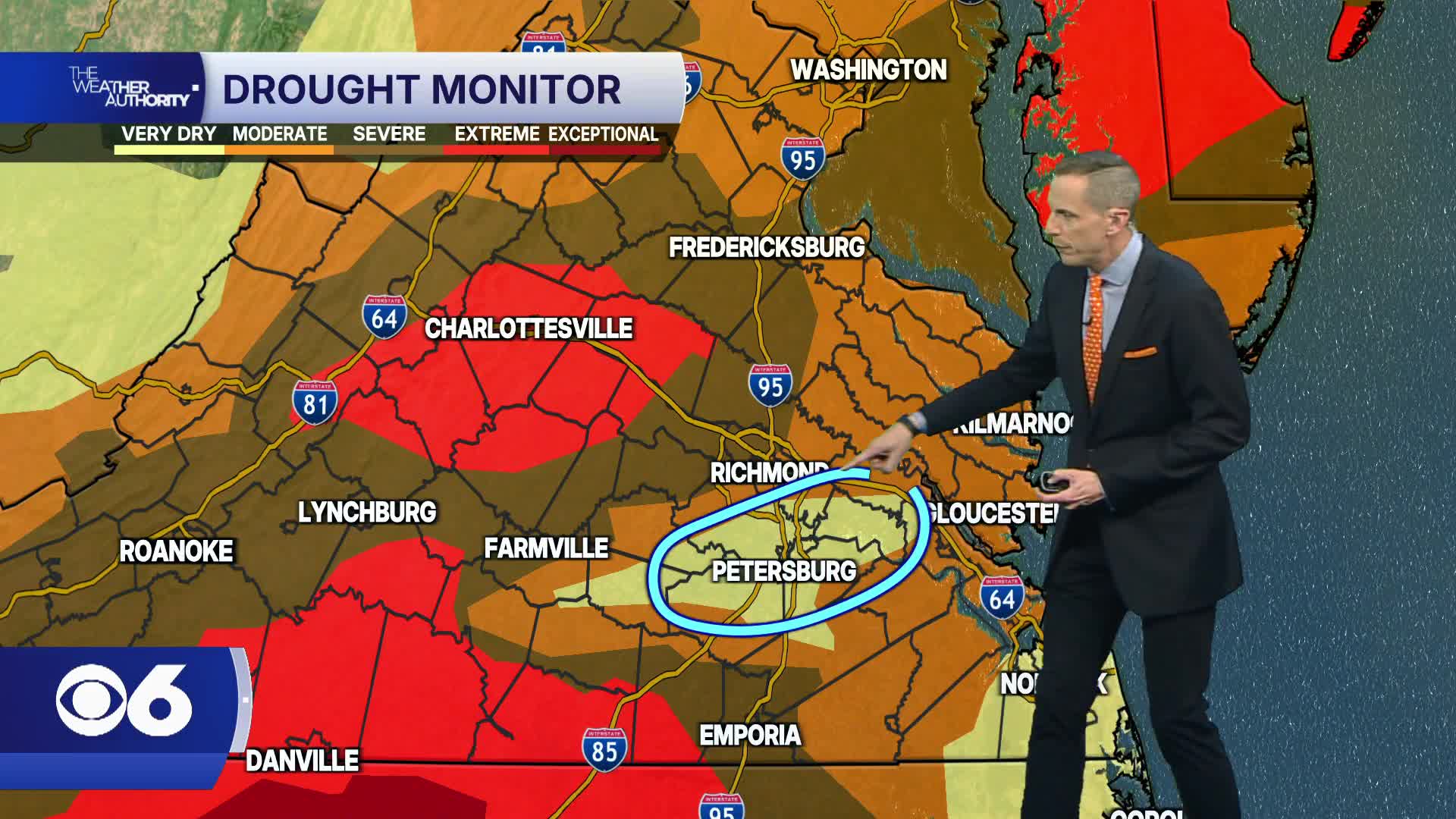


RICHMOND, Va. — Recent rainfall has brought a glimmer of relief to the Richmond area and Tri-Cities, but Virginia's historic drought has reached emergency status in the Roanoke region — and the rest of the Commonwealth is not out of the woods.
The latest U.S. Drought Monitor, released Thursday and based on conditions through Tuesday morning, shows meaningful improvement across multiple drought categories statewide. Areas near Richmond down to the Tri-Cities are no longer in drought status, having been downgraded to the abnormally dry category. Extreme drought has dropped from 26% to 17% — a decrease of nearly 10 percentage points. Severe drought has fallen 7 points to 33%.

However, the improvement does not tell the full story, according to the Virginia Department of Environmental Quality. That agency says all areas of the Commonwealth continue to experience historic drought conditions, as statewide rainfall is 7.8 inches below normal for the water year — making this the second-driest water year on record.
The Roanoke region has received only 57% of its normal rainfall, and that region has now reached drought emergency status.
"In the midst of this historic dry period, all Virginians can help preserve our water supply," Gov. Abigail Spanberger said. "Increased water conservation measures are critical to protect access to adequate water supplies for Virginia's families, farms, and communities as the drought persists."
NEWS CONFERENCE: Roanoke region reaches drought emergency
Roanoke region reaches emergency status
The Roanoke Drought Evaluation Region — which includes Danville, Martinsville, Roanoke and Salem as well as the counties of Bedford, Campbell, Charlotte, Franklin, Halifax, Henry, Mecklenburg, Patrick, Pittsylvania and Roanoke — has reached emergency status after Virginia's Drought Monitoring Task Force recommended a drought emergency for the region on July 7.
Spanberger held Thursday's news conference at Smith Mountain Lake, which sits 5.5 feet below normal levels. The lake, which provides electricity, drinking water, and water for farmers while also driving significant recreational tourism, has become a symbol of the drought's severity in the region.
"In Northern Virginia, in Richmond, on the Eastern Shore, the impacts of the drought impact everyone, even if the severity of it isn't as extreme as we are feeling right here," Spanberger said.

Conditions in the Roanoke region are among the most severe in the state. Surface water flow is below the 5th percentile, and streamflow within the James River, Meherrin River, New River, and Roanoke River watersheds continues to show significant deficits. Groundwater wells in the region continue to set provisional record daily low water levels.
Reservoir levels at Smith Mountain Lake and John Kerr Reservoir are well below normal, sitting 5.5 feet and 4.45 feet below normal, respectively.
"Unfortunately, if conditions on the ground do not rapidly improve, mandatory water conservation measures may be necessary in the Roanoke region," said Adrienne Kotula, the commonwealth's Acting Drought Coordinator and Deputy Secretary of Natural and Historic Resources.
Senator Mark Peake, who represents the 8th Senate District including the northern portion of Smith Mountain Lake, urged residents to act voluntarily to avoid government intervention.
"Only God can fix this. Only God gets to make water, but each and every one of us can do our own part to help ease this drought that we're going through," Peake said. "If we voluntarily take water saving measures, the government will not have to step in."
WATCH: Hour-by-hour shows when chances for storms 'goes way up' this weekend
Water utilities sounding the alarm
The Western Virginia Water Authority and Bedford Water Authority together serve the region and are working to maintain reliable water service. Brian Key, executive director of Bedford Water Authority, urged residents to reduce non-essential water use now.
"We much prefer to be in the voluntary restriction stage rather than the mandatory restriction stage, but it really calls for everybody to do a little bit," Key said. "If you can keep a little bit of those non-essential uses out and keep the water for the essential uses for the potable needs for drinking water, we'll all be in a better place."
Key also called on regulators to review the criteria for downstream water releases at Smith Mountain Lake, noting that evaporation accounts for far more water loss than withdrawals by water utilities. He said he was told Thursday that regulators are working with AEP to potentially reduce the amount of water released downstream.
Private wells going dry
Dwayne Roadcap, director of drinking water at the Virginia Department of Health, said the state is seeing an increase in well applications to replace wells that are going dry.
"If you're on a private well and you're noticing low flow pressure or no flow pressure, reach out to your local health department, but more importantly, give your well a rest and give it time to rest so that it can recover," Roadcap said.
Roadcap has served on the Drought Monitoring Task Force for the past year and said the task force, which typically meets every two weeks, is now meeting weekly given the severity of conditions.
What could come next
Spanberger said the administration is monitoring conditions on an hourly basis and that there is no clear timeline for what comes next.
"There is no clear map for what comes next, because what we are all wanting to see is a shift of improvement," Spanberger said. "We will celebrate any small minor improvement. We want to see that continue."
Secretary of Natural and Historic Resources David Bulova said some water utilities have independent authority to implement their own mandatory restrictions and that more aggressive outreach is possible in certain areas.
"In some areas there may be some more aggressive outreach and potentially mandatory restrictions," Bulova said. "We're looking at the whole thing and making decisions week by week about whether we need to ramp up those efforts."
Bulova noted that a single rain event will not end the drought. Like the 2002 drought, which lasted several years, recovery will require sustained rainfall over a long period of time.
Virginia's Drought Assessment and Response Plan, which has been in effect since 2003 and was developed in the wake of the last major drought, provides the roadmap for the state's coordinated response.
WATCH: Virginia farmers face drought, rising costs as they await financial relief
Agricultural impacts
Virginia's farmers have been struggling with the drought since 2025, and conditions have grown more severe throughout 2026. Secretary of Agriculture and Forestry Katie Frazier said the impacts are visible across fields, orchards, and forests statewide.
The USDA Farm Service Agency has issued drought disaster designations for over 75 Virginia localities, including all localities in the Roanoke region. Farmers have had to feed hay during times when pastures should be abundant, and some producers are trucking hay in from states outside Virginia.
Scott Sink, president of the Virginia Farm Bureau Federation and a beef cattle and hay producer in Franklin County, said mandatory restrictions would directly impact agricultural livelihoods.
"Agriculture relies on water for our livelihood and so having mandatory restrictions would definitely impact that," Sink said. "We already have producers that are having to truck hay in from states outside of this region."
Frazier said most of the severe agricultural impacts will not be fully known until fall harvest, when crop yields and losses are quantified. She encouraged farmers to report drought impacts to local extension agents and county Farm Service Agency offices, and to visit the VDACS disaster recovery resource website.
Farmers struggling with the mental health toll of the drought can call or text the AgriStress helpline at 833-897-2474, which provides support specifically designed for agricultural families.
Metro Richmond still under voluntary advisory
Richmond issued its first voluntary water conservation advisory since 2002 on July 1, as the James River continued to run below normal levels. Mayor Danny Avula urged residents across the region to reduce non-essential water use.
"There's little things that we can all do to play our part to make sure that we have enough water to get us through the season and hopefully as we head into the fall we'll see it pick back up," Avula said.
Richmond's water treatment plant supplies water to Richmond, Chesterfield, Hanover, Henrico, Goochland, and Powhatan, making regional participation critical.
Mandatory restrictions and what's next
Twenty-nine community water systems continue to have mandatory conservation measures in place across Caroline, Fauquier, Louisa, Orange, Powhatan, and Shenandoah counties.
"Protecting our water supply is a priority shared by leaders across the region," said Senator Chris Head. "I continue to hear from farmers, small business owners, and families who are worried about the drought facing our region — and know how vital a reliable water supply is to our economy and our way of life."
"The data is clear: our region is facing a drought emergency," said Delegate Lily Franklin. "It is important that we take action to protect our farmland, our communities, and our entire economy."
What residents can do
Officials say water conservation should remain an everyday practice at home and at work. Suggested steps include:
- Shorten showers
- Turn off faucets while brushing teeth or shaving
- Run full loads of dishes and laundry
- Disable automatic lawn sprinklers
- Water lawns less frequently
- Wash cars less often
-
-
Eat It, Virginia! with Scott and RobeyUntold with Catie Beck
-
-
-
This story was initially reported by a journalist and has been converted to this platform with the assistance of AI. Our editorial team verifies all reporting on all platforms for fairness and accuracy. To learn more about how we use AI in our newsroom, click here.
 Facebook
  TikTok
  YouTube
 Blue Sky
 Instagram
 Threads
 X
X
