


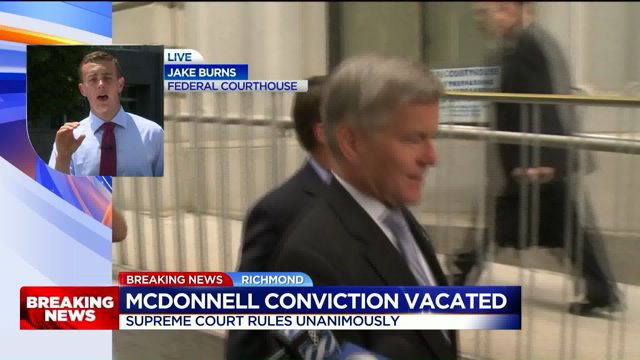


WASHINGTON, D.C. -- The U.S. Supreme Court has vacated the corruption conviction of former Virginia Governor Bob McDonnell.
The case was sent back to the 4th Circuit Court in Richmond. It is unclear whether the case will be heard again.
McDonnell had not yet served any prison time following his conviction as his appeal worked its way up to the U.S. Supreme Court.
He was originally sentenced to two years in prison after he was found guilty on 11 corruption charges on Sept. 4, 2014.
McDonnell and his wife, who were indicted on 14 charges, were tried together and the jury deliberated the case for three days.
Maureen McDonnell was convicted on nine of 13 charges.
Her case had been stayed until the Supreme Court ruled on her husband's case.
During the trial, the prosecutors hoped to establish that Bob McDonnell knew how much money Jonnie Williams, the CEO of Star Scientific Inc., gave the first family, and also that McDonnell used his position to influence research to the benefit of Williams' company.
Prosecutors said the most incriminating evidence was two emails, sent within six minutes.
The first was from Bob McDonnell to Williams asking about documents that would have finalized a $50,000 loan, and then shortly after an email request asked an aide to "see me about Anatabloc issues" at Virginia Commonwealth University and the University of Virginia.
Lawmakers and legal experts have followed the case with interest and have said that upholding McDonnell's conviction would open the door for prosecutors everywhere to go after politicians for doing what is considered routine political work, such as taking meetings with local business officials or lobbyists.
McDonnell's attorneys said Williams never received the government sponsored studies he sought through his relationship with the former first couple of Virginia, but prosecutors said the case is a clear example of political bribery for government access.
During oral arguments in April, Supreme Court Justices questioned the scope of federal laws prosecutors used to convict McDonnell and their impact in other contexts and cases, and struggled with the line public officials must cross before committing an "official act" that could trigger corruption statutes.
"What was interesting was that a number of the justices from what you would call both sides of the partisan divide on the court suggested that they were a little wary of this conviction," said political analyst Dr. Bob Holsworth.
"[SCOTUS]'s primary focus is defining what is an official action," said CBS 6 legal analyst Todd Stone. Stone said prosecutors across the country will use the Supreme Court's ruling in the McDonnell case as a guide moving forward. "This could affect people all over the country. It could affect current political investigations all over the country," Stone said.
This is a developing story.

