

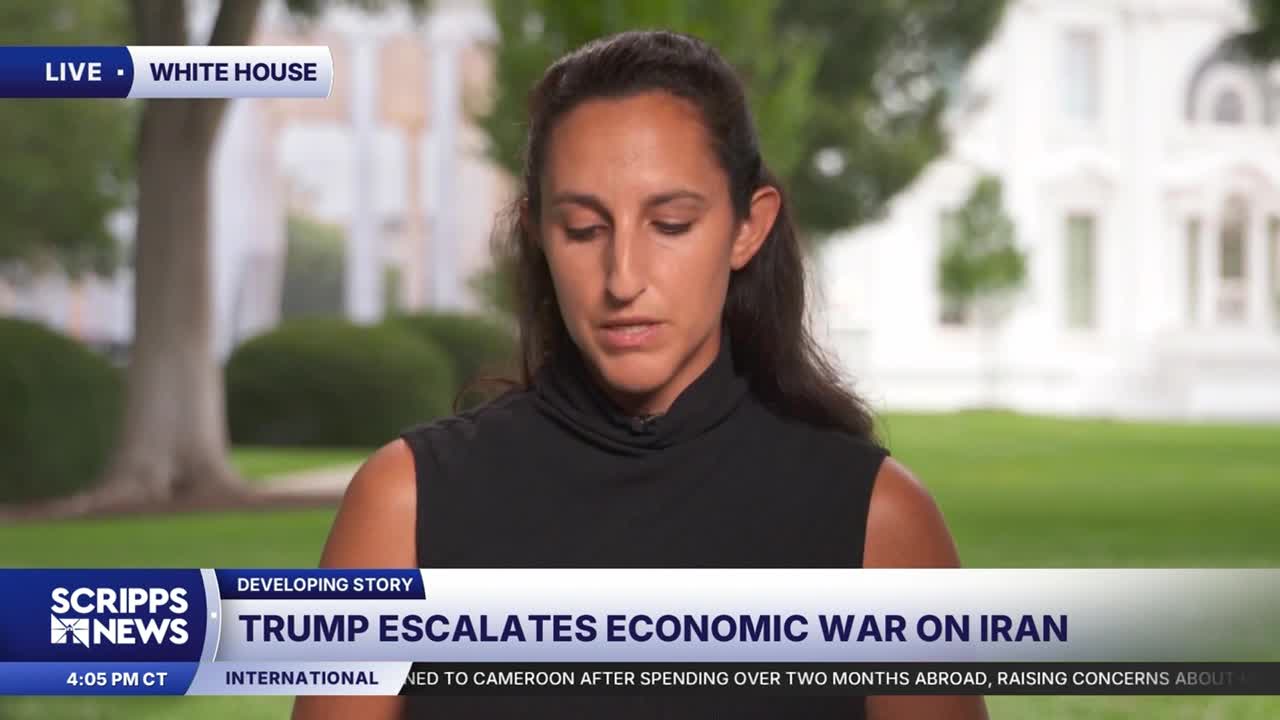


President Donald Trump vowed “economic D-day” against Iran and consequences for countries providing a “lifeline” to the country, as the U.S. intensifies economic pressure in its campaign.
“No one has given the Islamic Republic of Iran a greater opportunity to make a Deal than me. TRAGICALLY, for them, they have failed to take it. Therefore, today, I am announcing the MOST CRUSHING ECONOMIC OPERATION EVER TAKEN AGAINST ANY COUNTRY! This will be Economic Warfare and Isolation on an unprecedented scale,” Trump wrote on Truth Social.
MORE ON THE PLAN | Iran dismisses Trump’s ‘Economic D-Day’ threat amid pressure for deal to end war
While the specific details weren’t known immediately, a U.S. official said new action is expected.
“We are going to collapse this regime,” Treasury Sec. Scott Bessent said in an interview with CNBC, warning other countries that insist on doing business with Iran will face the force of the U.S. government.
“This will be an ECONOMIC D-DAY, and we need all of our Allies to stand with the United States of America to isolate, and defeat, the Iran threat. These maniacs are on the ropes, and these HISTORIC MEASURES will cripple them and their ability to project terror worldwide,” Trump wrote on Truth Social.
The announcement comes as the President’s focus appears to be on economic levers at this point in the conflict, rather than diplomatic or military means.
The administration’s focus is on squeezing Iran economically versus militarily, according to a U.S. official, though the president maintains military options.
The administration believes Iran is facing internal strife, particularly with its economy, and that the military campaign has helped put a chokehold on it, according to a senior administration official, who suggested ahead of the announcement Iran will be forced to make a deal.
“If we are doing the maximum economic pressure then that means likely there will not be a large scale kinetic restart but I would emphasize that is for now,” Bessent told CNBC.
IRAN WAR | As Hormuz blockade continues, Trump appears ready to wait for Iran to show interest in a deal
Earlier in the week, as U.S. military strikes have appeared to pause, Trump said there were no conversations going on with Iran. While there were “positive discussions” according to a source familiar, “President Trump has decided to wait and asked his team to not engage until Iran is ready to make a deal.”
However, Iran is dismissing President Donald Trump’s threat of an “Economic D-Day.”
“The so-called ‘Economic D-Day’ is a diversion from America’s own crisis: unprecedented debt & surging interest costs,” Iranian Foreign Minister Seyed Abbas Araghchi said on X. “Doubling down on failed policies will only bring further defeat—and enmity of Iranians. U.S. economic terrorism threatens global economy and sovereignty worldwide.”
But Vice President JD Vance called it a “new phase” where economic pressure is “the most effective tool,” in an interview with The Clay Travis and Buck Sexton Show.
“And this is a delicate dance because we apply economic pressure to them they’re gonna try to apply economic pressure to us but what has been true over the past couple of weeks they’ve felt a lot more pressure than we have. We’re gonna keep that going because we think that’s the best way to ultimately accomplish the final objective here, we have to go back to the very beginning the president said Iran cannot have a nuclear weapon,” he said to the hosts.
Vance said they’re trying to “…create a change reality on the ground where not just we can say with confidence their facilities have been destroyed, we can also say with confidence they’re never going to try to rebuild and that’s the phase that we’re in now.”
The impact for other nations remains to be seen. Major historical trading partners for Iran include China, the UAE, Turkey and Iraq.
“Sanctions and pressure will not help resolve the issue,” Chinese ministry of foreign affairs spokesperson Lin Jian said in a press briefing.
China, whose leader Trump expects to visit the U.S. next month, has retaliated against past U.S. trade crackdowns.
“That type of retaliation and response is very likely. The Iranians know that they are willing to sustain an enormous amount of pain, economic pain. They've shown that for decades,” said Amb. Daniel Shapiro, a distinguished fellow with the Atlantic Council, former ambassador to Israel in the Obama administration and former deputy assistant secretary of defense for the Middle East in the Biden administration.
The UAE got ahead of the President’s announcement, declaring Wednesday that it would cut financial ties with Iran after alleging it fired more ballistic missiles towards the Gulf nation.
“I don't take that announcement as at face value as a an indication that Gulf states are fully embracing this. They might be trying to avoid getting on the wrong side of Trump in this moment. They certainly feel a great sense of grievance toward Iran because Iran has attacked them when most of them were not combatants in this war and corrupted their economies, but they are likely at some point to sense a declining U.S. commitment, and they will then seek to cut their own deals with Iran and keep those channels open so that they're able to do so when the when the moment arrives,” Shapiro said.
