

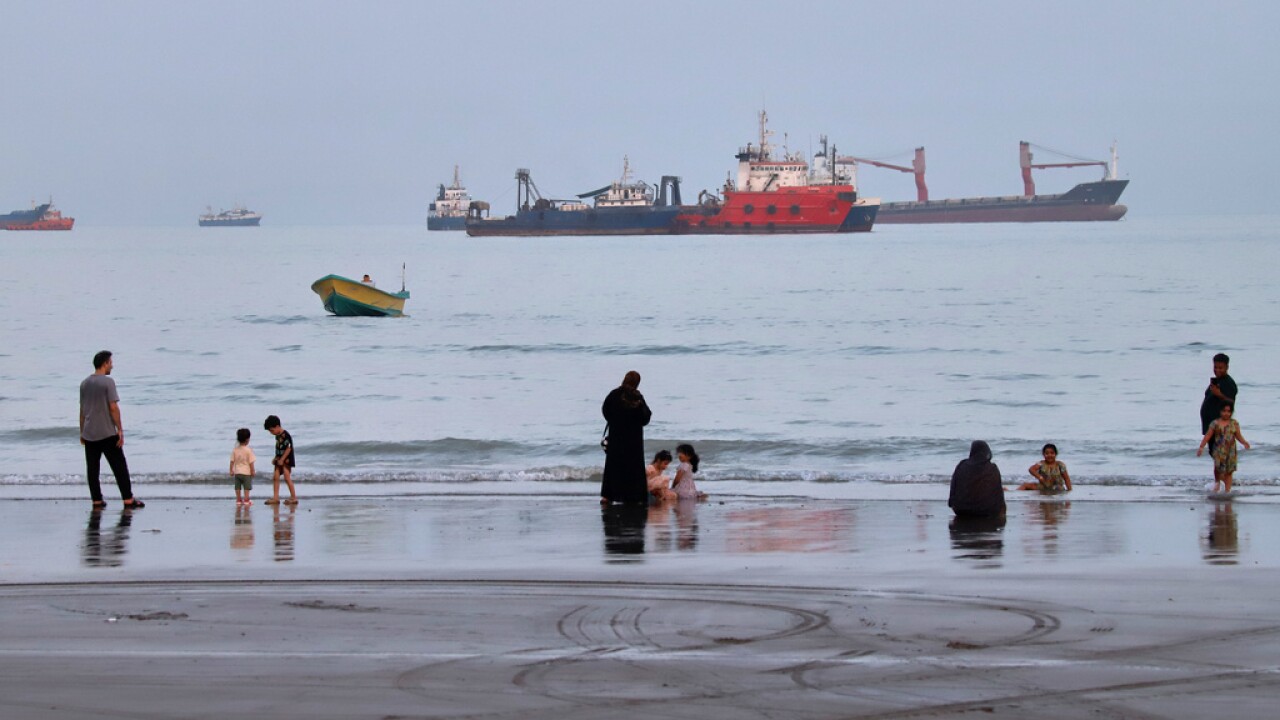

Iran issued dramatic new demands around the reopening of the Strait of Hormuz, and the United Arab Emirates said one of its ships was targeted by an Iranian missile. Yemen’s military attacked the country's Iranian-backed Houthi rebels. And Turkey’s Kurdish peace bill won approval in parliament.
Iran says strait won't open until the US ‘corrects’ behavior
Iran's politburo-like body known as the Supreme National Security Council said the Strait of Hormuz will not open until the United States “corrects its behavior," issuing new demands that could shake up talks on a deal to manage the waterway and traffic on it.
Iran's state broadcaster published the statement by the council’s secretary, Mohammad Bagher Zolghadr, who is also a commander in the powerful Revolutionary Guard.
RELATED STORY | Trump says US was poised for largest strike since World War II on Iran
The United States must never threaten Iran again, the statement said, and must permanently end the war with Iran and its armed allies in the region. The U.S. must lift the naval blockade of Iranian ports and withdraw its military from the area. It also must “completely compensate” Iran for war damage, lift sanctions and “unconditionally” release frozen assets.
There was no immediate comment from the U.S., which has wanted an acceptable deal first on the strait before ending the blockade. According to the interim deal signed in June, a schedule to end sanctions and plan on compensation would be part of the final deal, and negotiations would address frozen assets.
The end of a 60-day period to negotiate a final deal will end in just over a week but could be extended.
Iran has said it was close to reaching a separate deal with Oman to manage the strait, which runs between the two countries.
Iranian Foreign Minister Abbas Araghchi earlier Saturday said they were close to reaching an agreement on navigation, “specifically the determination of a transit route.” But the waterway’s reopening is contingent on other conditions, he said in remarks shared on social media, and blamed the situation on what he called the U.S. violation of the interim deal.
RELATED STORY | Deal to reopen Strait of Hormuz could be imminent, US officials say
Oman, a mediator Gulf Arab country which has said relatively little on the talks, said in a statement Saturday that the discussions were ongoing “in a positive and constructive atmosphere,” and condemned attacks on ships on the strait.
The strait, crucial to global supplies of oil and natural gas, had been considered an international waterway before the war. Ship transits remain low.
Iran attacks a vessel in the Strait of Hormuz, UAE says
A vessel owned by Abu Dhabi’s state-owned ADNOC oil and gas company was attacked while transiting the Strait of Hormuz, Emirati authorities said earlier Saturday. The Foreign Ministry said Iran fired the missile as part of attacks on commercial shipping.
ADNOC in a statement said there were no casualties following the attack early Saturday. The company said over a dozen of its vessels have been attacked by missiles and drones while transiting the strait since the U.S. and Israel launched the war on Iran in February. One crew member has been killed and 20 others wounded, it said.
ADNOC didn’t elaborate on the attack's location or any damage.
Later, the United Kingdom Maritime Trade Operations Center said a vessel east of the town of Khasab, Oman, had been struck by a projectile that caused a fire that was put out, with the vessel and crew safe. It was not clear whether this was the ADNOC incident.
Yemen's military attacks Iran-backed Houthis
The attacks were in response to the Houthis’ recent strikes in central and eastern Yemen. Col. Majed al-Nazili, spokesperson for Yemen’s military, said the attacks targeted the rebels’ “sites and capabilities” on multiple front lines, without elaborating.
The escalation between the Houthis and Yemen's internationally recognized government and its backer, a Saudi-supported coalition, threatens to reignite Yemen’s civil war following a 2022 truce.
