

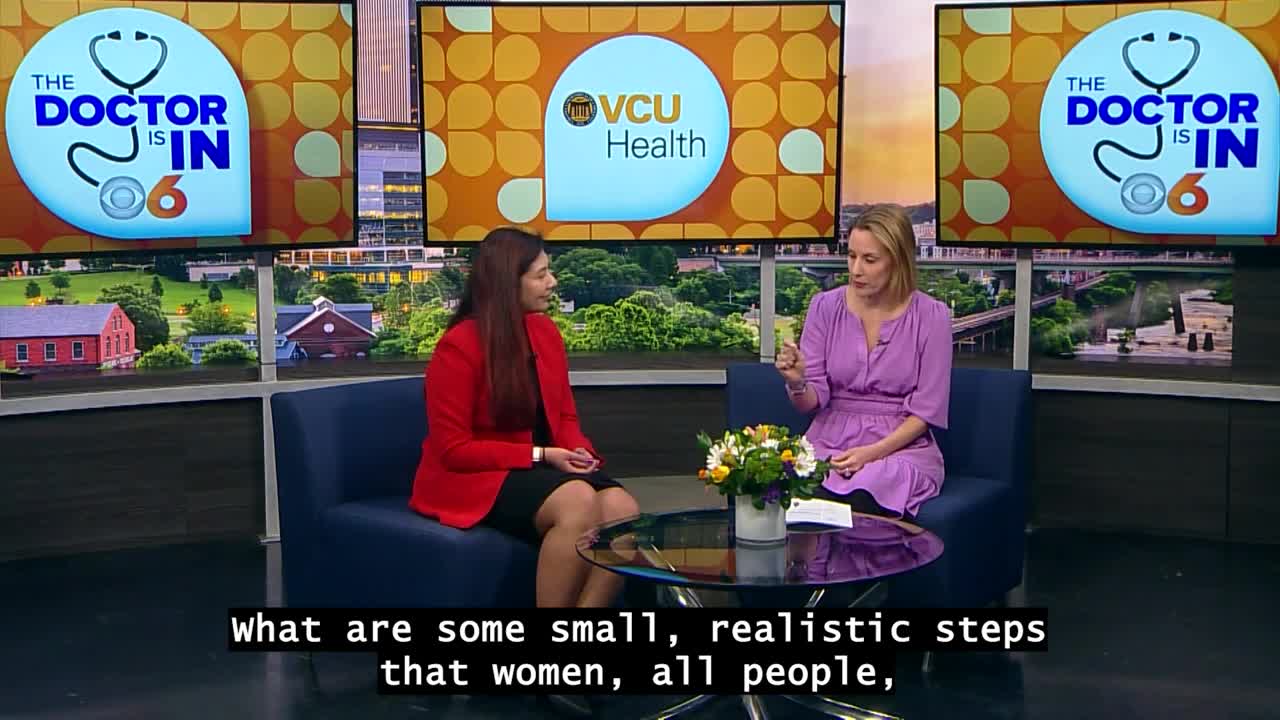

RICHMOND, Va. -- February is American Heart Month. Dr. Saima Shikari, a cardiologist with VCU Health’s Pauley Heart Center, shares information about women's health and heart disease.
What is heart disease?
So essentially the heart is a pump. We're talking about the organ that circulates oxygenated blood throughout your body, through the vessels that we call arteries. When you think about heart disease, we talk about three main types. The first is when you have blockages in those arteries, whether those blockages are in the arteries that supply your heart with blood and give you what we typically think of as a heart attack, or it's the arteries that are throughout the remainder of your body that can lead to issues like peripheral artery disease.
The second would be if you have issues with the squeezing or the relaxing function of the heart. That is what we talk about when we're speaking of different types of heart failure.
Last would be if you have issues with the valves within your heart, which are like doorways between chambers. If you have a problem where the doorway is too stiff and gets stuck, blood can't move forward, and if the doorway opens too easily, it's leaky and blood goes backwards, all of which can cause issues. This is an especially major problem for women.
Why is heart disease a serious problem for women?
Heart disease is the number one killer of women in the United States. It kills more women than all types of cancer combined. And the women present differently.
If women are having symptoms like nausea, severe fatigue, difficulty being able to climb the flight of stairs that they could climb a week ago; if they're having really bad acid reflux, or if they're just exhausted – this isn't just signs of, “oh, I need to get a little bit more rest.” It can actually be a sign that you're having major cardiovascular disease, and that's very different from how men present.
What are some small, realistic steps that people can make to improve their health and to prevent heart disease?
What you really want to do is make sure you're creating small changes that are sustainable, that you can then build on to have life changing habits.
In terms of diet that comes to things like reducing the amount of salt you take in, being aware that deli meat, canned soup and frozen food all have more salt than you would think. It's part of what makes them taste so good. See if you can reduce some of those things and replace them with fresh alternatives. Can you reduce the amount of salt you're putting in your food?
Second, I would be looking at the things you can do for your cholesterol. A high fiber diet can absolutely reduce your cholesterol – having a serving of quinoa or broccoli or sweet potatoes with the skins on, blueberries, apples – all of those things are high fiber and will help reduce your cholesterol.
Next, I would say think about your activity. We are always talking being active and why that's important, but there are ways you can incorporate that into your daily life. If you have to take a bunch of things up the stairs, break it into a couple of trips. Then instead of one trip up the stairs, you've got 3 or 4 or 5 – that counts as getting your steps in and getting your exercise in.
If you're already taking your trash out and you're at the end of the street and it's cold out, so you've got all your outerwear on already, just take the extra ten minutes and go for a walk around the block. That counts. And it's getting your movement in, in small ways that already fit into your lifestyle. It is realistic and it can really have big impacts.
{*THIS SEGMENT IS SPONSORED BY VCU HEALTH’S PAULEY HEART CENTER*}
