

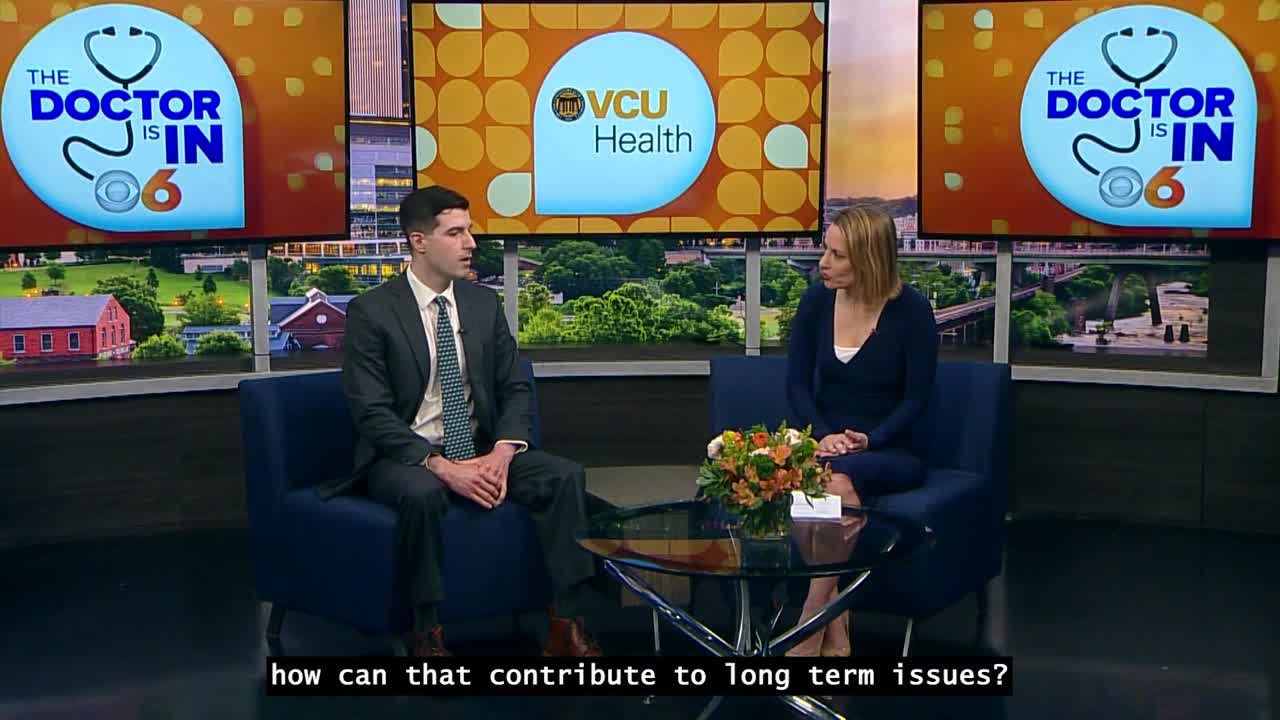

RICHMOND, Va. -- Cold weather can mean more injuries and joint pain. Dr. Daniel Layon, orthopedic surgeon with VCU Health, explains why and shares when treatment might be needed. VCU Medical Center is the only Virginia hospital nationally ranked in orthopedics by U.S. News and World Report (2025-26 rankings).
What injuries do you see more often in the winter months?
The CDC reports that over 1 million Americans every year sustained falls or slips on the ice and snow during the winter months. We see a wide range of injuries at VCU Health, from simple sprains in our clinics to significant fractures or even hip fractures in our emergency department.
Many people feel cold weather in their joints and in their bones. How does orthopedics relate to the weather?
That's a great question. What we commonly hear from our patients is that any time there's a change in the weather, particularly in the winter months, they feel it in their bones. We don't have a great scientific answer for that, but what we think is that changes in what we call the barometric pressure, which is the atmospheric pressure, can cause changes in the fluid inside joints. That's particularly impactful in patients that already have arthritis or degenerative joint disease.
If someone has a flare up during the winter months or they have a new injury, how can that contribute to long term issues?
When people have injuries in the past, particularly falls or even higher impact injuries like skiing accidents can result in damage to either the cartilage inside the joint (which is the slippery stuff in all of our joints that lets us run, walk, jump, and do all of our daily activities without pain) or it can result in damage to the stabilizing structures around joints. Once those have been injured, even with surgical treatment, sometimes that can result in what we call post-traumatic arthritis, which is damage to the cartilage or joint that happens after an accident or injury. Unfortunately, we do see a significant number of those types of post-traumatic arthritis patients during the winter months because as we mentioned previously, the cold weather tends to flare up the pain.
For someone who is dealing with a joint pain or a joint injury, when is it time to see a specialist like yourself?
When you're not able to do the things that you love doing, or when you have pain that's interfering with daily activities, that's when it's time to seek a specialist. Some people are nervous because the idea of seeing a surgeon means that they might have to have surgery, but we have a wide variety of conservative or non-operative treatments, all the way up to surgical treatments at one of our many locations. And we do see patients from downtown Richmond to Short Pump to even as far north as Tappahannock at one of our many clinics.
{*THIS SEGMENT IS SPONSORED BY VCU HEALTH*}
