

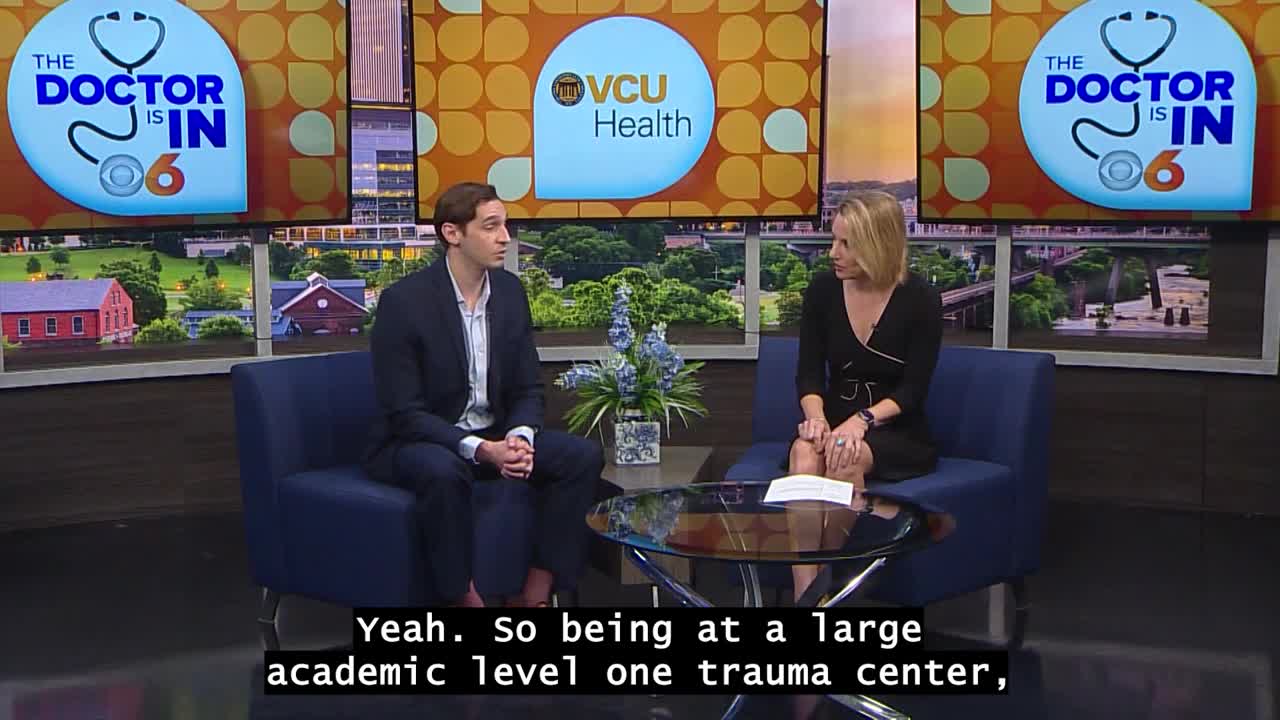

RICHMOND, Va. -- Back pain is one of the most common health concerns in the United States, yet many people aren't sure when it's time to seek specialized care. In this episode of The Doctor Is In, we were joined by Dr. James Mooney, a neurosurgeon with VCU Health, Virginia's leader in neurological and neurosurgical care. He talked about warning signs you shouldn't ignore, common misconceptions about spine surgery and the advances helping people get back to living their best lives.
When does back pain become a sign of something more serious?
The good news is that almost 80% of Americans will have some sort of back pain over the course of their lives, and the majority of those will improve with conservative treatment in time.
The red flag symptoms and warning signs we want people to be aware of are:
- Back pain that might be associated with progressive weakness, numbness or tingling in the arms or legs
- Back pain associated with balance issues or bowel and bladder dysfunction
- Back pain that is associated with infection, fever, chills, weight loss or trauma
- Back pain that is not getting better despite conservative treatment and therapy
What are some of the biggest misconceptions people have about spine surgery?
People assume that seeing a spine surgeon means they're going to need spine surgery. I spend the vast majority of my clinic talking to patients that don't end up ultimately needing spine surgery. They just need to be guided in the right direction as far as therapy.
There’s also the misconception that spine surgery is going to require a large operation with a prolonged hospital stay and significant pain. That's certainly not the case with the advancements we've made in minimally invasive technology, as well as in decision making about which patients are the optimal candidates for surgery.
Lastly, there is the misconception that all back pain can be treated with spine surgery. That's certainly not the case. At VCU Health, we carefully match each patient's symptoms with the underlying cause of their pain to determine whether surgery is appropriate.
What types of spine conditions are you treating most often?
Being at a large, academic Level I Trauma Center, we see a wide variety of pathologies. I would break my practice into three buckets, the first being more degenerative conditions such as spinal stenosis or disc herniations that are associated with aging. I prefer to treat those patients with minimally invasive options when possible because it gets them back to function quicker, and there is less tissue disruption and bleeding.
Second, I'm also fellowship trained in complex and minimally invasive spine deformity surgery, so I have the skillset to offer more complex procedures to patients who may require revision surgery or treatment for conditions like scoliosis.
Lastly, on call, we see a wide variety of trauma patients, tumor patients, infection cases and other conditions.
What advantages come from being cared for at an academic medical center like VCU Health?
There are a couple of massive advantages that I think about when being at a large academic medical center for spine care. I think it's important.
Number one is the incredibly multidisciplinary, collaborative nature of the institution. We have pain medicine doctors, PT/OT doctors, neurosurgeons, orthopedics and bone health doctors. All of us have a monthly spine conference where we go over indications with the goal of coming up with the best treatment plan for each individual patient.
Number two is the incredible technology we have at VCU Health, ranging from minimally invasive technologies to complex deformity-planning technologies and patient-specific implants designed to treat the most complex patients. That's the unique opportunity VCU Health offers: comprehensive care across the full spectrum of spine conditions.
To learn more about VCU Health's comprehensive spine care, you can visit vcuhealth.org or call (804) 828-9165 to schedule a consultation.
