

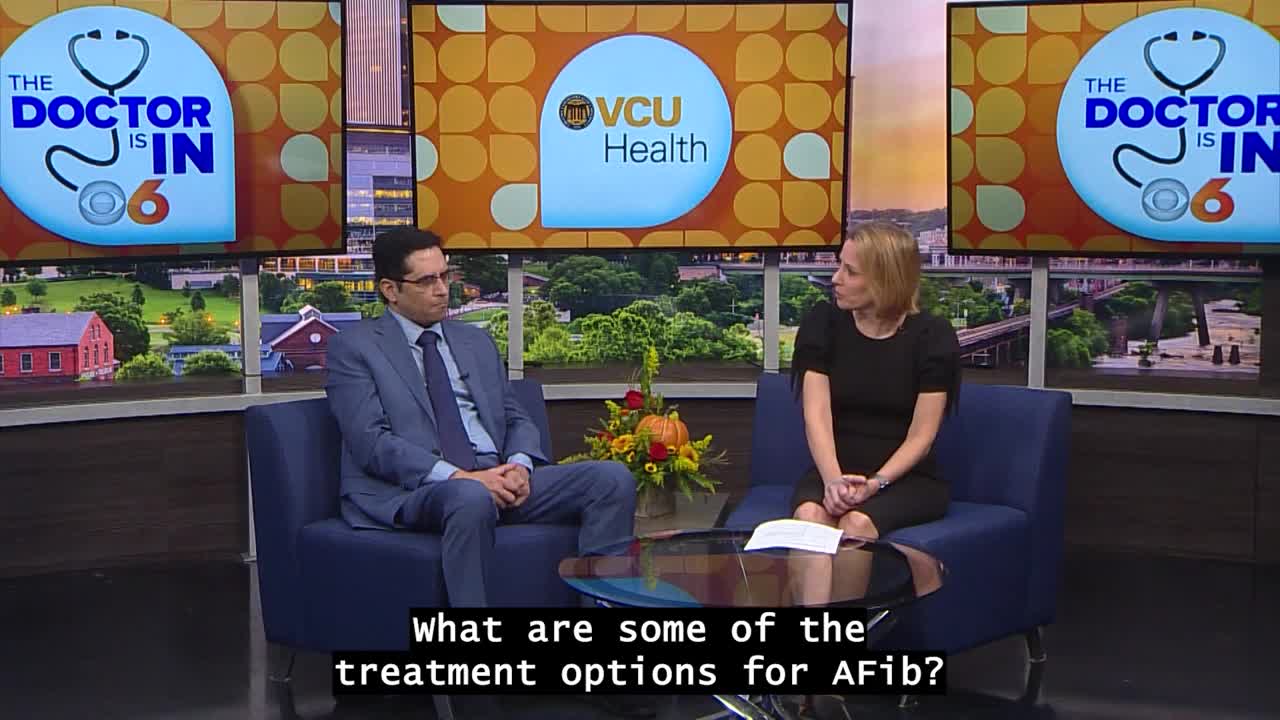

RICHMOND, Va. -- Atrial fibrillation, AFib for short, is the most common type of heart rhythm disorder. About 1 in 22 American adults has AFib, and your risk increases as you age – but 1 in 3 people with AFib experience no symptoms. Dr. Jay Koneru, Director of Cardiac Pacing at the VCU Health Pauley Heart Center, Virginia's top-ranked heart hospital, joined us in the studio to share more.
Can you tell us more about what AFib is and its symptoms?
Normally our heart beats in a synchronized fashion. The upper chamber contracts. The valves open. The bottom chamber fills up, and the valves close. Then the bottom chambers send blood to the lungs and to the entire body.
But during AFib, instead of being synchronized with the bottom chambers, the upper chambers start quivering like a bag of worms. And when that happens, people can feel fatigued. That is the most common complaint. Many people think, "oh, my heart is racing. I have palpitations." But that's not always how AFib manifests. Most people feel a little bit off. They're not able to do the same things that they used to be able to do without getting fatigued, and often people will attribute that to aging.
Unfortunately, some people have the first manifestation of AFib as a stroke, because when the upper chambers are quivering like this, the blood stays in one place. When blood stays in one place, there is a tendency to form blood clots, which can go north and cause a stroke.
What causes AFib?
AFib can be a manifestation of multiple things – but it's primarily a disease of aging.Less than 5% of the AFib patients we see are younger than 40 years.
But there are a multitude of other things that cause AFib. We are increasingly realizing that genetics can cause AFib, and lifestyle, big time: being overweight, sleep apnea, alcohol, and uncontrolled high blood pressure — these kinds of things can cause AFib, too.
What are some of the treatment options for AFib?
First of all, it is better to prevent AFib. Once you have it, our primary responsibility is to protect the brain. We treat AFib with blood thinners to make sure that people don't have a stroke. Even if you have about 8 to 10 minutes of atrial fibrillation per month, depending on your age, your risk of stroke can be almost doubled. We can calculate a risk score for each patient and then treat them to prevent a stroke.
Second, AFib begets AFib. There is a progression of AFib. The first stage is when people go in and out of AFib. The second stage is when people stay in AFib until we intervene with treatment in some way. That's called persistent AFib. The third stage is when people don't realize they are in AFib but have been in AFib for years. And the fourth stage is where we have done everything we can in terms of treatment, and now we just have to treat the repercussions. In this fourth stage, the patient remains in AFib, but we do not stop taking care of them.
Our ability to intervene with treatment is highest in the first stage.
What are some of the things we can do to prevent AFib?
We encourage patients to use what we call a “HEAD 2 TOES” approach to lowering AFib risk. It's an acronym:
- “H” stands for heart failure optimization
- “E” stands for exercise, up to 210 minutes a week
- “A” stands for arterial hypertension management, which is blood pressure management
- “D2” stands for diabetes type 2 management
- “T” stands for tobacco cessation
- “O” stands for obesity management
- “E” stands for ethanol or alcohol management – we expect patients to have no more than three standard drinks per week
- And “S” stands for sleep apnea management.
Learn more about AFib care and treatment at vcuhealth.org/heart.
 Facebook
 Instagram
 Threads
 Blue Sky
 X
 TikTok
 YouTube
