

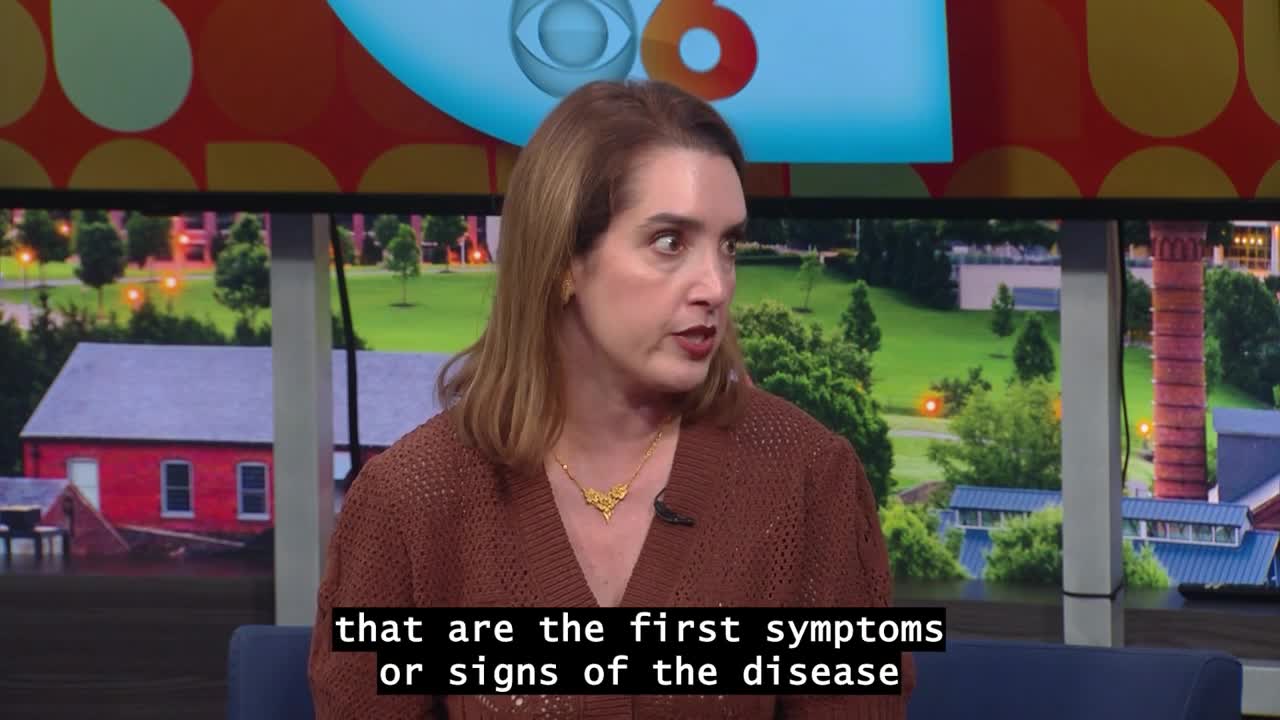

RICHMOND, Va. -- April is Parkinson’s Awareness Month, a time to shine a light on a disease that affects nearly one million people across the United States. As awareness and education become more important than ever, VCU Health remains a leader in advancing Parkinson’s care. Recognized by the Parkinson’s Foundation as a Center of Excellence, VCU Health offers comprehensive, specialized care for people living with Parkinson’s disease. In this segment, Dr. Leslie Cloud, a neurologist with VCU Health, helps us better understand Parkinson’s disease and highlights the treatment options available right here in our community.
What is Parkinson's disease and how does it affect the brain?
Parkinson's disease is a slowly progressive neurodegenerative disease that predominantly causes loss of the brain cells that produce dopamine, and lowers the normal level of dopamine, which causes a variety of problems initiating, coordinating and maintaining movement. It's a movement disorder. We don't know exactly what causes Parkinson's, but it appears to be a combination of environmental and genetic factors. Typically, the most common age of getting Parkinson's is in one's early 70s, but in some people, it can happen much younger.
What are some of the early signs and symptoms that people really should be aware of?
So those sub-optimal dopamine levels cause problems with movement. Specifically, we see a lot of tremor or shaking. We see stiffness of the muscles. We see slow movement or small movements, and we see trouble with posture and balance. Any of those movement problems can be early or initial symptoms. In addition to those movement problems, people with Parkinson's can develop a variety of non-movement problems – problems with mood, memory and thinking, sleep and even gastrointestinal function. And occasionally, it's those non-movement problems that are the first symptoms or signs of the disease. So, there's a lot of variability from patient to patient.
What are some of the treatment options available today that can help patients manage the symptoms?
Oral medicine to raise dopamine levels in the brain have always been and still are the mainstay of medical treatment. In the modern era, fortunately, we have some other options for more advanced Parkinson's disease, including infusion-based medications that can keep those dopamine levels where we need them to be, and then also surgical treatment options like deep brain stimulation surgery and focused ultrasound. At the VCU Parkinson's and Movement Disorder Center, we're able to offer patients access to all of those state of the art medical and surgical treatment options under the supervision of a fellowship trained movement disorder specialists, which is important.
How does VCU Health's team-based approach make a difference to people who are going through Parkinson's?
It takes a village. In addition to physicians, speech therapists, physical therapists, occupational therapists and neuropsychologists can all be very useful to someone with Parkinson's disease. Having all those subspecialists under one roof, collaborating together to craft a unique plan for your specific set of symptoms, has been shown to improve outcomes. It's an important piece of modern Parkinson's disease care. Because of our very rigorous, multidisciplinary approach to clinical care and clinical research, we received that very prestigious Center of Excellence designation from the Parkinson's Foundation. We are one of only 40 such centers in the U.S. and are the only Center of Excellence in the state of Virginia.
Visit vcuhealth.org or email pdcenter@vcuhealth.org to learn more about VCU Health’s Parkinson’s disease care.
{*THIS SEGMENT IS SPONSORED BY VCU HEALTH*}
