


RICHMOND, Va. -- Kids are growing by the minute and when an injury or illness affects their bones and muscles, it's important they see a specialist who has the understanding and tools to meet their unique needs. Pediatric orthopaedic surgeons Dr. Victoria Kuester and Dr. Chester Sharps from Children's Hospital of Richmond at VCU answer questions about the conditions they treat and an innovative approach to treating scoliosis.
What conditions does your team treat?
We treat everything from minor injuries and small broken bones to complicated conditions like scoliosis, intra-muscular diseases, limb deformities and bad fractures. We also treat athletes who are injured on the court, on the field or in the pool. We have a team of experts who can care for all types of pediatric injuries from birth to the teenage years. We not only have state-of-the-art equipment at our disposal, we have a real understanding of how children grow, their bones and their growth plates, which makes treating them different than treating adults.
Scoliosis is a condition that’s typically diagnosed in childhood. What is it and how do you treat it?
Scoliosis is curvature of the spine and most people think of it like an S or a C when they look at an impacted child’s back. It's not always obvious, so pediatricians will look for it and when cases are more serious, refer patients to us for treatment. Many times, it’s mild, but when severe, scoliosis can affect a child’s posture or even their heart and lungs. There are times when a brace can be used to prevent the curve from getting worse, but if it’s too severe, we do recommend surgery.
The most common surgery that we've done in the past is called a spine fusion, where we put in rods and screws to solidify the spine. We try to straighten it as much as we can, but it does make the spine a little stiffer.
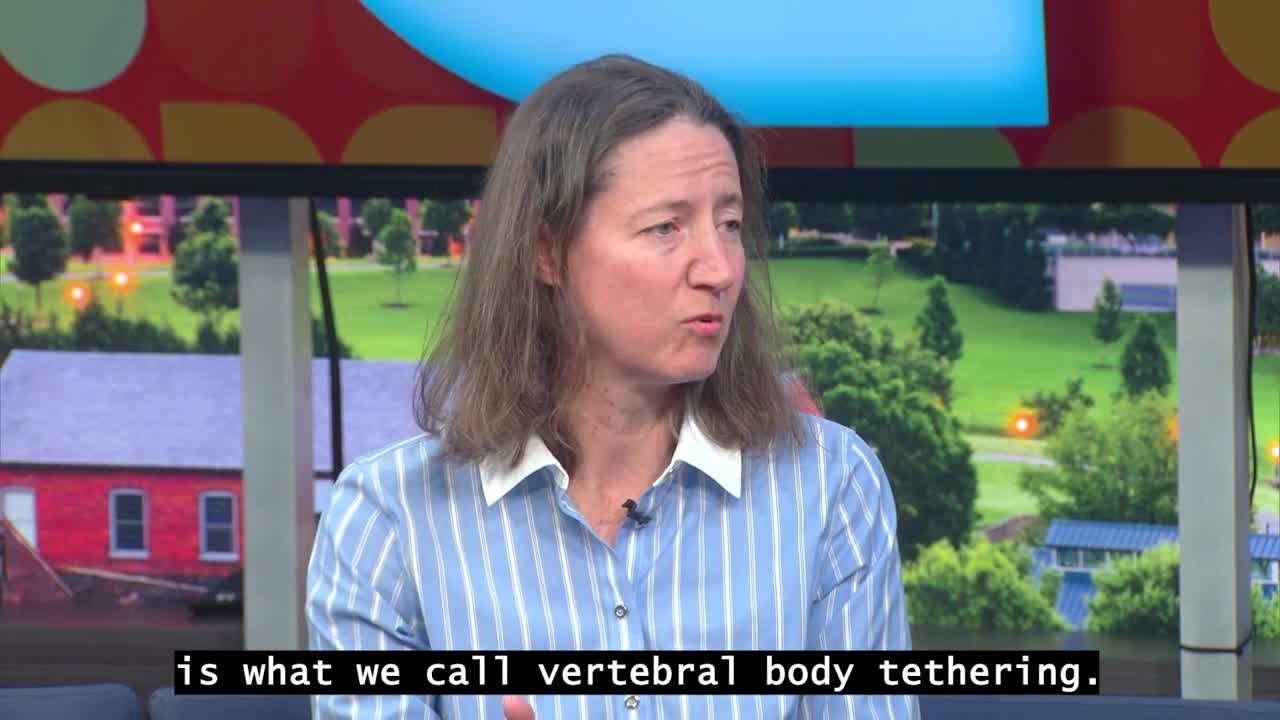
A newer approach is something we call vertebral body tethering which is a great option for some kids.
What is vertebral body tethering?
The vertebral body tether is insertion of a tether, which is comparable to a nylon cord to correct the spine and hold it into place. With guided growth over time, the curvature of the spine can be corrected. It is done with small incisions around the spine and special radiology equipment. Recovery times are much shorter than a spine fusion and often within six weeks kids are back to full activity.
It also has reduced scarring because there’s no big incision like you have with the spine infusion and the patient has more range of motion following the procedure.
How is orthopaedic care at Children’s Hospital of Richmond at VCU expanding?
CHoR in general has been growing, but so is our capacity for orthopaedic care. We are doubling in size, we have a new provider on our team, Dr. Andrew Peace, and we are growing to better serve our kids and their families better. We see patients downtown at the Children’s Pavilion, where we have a low-dose radiation unit, which is the only one I know of in our area. It’s great for kids who are getting a lot of X-rays, like scoliosis X-rays, repeatedly in their lifetime.
We do see patients at other clinics to make it easier and more accessible for patients, including Fredericksburg, Colonial Heights, Short Pump and Stony Point. New patients can even make appointments on the CHoR website.
For more information on innovative treatments for scoliosis, you can call (804) 828-2467. Children's Hospital of Richmond at VCU is located at 1000 East Broad Street in Richmond. You can visit chrichmond.org.
{*THIS SEGMENT IS SPONSORED BY CHILDREN'S HOSPITAL OF RICHMOND AT VCU*}
 Facebook
 Instagram
 Threads
 Blue Sky
 X
 TikTok
 YouTube
