



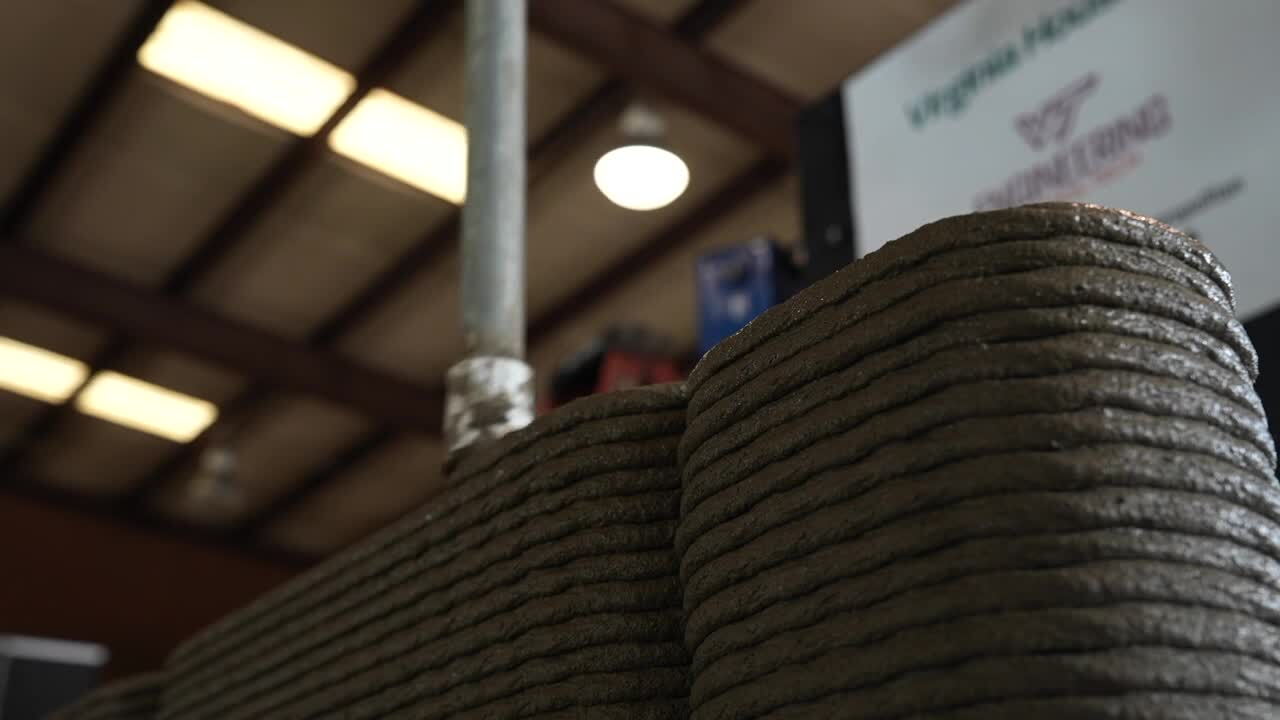
RICHMOND, Va. — A robotic arm is printing concrete walls in 45 minutes — and Virginia Housing officials say the technology could be a key part of addressing the state's housing affordability crisis.
At a Richmond warehouse, human hands mix the ingredients, but it is a robotic arm equipped with a specialized nozzle that constructs the walls with the precision of a 3D printer.
A process that would normally take several hours on a job site was reduced to just 45 minutes before a crowd gathered to address housing affordability.
Virginia Housing Director of Strategic Housing Chris Thompson said the solution to present and future housing demand may lie in the technology.
"We need more housing to be built to meet present demand and to keep up with future," Thompson said. "The technology is here; we can do this and now this is our first example of building this at scale and that's where we really need to be."
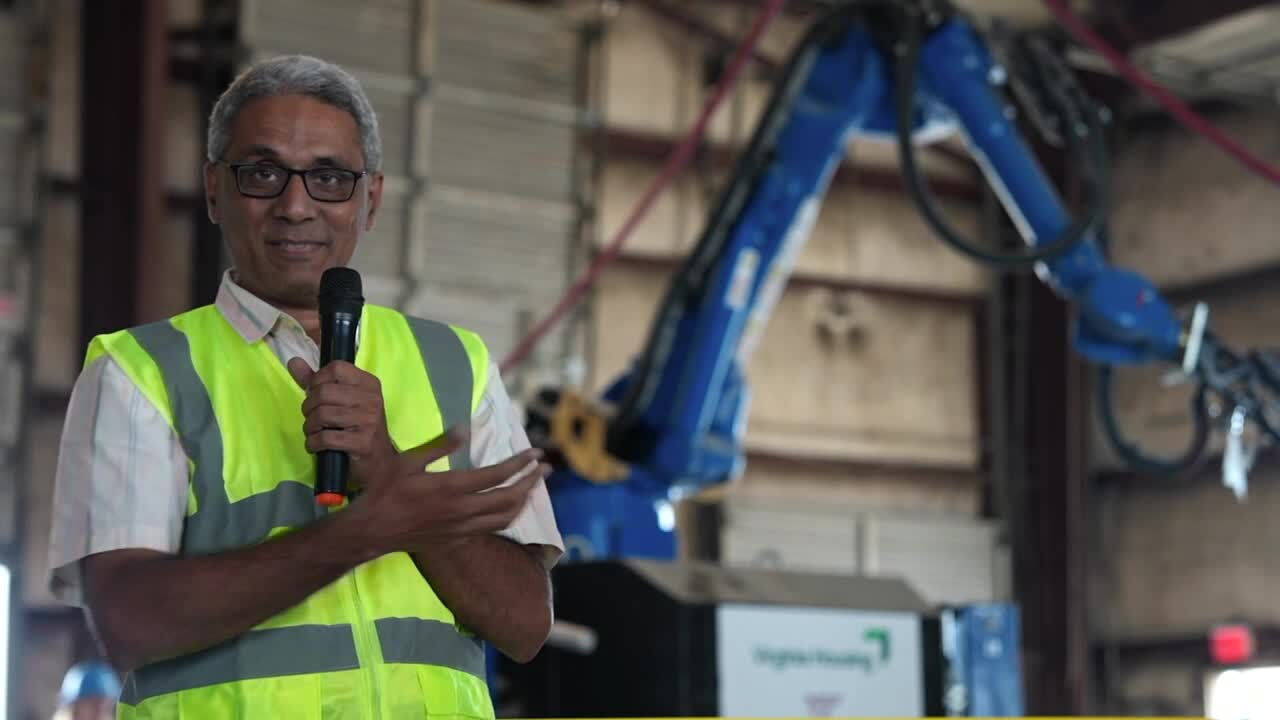
Using a $1.1 million grant from Virginia Housing, Virginia Tech University purchased the mobile concrete printer, which was designed by India-based company TVASTA, a firm that specializes in 3D concrete printing.
TVASTA Chief Technical Officer Kalyan Vaidyanadhan said speed is central to the technology's value.
"We want to be able to do this faster than conventional construction because only then can we make this meaningful," Vaidyanadhan said.
Vaidyanadhan said the machine's mobility means the 2.5-ton walls can be constructed in a warehouse or directly on a job site.
"Less labor, better performance and hopefully cheaper too as we scale up," Vaidyanadhan said.
Virginia Tech Associate Professor Alexander Brand said the university is currently researching the best materials to make 3D-printed homes feasible.
"Changing the ratios, changing how we're making the materials and then actually testing the strength, its durability, how does it hold up to different environmental conditions," Brand said. "That's why we're all doing at Tech so that we can have confidence when the house is built that it does exactly what it's designed to do."
Houston-based construction company HiveASMBLD provided technical expertise during the build. Construction Director Wafaey Swelim said the technology is not a complete fix, but a meaningful step forward.
"It's not the silver bullet that's going to make construction overnight affordable, It won't solve every single issue, but it will help us get closer," Swelim said.
Virginia Habitat for Humanity Vice President of Construction and Real Estate Ryan Pacyna said labor remains the critical bottleneck.
"The pinch point is really that of labor and its so that of being able to deliver homes that affordable, but not cheap," Pacyna said.
Virginia Habitat for Humanity stands to benefit directly from the demonstration. In a few weeks, the printed walls will be transported to an off-site subdivision on Henrico's East End, where the nonprofit plans to build 5 additional 3D-printed homes.
"You're looking at being able to deliver a home that is disaster resilient and energy efficient. That's really where affordability lies," Pacyna said.
At the Carter Place 1 construction site in Eastern Henrico, Virginia Housing said nonprofits and contractors will study how the 3D-printed homes are assembled to determine how the technology can be improved, where costs can be saved, and how it can be scaled to reduce housing costs statewide.
CBS 6 is committed to sharing community voices on this important topic. Email your thoughts to the CBS 6 Newsroom.
-
-
Eat It, Virginia! with Scott and RobeyUntold with Catie Beck
-
-
-
This story was initially reported by a journalist and has been converted to this platform with the assistance of AI. Our editorial team verifies all reporting on all platforms for fairness and accuracy. To learn more about how we use AI in our newsroom, click here.
 Facebook
  TikTok
  YouTube
 Blue Sky
 Instagram
 Threads
 X
X