




RICHMOND, Va. — Richmond's riverfront Allianz Amphitheater wrapped up its debut 2025 concert season with more than 200,000 fans through the gates, unforgettable performances from Dave Matthews Band, Neil Young, and Widespread Panic, and even a few unexpected guests (yes, including a wandering opossum).
Now, venue leaders are reviewing fan feedback about the 7,500-seat amphitheater and the nearby hillside where crowds gather to enjoy free shows (more on that later), with plans to improve the experience ahead of the 2026 concert season.
As the season closed in October, I spoke with Richmond music fans about what they loved and what they think needs attention from Allianz.
The feedback was immediate and strong.
"Room for improvement," Jordan Burns said. "The three biggest problems to me are: bathrooms, drink cost and crowd control / overselling the lawn."
Ti Hensby highlighted pros including the beautiful venue, city views, friendly staff, and quality of artists; along with cons like the sometimes oversold lawn, hot bathrooms with long lines, and expensive concessions.
"I love the place and am so excited about it," Hensby said. I just really hope they figure out the lawn capacity, air conditioning in the restrooms, the men's bathroom efficiency, the obstructed views on the lawn behind the soundboard, and offer more lower priced beverage options."
Brian Kennon said he was grateful Richmond now has an amazing outdoor music venue.
"We can all only hope that our collective voices will be heard and that minor improvements will be made," he said.
Good news, Brian. It appears that is already in motion.
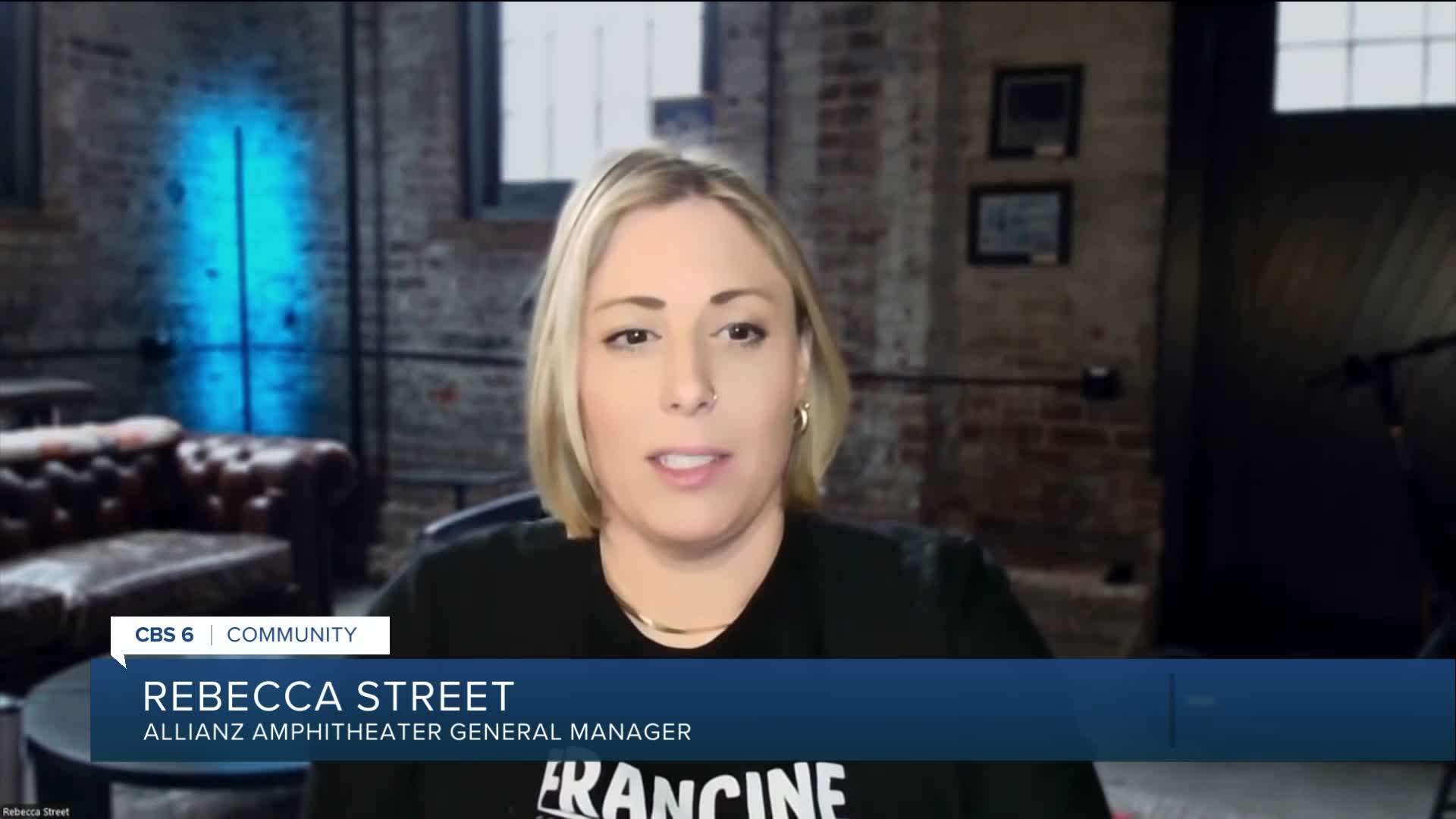
I collected those comments and more, and scheduled an interview with the people who run the venue to both share the feedback and get answers to lingering questions. Below is a lightly edited transcript of my interview with Live Nation Entertainment Regional Vice President Matt Rogers and Allianz Amphitheater General Manager Rebecca Street.
Watch Full Interview: Allianz Amphitheater to make changes after first Richmond concert season
Scott Wise: Before we talk about Allianz, can you share with me your first concert experience and a memorable concert experience?
Matt Rogers: That's a great question. First concert experience was the New York City Fresh Fest at the Richmond Coliseum, featuring Houdini, the Fat Boys, and Eric B. & Rakim.
My most memorable concert, we did United We Stand at RFK Stadium after 9/11.
It was Al Green, Michael Jackson, Aerosmith, P!nk, Backstreet Boys. Being a part of that experience was pretty special.
Rebecca Street: My first concert was George Strait with opener Clay Walker at the former Patriot Center at George Mason University. My most memorable, similar to Matt, mine was just after 9/11 and it was U2 at Baltimore Arena. By far, still the most memorable concert I've ever seen.
Scott Wise: So let's get to the task at hand here. A lot of the fans that I've spoken with in person and on social media have raved about the views and vibe at Allianz. When you were in the planning stages of this amphitheater, how does what you had on paper compare to what you experienced in real life this past season?
Matt Rogers: I think what stands out the most to me is how intimate it feels. We were able to use the existing sort of topography to our advantage. The other thing that stands out to me is, I think we were very successful at sort of complementing what was already existing around us and added to that aesthetic.
From a fan perspective, I think what stands out to me the most is just, there's no bad seat in the building.
Rebecca Street: I really echo Matt's sentiments on the experience of the amphitheater versus what I saw coming into it. I think at that point, the stage had just been built and the lawn was getting put down, but none of the seats or anything were in yet.
Matt's exactly right. The experience you have is way more intimate than you ever think it's going to be. You can say, okay, this is a smaller amphitheater and try to compare it to a bigger one. But when you're there, it's just, you get to see Dave Matthews and these, like, world class artists in such an intimate setting. You can literally see the whites of their eyes if you're sitting in a seat, it's wild to me.
Scott Wise: A lot of the people I spoke with praised the sound quality once you're inside the amphitheater. What goes into making sure that everything's dialed in in an outdoor space like that?
Matt Rogers: The band has their own sound engineers, and most of the PA that comes to the amphitheater is brought by each band. We support the stage sound with a lawn delay system that allows us to sort of control the throw of the sound to try to keep it inside the venue.
But it's state of the art sound. I think the setting of the venue with sort of the topography of that natural amphitheater, it just helps with the overall acoustics.
Watch: The future of Free Hill outside Allianz Amphitheater in Richmond
Scott Wise: You talked about the topography of the amphitheater. One of the features that is often talked about, but not so much promoted, are the hills around the amphitheater and the experience that some fans have just kind of wandering through town and stumbling upon a concert.
Obviously, this isn't a big secret to you guys. You knew that this was going to happen when you were planning it. How closely are you tracking what's happening outside of the amphitheater during show days?
Rebecca Street: So that was something we, the people on the outside of the venue that are watching from, kind of that Brown's Island Way and 2nd Street area, we anticipated that was going to happen, but we didn't know just how much people came and enjoyed it, and they were with their families, and they brought their pets out.
I was really impressed by how well they just kind of self-managed. We keep a traffic control team out there, just to make sure that if there are any vehicles coming through, that we're watching for pedestrians and folks sitting around.
But people seem to really enjoy it, and they always clean up after themselves.
We always see them enjoying it safely. So that's all you can ask for.
Scott Wise: I'll admit to being out there for the Neil Young concert myself, which sounded amazing. I got to take my son and just experience, have him experience a couple of Neil Young songs. It was nice for us, for sure. I did see some trees being planted in the perimeter there.

And I'm wondering, for season two, is there anything directly or indirectly you guys are going to do to address fans outside the venue?
Matt Rogers: No. I mean, I think Scott, you nailed it on the on the first question. We expected this. The building is situated in a very unique setting. We're right in the downtown area. Like Rebecca said, the fans were fantastic. I don't see us changing anything for that piece in 2026.
Scott Wise: Speaking of the fans, everyone's excited in general about the venue, because we're able to attract large name acts back to Richmond. I know for next season we have six shows already announced (including Sting, Mt. Joy, Goo Goo Dolls). Any news we can break here about other acts?
Matt Rogers: Yeah, I mean, listen. First off, Richmond is in a great position. It's centrally located. It routes fantastically with Washington, DC, the 757 area down in Hampton Roads or Raleigh. We expect to have a very diverse lineup in 2026.
I think the success that we experienced in 2025 has piqued everybody's interest about what Richmond is able to bring and we think the market can continue to support 35 to 40 shows a year.
And I think as we continue to program the calendar for the 2026 season, fans will have a lot to look forward to.
Scott Wise: All right, keeping it hush hush.
How many fans would you say walked through the turnstiles this past season?
Rebecca Street: We had about 200,000 fans come through over that small season, that small window between June and October, which is really incredible.
Matt Rogers: I think everything exceeded our expectations. The response to the venue has been amazing, and it certainly exceeded our expectations, and I think it has set us up for success for future years. We are now on the map as a must play market, and we're excited about the opportunities that are ahead of us.
Scott Wise: I know a lot of fans are curious about what changes they might expect from year one to year two and the adjustments that you guys are going to make.
There are some points I wanted to make sure we touched on that were raised pretty consistently with me.
The first one that I heard a lot about was the lawn capacity.
Some of the shows felt like they were oversold, and people felt like there wasn't the comfort level back on the lawn that they expected. What is your reaction to that, and is there going to be any adjustments made for the next concert season?
Matt Rogers: First off, Scott, we survey every guest that comes through the building the night of the show. So we're taking that feedback and constantly evaluating the operation.
To your point about the lawn capacity, that's something we are evaluating. We've already taken some steps to reduce the capacity in that area, to make it more comfortable for our guests, and I think the steps will take there will significantly improve that experience.
Scott Wise: You said reducing the capacity. What is the lawn capacity?
Matt Rogers: I don't have that specific number off the top of my head. I can tell you that around 4000-ish. So we're, we're evaluating, again, adjusting the capacity down on a go-forward basis for all 2026 shows again, to improve that overall fan experience on the lawn.
Rebecca Street: Yeah, and Scott, just to piggyback off what Matt's saying. That's the most interesting part about having opened this venue in an inaugural season. I've never done that before. I've done plenty of renovations in venues, but never something from the ground up.
So you have all the measurements that the architects will tell you, and the design team and everything's been measured out, but you have an idea of how it's going to go. And I did, too. And then as soon as we opened those doors, I was like, all right, let's throw that away and start all over.
And every show was a little bit different, because every crowd was a little different.
Some people didn't want to sit on the lawn, they wanted to stand up, and it was more of a party.
And then some people, you know, wanted to be in their own private picnic, which I totally understand.
So it was really dependent on the artist.
And when we talk about what the capacities of different areas should be, it's kind of taking in all those factors into account. You know, what will the crowds look like? How did we perform in this past season?
I know I did a lot of data mining and looking through just our scan rates and trying to figure out what shows were issues, and why were they issues? So really, just getting into the why of it.
Scott Wise: Can you share any of that information you gleaned?
Rebecca Street: Yeah, I mean, it's really what I expected. So on a show that was leaning towards a younger more, maybe a party crowd going out with their friends for the night, like on a show like Parker McCollum or Whiskey Myers, no one wanted to sit, so we have lawn chairs available to rent, and everyone wanted to stand.
But if you look at to something that's more of a James Taylor or Neil Young, that's more of a like a listening experience, Alison Krauss, people want to sit.
So you have to find a happy medium in there of doing that math of, how do I create enough space so some people can sit and some people can stand. Ultimately, we're trying to make it the most comfortable experience. I mean, when you come to the show, you want to enjoy it.
Scott Wise: One of the things that actually did kind of surprise me was the bathroom situation. And obviously you guys knew when you designed it what the bathrooms were going to be like. A lot of people that I was heard from were basically questioning if there was going to be any improvements to that situation.
Matt Rogers: Stay tuned. More to come there, Scott.
Scott Wise: Big breaking news!
Matt Rogers: We hear you. We heard the guests. We are in our off-season capital planning process right now Scott, and bathrooms are top of mind for us.
Scott Wise: Right, I think we got the headline for the story now.
Rebecca Street: We hear in the surveys that we get after the shows and guests would, you know, come up and ask questions during the during the event themselves.
I think I love that the most about Richmonders and concert attendees is they, they want to help you along the way. They're like, Hey, here's what I think you should do. So I have some that I might tap into to see if they want to work at the venue.
Scott Wise: Along the same lines, we heard from some folks about the ADA access, getting into the venue and once you're in the venue, the way it's set up for them. Is that something you guys were hearing as well, and if so, any adjustments you can share for the next concert season?
Matt Rogers: We have an accessibility coordinator that acts as sort of a concierge for our guest with accessible needs. And I think you know, the feedback that we've got from her and from some guests that she was able to support during their visit was very positive. But again, we always evaluate the experience for all of our guests on a show by show basis.
Rebecca Street: I can speak to one of the issues I heard the most, and honestly, it was one of those things that you look at as soon as you open and you're like, wow, I didn't consider that.
The venue is incredibly accessible. We have every type of walkway to get to places, and everything is as it should be, so that folks can get to where they need to go with you know that they have mobility issues.
One thing that I didn't consider in my plans necessarily, was we had the ADA entrances, and everything was set up, and we had the ADA Coordinator, as Matt was speaking to. But Richmond's topography lends itself to a whole separate challenge. So no matter what side of the venue you're coming in on, you're on a hill, and I think that's challenging.
It really got us thinking of some things that maybe we can look into going into next season. So those wheels are already turning there, but we're always trying to do our best to make it you know, the most easy for people to come and enjoy the concert, for sure.
Scott Wise: One of the things we talk about a lot are the concession and drink prices. I realize that's just kind of like just an industry thing at concerts and sporting events. But for folks that haven't been to concerts in a long time, I think there's sticker shock. Do you have any advice, is there a value meal inside the venue you would suggest people do next concert season?
Rebecca Street: We do carry drinks at all different price points. Some fans have already been really tapped in. I'm telling you, go on Reddit and you can see them on there, they're helping other fans like, hey, go to this bar.
We do beer prices from $5 and up. So there really is, depending on your budget, you can get something that's in line.
The other part is the math of it, right? The drinks that are here aren't necessarily 12 ounce drinks.
I think one of the cool things that we do have, and I hope to continue to expand this, but we had Hardywood Sheep Mullet and we had Star Hill Ramble On. I think that's the coolest part, is being able to get all these great Richmond breweries in here. I'm looking forward to being able to add more of that regularly.
Scott Wise: I think the two things we heard about the most leading up to the opening was the parking and the neighborhood sound. I know there's a big parking deck in the works. What would you say to people who said they couldn't go to a concert this year at all because the parking scared them away?
Matt Rogers: There's over 7,000 spaces within about a 10 to 15 minute walk from the venue. And remember, our capacity is 7,500 and as you know, that area has supported events that are way north of 7,500 whether it's Dominion River Rock or the Richmond Folk Festival, those attract, you know, 20 and 30 and 50,000 people to that area.
So I hope folks will give us a chance, a shot. I think once they try it, they'll find out that it's not as difficult as maybe the narrative has made it out to be.
I think what we're looking at going forward, is trying to partner with some of those lots so that guests can potentially pre-purchase the lot, so it's a reserve space they know where they're going, and maybe that makes it a little more comfortable.
But again, there's over 7,000 spots within a 10 to 15 minute walk. And even, I think, for the local Richmond folks that have been there for a while, we found folks parking on the south side of the river as well and walking across the T Pot bridge.
Rebecca Street: Going to concerts in other cities, maybe in D.C., maybe somewhere else, it's not that easy to find a spot to park in major metro areas like that. So I think we're pretty lucky here in Richmond to be able to find a place that's a quick 10 to 15 minute walk, and so many of those spots are free, especially when you're parallel parking.
Scott Wise: The other issue was the neighborhood noise. We heard about it a lot before the concert season even started. I think we did a news story with you guys about how you're going to address it. Once the concert season started, did you hear from people in Oregon Hill?
Matt Rogers: We want to be a good neighbor to our neighbors, right? And so we manage the sound real time during all shows.
We have a person on staff that goes and takes readings, dB readings, in and around the venue, as well as our surrounding neighborhoods to make sure that we're staying within the City of Richmond noise ordinance.
We work with Richmond Police to make sure that that that is occurring every show.
So again, I think sometimes there's atmospheric conditions that allow sound to travel further than on a normal day, and we have to manage to those. That's why it's imperative for us to be in and out of the venue and taking those readings real time and providing the feedback to the band to make adjustments where necessary.
Scott Wise: I imagine in your job, no day is really the same and there's a lot of nerves for every show.
You don't really know what's going to happen with the band showing up, or the fans, or weather, all these things happening.
But was there a moment during the first season where you had a chance to, like, exhale during the show and just kind of be like, we did it, or we're on to something here?
Matt Rogers: For me, Scott, I grew up in Richmond and I'm a huge Dave Matthews Band fan. I began watching that band ever since they played the Flood Zone back when I was in high school.
I think the moment he hit the stage for the first night and the energy that was in that venue was just absolutely incredible.
And I love the moments, and I get them very often at that venue specifically, you get the goosebumps and the hair stands on end on your forearms, and it's like, wow, how fortunate are we to be able to be a small part of this experience.
I think the first night of Dave Matthews Band, that first note played, and the crowd just absolutely erupted. I think that's what it was for me.
Rebecca Street: Dave Matthews was one of those shows where you were like, wow, we did it. We somehow fit every single piece of gear from all of those trucks on the stage, two nights of it.
I remember going to see Dave Matthews when I was in high school, at one of our sister venues now, Jiffy Lube Live, that was Nissan Pavilion at the time. And so it was definitely a full circle moment for me just to be like, wow, I've got Dave here.
I don't think I really exhaled until that last show ended, however, because all of it, every show was, it was the first time. It was the first October show we were doing. It was the first August show. It was the first weather show. And definitely not the last you know, everything was a bunch of firsts this season. So I exhaled after.
Scott Wise: Spoken like a true boss. So now that we've gotten past all the firsts, except for the first Phish show, what are you guys most excited about season two?
Matt Rogers: That's a great question. Look, when you open a building and you start with doing shows immediately, you don't really have time to sit back and think about the business and what we can do to change and improve.
So I think just having the offseason, a full offseason, in front of the second season, taking what we learned in year one, applying those learnings to year two to make improvements, to show the fans that we're listening. I think that's what I'm most excited about.
Rebecca Street: I have two really favorites looking into the 2026 season.
One is bringing my team back. This was such a unique experience for me. Everyone was brand new of working together. None of us had ever worked together, ever before in any capacity. Much of our staff had never even worked in venues before.
And to bring everyone together, and learn together and make improvements and make suggestions, was so much fun.
So I think being able to go into the 2026 season with that solid team that's lived and breathed it for a season, and, you know, recruit some new talent to help facilitate our shows. Really looking forward to that.
The other part is just our involvement with the community.
We were able to do some little things here and there this season, whether it was backstage artist experiences, we brought in some local vendors, like Ruby Scoops ice cream. We brought that in for the artist.
And, you know, we would, we would get items from like Mongrel or Beasties, local Richmond, things that we would send the artist off with.
So I think having this off season to be able to kind of dive a little bit deeper and say, Hey, what else can I do inside the venue, on the fan side, what else can I do on the artist side that just really makes an impact on their experience here.
Scott Wise: If there's one thing you could tell the community, one piece of information to tell the fans who've given feedback, positive and negative, to you guys over the course of the first season, what would you want them to hear from you?
Rebecca Street: I would tell them keep it coming. First of all, I think that's what makes us all better, is hearing from everyone else's experience. Everyone's experience is going to be different, and it's important that we hear those perspectives. But also we hear you, and just know that we're taking all of those into account. They're being read. We're evaluating them. And there's not just one person giving feedback. I mean, it's all 7,000 people every single night that we hear from. So I appreciate it, I do.
Matt Rogers: We got great feedback from the artist community. Widespread Panic playing two nights. They stayed the night here.
Goose, obviously Dave has experience in Richmond, but just their experience, whether it was down at the river or going to coffee shops in the city or having dinner or whatever.
I don't know that we realized how great of a city that Richmond is and the bands have absolutely loved playing there. And I think that will just continue to drive our success in the future is just how cool of a town Richmond is and the experience that the artists have when they play the venue.
Scott Wise: Is there an anecdote you could share from an artist speaking to that, like a very Richmond moment that someone had?
Rebecca Street: I know, Rob Thomas, when he came to play, he actually came a day earlier before he supposed to play, because he wanted to explore Richmond. He's like, this is cool. When he got on stage the next night, he talked about the things that he did, and I think that is so cool, because you don't get that at most places. Most venues, aren't as unique as this. You don't have the history of Tredegar Iron Works around you and the river and the skyline and all the art and the culture.
That was one of my favorites.
The other one, which was truly a Richmond moment and to keep the animal news cycle in good form, there was a night, I think there might have been two, that a opossum came in and came into our building and said hi.
And that is the ultimate Richmond experience.
This is a developing story. Email the CBS 6 Newsroom if you have additional information to share.
CBS 6 is committed to sharing community voices on this important topic. Email your thoughts to the CBS 6 Newsroom.
📲: CONNECT WITH US
Blue Sky | Facebook | Instagram | X | Threads | TikTok | YouTube

This story was initially reported by a journalist and has been converted to this platform with the assistance of AI. Our editorial team verifies all reporting on all platforms for fairness and accuracy. To learn more about how we use AI in our newsroom, click here.

